

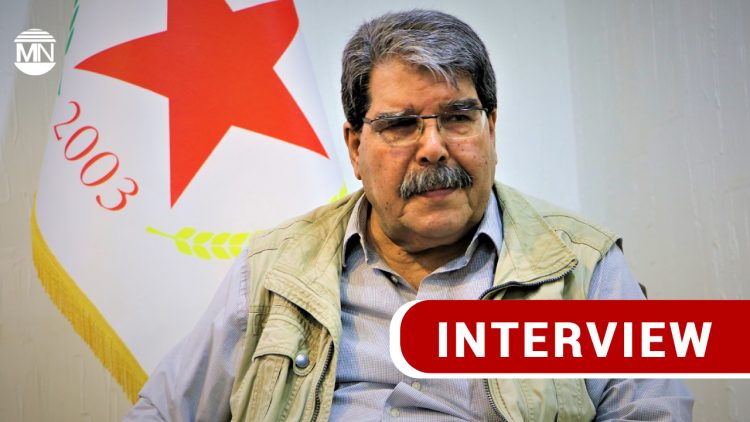
Salih Muslim, head of Foreign Relations for the Democratic Union Party (PYD), has stated that the form of “integration” proposed by the Syrian interim government or by Turkey is fundamentally incompatible with the political and military vision of North and East Syria’s Autonomous Administration. In a wide-ranging interview with Özgür Yeni Politika on 5 June, Muslim stressed that any future arrangement must preserve the Syrian Democratic Forces (SDF) as a distinct and unified structure — not subject to individual recruitment or external command.
Muslim also discussed the stalled negotiation process between the Autonomous Administration and Damascus, warning that delays stem largely from the regime’s unwillingness or inability to engage seriously, potentially under pressure from Turkey. He highlighted the role of international actors such as the United Kingdom and the US-led International Coalition, noting their influence in curbing Turkish interference but stressing that they do not intervene in the content of the talks.
The interview provides valuable insight into the Autonomous Administration’s expectations on military integration, local governance, education and the broader roadmap for a decentralised Syria.
What concrete work has been done so far by the subcommittees established to implement the memorandum signed on 10 March?
A main committee has been formed to lead the general negotiations. This body establishes subcommittees as needed, depending on the issues and requirements at hand. So far, committees on education and the Aleppo issue have been set up. Broader discussions are being conducted through the main committee.
A large meeting was held during the week as part of this process. Topics previously raised were revisited, particularly those concerning education and the Aleppo agreement.
We are approaching this process with full seriousness. We want these talks and dialogues not only to continue but to become a regular, ongoing process. However, the other side is not conducting the process at the level we expect. There are delays and obstructions.
What specific difficulties are you facing in terms of forming and operating the committees?
The difficulties arise because the other side cannot act freely, or appears to be waiting for instructions from elsewhere.
For example, in discussions related to students, they initially accepted everything regarding exams and testing, then suddenly withdrew and postponed things. After the meeting, they reverted to their previous position.
It seems clear that they are waiting for approval or direction from somewhere else, which causes delays in the process. A similar situation exists regarding the Aleppo issue—some detainees are not directly in their custody.
In particular, some detainees in the Çobanbey (Jarablus) prison are under the control of Turkey or its intelligence agency, MİT, which means the regime is unable to release them. This shows that not everything is within their authority; they are not free to act independently.
We encountered similar problems during the prisoner exchange talks. Negotiations are ongoing.
What obstacles need to be overcome in order to make progress?
The issue of students is not limited to exams. The education committee’s agenda includes much broader topics such as universities, the official language, culture and the overall education system. So far, these discussions have been postponed. Only agreements on urgent issues, such as exams and testing, have been reached.
For instance, students who previously had to travel to Aleppo or Damascus for exams will now be able to sit them locally, and we will cover the costs. But the fundamental education issues will be addressed later, as they are not matters that can be resolved in a single meeting.
What approach has been adopted in the talks with Damascus on security and military integration?
The SDF is different from other groups; they do not act like them. Other groups have either been incorporated or at least nominally included. But security and military integration is an extremely sensitive matter, and it requires long and detailed discussions — both for us and for them. A dedicated military committee should be established for this purpose, but so far, no such body has been created.
There is no question of the kind of integration claimed by Turkey or the regime. We would never accept things like individual enrolments or the redirection of units elsewhere — nor has anything of the sort been discussed. This issue has not yet been brought to the table, but it certainly will be in future.
We will not agree to anything other than an arrangement whereby the SDF joins the army as a distinct and unified structure. As our commanders have said, this is not a minor issue — it is a process that could take years. That is why no tangible progress has been made so far.
How are your demands for autonomy, federalism or strong local governance being addressed in the negotiations, particularly in light of Damascus’s emphasis on the “Syrian Arab Republic” and its insistence on a centralised system?
This issue has not yet been discussed, as it falls under governance and constitutional matters. So far, no constitutional or governance committee has been formed. These are topics that may be addressed in later stages of the talks.
What we seek is a decentralised model of governance — essentially, the ability to preserve our current status as much as possible. We are working towards that. In fact, one of the key decisions of the Kurdish Conference held on 26 April was to bring the issue of federalism onto the agenda.
Once the discussions begin, we will see how long they take. But up to now, these matters have not been raised.
Why have the relevant committees not been established?
The problem lies with the other side. They are dragging their feet, and we are not entirely sure why. Perhaps Turkey’s influence is a factor, or perhaps they are dealing with internal issues of their own. What I can say with certainty is that the delay is not on our side — the issue stems from them.
What will be the function of the joint Kurdish delegation?
This body focuses solely on Kurdish rights. It acts as a kind of reference and oversight committee. Its role is to engage both with the central government and with other political structures in order to guarantee Kurdish rights.
It is currently waiting for an official appointment from Damascus — once that is granted, the negotiations will begin.
Is the support of the United States and the International Coalition a decisive factor in ensuring the implementation of these agreements?
Yes, the UK and the International Coalition are currently engaging with both parties. They are supporting us not only in regard to the Kurdish question but also in the broader negotiations taking place here. However, they do not intervene directly in the content of the talks.
It can be said that international actors do exert some influence on the other side. They are particularly trying to prevent them from acting in line with Turkey’s agenda, and they are working to limit that influence.
Despite the challenges, we are determined to press ahead — because we believe that this is the most realistic path to achieving peace between peoples. The International Coalition is playing a supportive role in this negotiation process.
What kind of roadmap is the Autonomous Administration preparing for lasting peace, and what principles is it based on?
Through these committees and the work we are doing, we are striving to achieve a lasting solution and peace within Syria. We are fully committed to this effort and are ready to do whatever is necessary.
The other side has a more complex structure — they come from a jihadist background and are shaped by external influences. Nonetheless, we believe we are on the right path and will continue forward:
•Our goal is a decentralised Syria — a system that moves away from centralism, is autonomous, self-governing, and grounded in freedom, women’s rights and the right to legitimate self-defence.
•We believe that every canton and every region should have its own legitimate self-defence force and internal security structures.
•In the field of education, we support serious steps to ensure mother-tongue education from primary school through to university level.
These are our demands, though it remains unclear to what extent the other side will agree to them. Still, we believe international powers, agreements and protocols generally favour our position, and we are trying to make the most of that foundation. We hope they will eventually come to accept these principles as well.
How have the recent increased contacts between international actors such as the US and the European Union and Damascus—along with the de facto legitimacy this has granted the regime—affected the Autonomous Administration’s negotiations and the overall political balance in the region?
The US, the EU and other relevant parties maintain certain sensitivities when it comes to values such as democracy and freedoms. In the past, they have sought to reform or contain structures that emerged from jihadist backgrounds, such as al-Qaeda or ISIS. In fact, the model we are implementing in our region—based on democracy, freedoms, the canton system and specific governance norms—is closely aligned with the principles they seek. For this reason, their presence can serve as both an advantage and a source of support for us.
However, these actors sometimes act in accordance with their own interests, which can result in delays or a lack of timely intervention. Still, we remain hopeful that these processes will ultimately benefit the peoples of the region and lead to a positive outcome.
How does Turkey perceive the developing dialogue between the Autonomous Administration and Damascus? Could this process lead to new pressures or shifts in Turkey’s Syria policy?
Turkey is not approaching this process with sincerity. It does not wish to acknowledge Kurdish rights or support them—instead, it focuses on weakening Kurdish actors. Turkey’s influence is significant; many agreements, such as the Tishreen ceasefire, were only accepted after strong pressure from international forces and the Coalition.
Turkey continues to intervene on the ground through proxy groups. Some sectarian atrocities, including attacks on Alawite communities, were carried out by Turkey-backed factions. Even HTS (Hay’at Tahrir al-Sham) appears displeased with the current trajectory. International and regional actors are now looking for ways to limit Turkey’s influence. Whether they will succeed remains to be seen.
You mentioned a current ceasefire. Does this ceasefire apply across all of North and East Syria?
The ceasefire in effect was initially agreed upon for a limited period and was later extended. At this point, we do not know how long it will continue. Ideally, it should evolve into a permanent agreement, but the timeline for this remains uncertain.
We are not entirely sure whether the groups active in the area are under the full control of HTS. Technically, the ceasefire is holding—there are currently no clashes, and the situation is stable. Turkish drones continue to patrol the skies above the region, but there have been no attacks for approximately two months.
Has Turkey’s position on preventing any formal status for North and East Syria changed?
No, Turkey categorically rejects the existence of this political structure. The Syrian regime also maintains a strict centralist stance. This is evident in its provisional constitutional declarations, which point towards a one-man authoritarian model.
Decentralisation is not only our demand—it is also a widely shared aspiration across Syrian society, including among Alawites, Druze and other communities. Nonetheless, the regime has so far maintained a highly rigid approach. Whether this will change in the future remains unclear. Turkey, for its part, continues to reject any decentralised solution outright.
How do the efforts toward a political solution in North Kurdistan (southeastern Turkey) affect Turkey’s approach to North and East Syria?
One would expect that entering into a negotiation process with the PKK would lead to a reduction in pressure on us. But so far, not much has changed. There has been a slight softening in rhetoric—they no longer use the term “terrorist” directly and now refer to us as the Syrian Democratic Forces (SDF) or YPG [People’s Defence Units]—but the core approach has not shifted.
In practice, the situation remains the same. We believe that Turkey’s continued pressure is one reason why the Syrian regime has not developed a more serious position toward us. According to what our colleagues have shared, some direct technical talks are now taking place, which is a positive development—but it is not enough. We believe more change and concrete steps are needed.
Özgür Yeni Politika | By Erkan Gülbahçe | Translation by Medya News


