

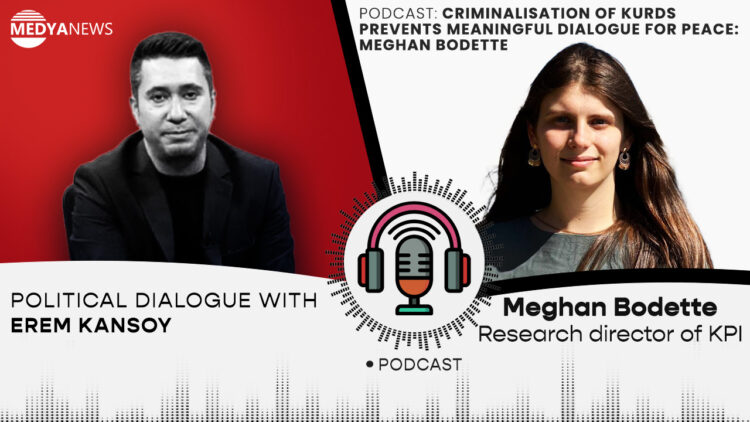
Meghan Bodette, Director of the Kurdish Peace Institute, joined Medya News’ Political Dialogue podcast to discuss the critical role of Kurdish leader Abdullah Öcalan in resolving the Kurdish question, the continuing isolation he faces, and the wider implications for peace and democracy in the region. The discussion, hosted by Erem Kansoy, also touched on Turkey’s bombardment of Rojava and the inspiring Kurdish women’s movement.
Bodette described Öcalan, leader of the Kurdistan Workers’ Party (PKK) as an essential figure in any future peace talks between Turkey and the Kurdish movement. She stressed the need for international involvement, saying: “The basic condition for peace talks is that Öcalan is allowed to communicate freely. His participation ensures a dialogue that cannot be abruptly stopped by the Turkish government.”
The discussion also touched on Turkey’s military operations against civilian infrastructure in Rojava, Kurdish-led northern Syria, which Bodette described as ethnic cleansing and a violation of international law. “These actions are aimed at destabilising the region and forcing demographic changes,” she said, noting the dire consequences for millions of people.
The Kurdish women’s movement was singled out as a beacon of hope. Praising their grassroots efforts, Bodette said: “The Kurdish women’s movement is a model not only for the Middle East, but for global struggles for gender equality and coexistence.”
The podcast also looked at the international campaign for Öcalan’s release. Drawing parallels with past global movements for justice, Bodette stressed: “Öcalan’s ideas provide a framework for peace and coexistence that resonates far beyond the region.”
Finally, on the status of the PKK, Bodette stressed the need for dialogue. “Criminalising one side of the conflict prevents meaningful negotiations. Removing the PKK from the list would be a crucial step towards resolving this decades-old issue,” she said.
Watch the full interview, listen to the podcast, or read a full transcription below:
Erem Kansoy: Hello and welcome to another Political Dialogue program. This week we have a very important guest, Meghan Bodette, Director of the Kurdish Peace Institute. We’re going to talk about the situation of Kurdish leader Mr. Abdullah Öcalan as well as the latest developments about the Kurdish question, also the ongoing campaign which is Freedom for Öcalan and Political Solution for Kurdish Question. I would like to first welcome dear Meghan, thanks for joining us today.
Meghan Bodette: Thank you so much for having me on the program.
Thank you, Megan. First of all, I would like to start with the recent development that Kurdish leader Mr. Abdullah Öcalan, after 43 months of incarceration incommunicado situation, has been able to see his nephew Ömer Öcalan. Mr. Öcalan also shared a message to the Kurds and Kurdish friends, saying that he is in good health, strong enough to bring the conflict between Kurds and Turks to a much more peaceful process, whilst underlining that his isolation still continues. First of all, what would you like to say on the isolation of Öcalan as well as his latest message? How would you evaluate this?
This is a very important topic because that message is important. We know from previous peace processes that the PKK and the wider Kurdish movement and Kurdish society, as well as the Turkish government, have accepted Abdullah Öcalan as an interlocutor and that it’s Öcalan’s theories that form the sort of basis for what a political solution to this issue would look like, not only for Kurds and Turkey, but for attempts to resolve the regional Kurdish question as a whole. And so it’s extremely important that he be able to participate in such a process in order to facilitate an end to this conflict.
Obviously, he’s unable to do that if he’s barred from communicating with the outside world. On the one side, too, this is a violation, as we know, of Turkish law, European and international law. So the basic precondition for simply following established legal frameworks and procedures would be allowing Öcalan to communicate with his family and his lawyers.
And then for peace talks, allowing him to participate in the way that he has before and to fully be able to share those frameworks, negotiate on behalf of the Kurdish movement for a political solution. We saw last time that because these negotiations were being conducted while he was in prison, when the Turkish state was unwilling to continue with the negotiations because they no longer served Erdoğan’s political fortunes, they were able to simply cut off his communication and stop talking to him. So this is why I think the Kurds this time are demanding freedom for Öcalan, so that he will be able to participate in such a process if there is to be one without this risk that the Turkish government will simply decide that they don’t want to talk to him anymore and cut off communication.
So I think his latest message is very important. I think that this violation of Turkish and international law in preventing him to communicate is an impediment to peace. And I think we’d all like to see a political resolution to the Kurdish issue in Turkey and would want the fulfilment of any practical conditions that make that more likely.
So I think that it’s really important that we’re talking about this issue.
Thank you, Megan. Secondly, a peace process and dialogue between Turkey and the Kurds is now also on the Turkish right’s agenda. Devlet Bahçeli, leader of Turkey’s far-right National Movement Party (MHP), has talked about bringing Mr. Öcalan to the parliamentary to give a speech. But they are also asking the PKK and Kurdish movement to give up the fight, basically. So to stop the war, what needs to be done by the international community, and what should be the position be of the Kurdish people and the Kurdish movement, to bring peaceful negotiations to the table?
Yeah, I think it’s important to recognise that disarmament is typically the final stage of a peace negotiation. It’s not the starting stage of negotiations. And so these maximalist demands that the Turkish government is making are likely posturing at this point. [Turkish President] Erdoğan and Bahçeli are in a position where they know that they cannot defeat the PKK or address the Kurdish issue by military force.
They’ve been trying to do so for the past 10 years. Previous Turkish governments have sought to end this issue by force since the founding of the Turkish Republic. And it simply has not worked.
Kurdish people are still demanding the recognition of their identity and the existence of self-governance and civil rights. And the denial of this identity and forcible repression of attempts to seek this identity by political means have only created conflict. They have not made the problem go away.
Now, Erdoğan knows this. Bahçeli knows this. The Turkish government knows this.
That’s why, even when they make these very maximalist demands that it’s impossible that the Kurdish movement would agree to without other steps being taken, the very fact that Bahçeli feels as though he has to say that Abdullah Öcalan should come to parliament means that the Turkish government recognises that there is not a military solution and that to come to a political solution, they have to negotiate with the leader of this movement. So, I think this is a recognition that their policies of war and conflict and repression have failed. They are still making these very maximalist demands.
I think where the role of the international community comes in is, one, reconsidering policies that provide military or legal support for Turkey’s ability to wage that war. We see Turkey’s defence industry still very reliant on foreign weapons and foreign components for domestically produced weapons. That’s not an incentive to sit down and talk.
We see the criminalisation of Kurdish politics and Kurdish political movements in the international community. That also makes peace more difficult because it makes it virtually impossible for the international community to engage with one party to the conflict. So, reconsidering these kinds of steps and also offering support in mediation, negotiation, ultimately this is an internal issue related to Turkey and related to Kurdistan and the Kurdish community.
But the international community, given the role in provoking and prolonging this conflict, they should own up to that and for their own interest in promoting security, stability and democracy in the region, they should want to help. I think that in order to get to a position where productive negotiations are possible, as I mentioned previously, we would have to see Abdullah Öcalan able to participate freely in such a process in a way that the Turkish state could not simply cut off his communication or refuse to speak to him. We would ideally want to see a ceasefire as well.
It’s very difficult to talk about peace when you have Turkish air and drone strikes targeting civilian infrastructure in Rojava in northeast Syria, cutting off power and water to millions of people. It’s very difficult for negotiations to go on in that context. So, a two-sided ceasefire, ideally monitored by some sort of international mediator acceptable to both sides, would be ideal.
And then finally, we would need to see an end to political repression. Look, if the government of Turkey wants the Kurdish movement and the Kurdish community to believe that it is possible or desirable to lay down arms, they have to create conditions wherein achieving Kurdish rights and Kurdish self-governments by peaceful means is possible. Now, Kurds have created a model by which they can do that.
The pro-Kurdish political movement in their municipalities has really test-driven a lot of the policies that they see as a model for a solution. But what is Erdoğan’s government doing right now? They are imprisoning and removing from office elected Kurdish mayors. They are taking over these municipalities.
They’re essentially saying, we don’t want you to participate in democratic politics. And so I think that looking at these next steps, we would want to see an end to the international community’s policies that prolong this war. We’d want to see international interest in getting to negotiations between Öcalan and the state and to a ceasefire. And we would want to see real political commitments on behalf of the Turkish government to allowing the political space for this issue to be discussed without violence.
I think in conditions where you have Öcalan being unable to communicate, being recognised as the Kurdish side’s lead negotiator, if you have conditions where Turkey is bombing Iraq and Syria every day, and you have conditions where the government is cracking down on peaceful democratic Kurdish politics, it’s going to be very hard to have peace talks.
But fundamentally, as I mentioned before, we’ve seen that in those conditions, look, that’s what’s been going on for the past 10 years. That hasn’t worked. The military solution has failed. The Turkish government knows that, and it’s time to pursue another approach.
Thank you, Megan. You mentioned Turkey’s bombardments of civilian infrastructure in Rojava, northern Syria, a war crime. What is Turkey trying to achieve by bombing Rojava and leaving the people without water and electricity? Also, from what I understand, you are saying that action speaks louder than words: the Kurds are waiting for action, for peaceful negotiations, not just words, is that right?
Of course. So Turkey’s aim in targeting critical civilian infrastructure, including energy and water infrastructure, across north and east Syria, is to make life unlivable for the four to five million people who live in that region, particularly Kurds, Christians, Yazidis, other communities that have suffered persecution at the hands of Turkish governments and extremist groups in the past.
The goal is to force demographic change, the ethnic cleansing of those communities, in order to both break the social base of the autonomous administration and the Syrian Democratic Forces (SDF) and to remove these communities from Turkey’s border so that Turkey can resettle, often by force and in violation of international law, Syrians from other parts of Syria in that territory.
So this is ethnic cleansing, this is a violation of international law, and this is massively destabilising because it is those Kurdish, Christian, Arab communities working together who created the autonomous administration and the Syrian Democratic Forces, who defeated ISIS, who worked with the international community to ensure that ISIS could no longer threaten the world from that region. And so these attacks aren’t just a massive human rights violation.
They threaten to give ISIS a new lease on life, empower all kinds of bad actors in that region, and really create a lot of instability that’s bad for Kurdish people, bad for the people of northeast Syria, bad for the international community, and ultimately not good for Turkey either. So that’s what’s going on there. And again, I think you put it perfectly well.
Actions speak louder than words. I think that it is very important when we see words and statements about negotiations, look, that’s an opportunity. You know, we don’t want to throw this away.
But at the same time, if the Turkish government is going to say that they want to solve this problem, it’s important that they be held to that, right? It’s important that we get from a point where they’re simply making these statements but taking action that prolongs conflict to a point where their actions are aligned with their statements.
And ultimately, you know, and this is something that we’re going to get into with Öcalan’s writings. You know, he talks a lot about in the roadmap, in other writings of his, a political solution to the Kurdish issue isn’t something that should be done just as charity for Kurdish people.
A Turkey that could resolve this problem would be a stronger, peaceful, more pluralist country, you know, a better place for all citizens of Turkey, Turkish or Kurdish, to live, and a model for what peace and coexistence could look like in the region. So ultimately, this is in their interests, too, to solve as a country and as a society. And so it’s time for the international community, I think, to help them see that and for, you know, both sides to really start taking steps. I say both sides. I think the Kurdish side has taken all of the steps that they can take. But we would want to see the Turkish government align their actions with their words, and the international community, their allies, to help them do that.
Relating to my final question, on Öcalan and his philosophy, how important a figure do you think Öcalan is, and do you think his key role, to bring peace and sustainability to the Middle East, is inspirational to the Western powers, or a threat?
Yeah, you know, I’ll never forget visiting Manbij the first time in northeast Syria. It’s an Arab-majority city. I was there on a research trip in 2021, and we went to the Mala Jinn, which is the women’s house, and met with a group of local Arab women who were working in the women’s house to do everything from resolving domestic violence cases to providing literacy courses for women who couldn’t go to school.
And when I was talking to them about all of their work helping their community recover after ISIS, one woman said to me completely unprompted – you know, we hadn’t been talking about political philosophy at all – she said, ‘I need you to know, and I need you to tell people in your country that all of us are here because of Öcalan’s ideas.’
And I think that when we look at what these ideas are, you know, the framework he’s proposing for the region, it’s based on local democracy. It’s based on gender equality. It’s based on coexistence and pluralism between all the different ethnic and religious communities that live in the Middle East.
And these are ideas that really can address the problems that you have in that region and not just the problems in that region because these types of problems, we might see them expressed so intensely in the Middle East because of the history of colonialism and war and fundamentalism and nationalism there. But these problems are global problems. They exist everywhere.
And when we look at northeast Syria, you know, a place where these ideas are being put into practice by many people from many different ethnic and religious backgrounds, many different political backgrounds, we see that this locally rooted, democratic, gender equal, ethnic and religious pluralist model has successfully helped this region recover from some of the most horrific persecution and conflict under ISIS, become the most stable part of Syria, and try to build itself back up again in a context where when you look at the rest of Syria, you look at other war-torn countries, we’re not seeing this kind of progress.
Now, that’s not to say everything’s perfect, but they have been able to take these ideas to really resolve some of the most serious problems we see in global politics and conflict and to build a better future for themselves. So I think that’s proof enough that those ideas work and that they can work in some of the most difficult contexts in the world.
Thank you, Megan. We must note the latest developments in the ‘Freedom for Öcalan, a Political Solution to the Kurdish question’ campaign. It’s been two years since it launched. Recently in Kern there was a huge demonstration to free Öcalan, and we’ve seen similar historical campaigns for Mandela. Öcalan’s total isolation still continues, but the campaign brings Öcalan and his ideas to global grassroots movements. So how important is this campaign and what needs to be done to make it more effective?
At the end of the day, if you want to resolve a conflict, then the leadership of both sides of that conflict have to sit down and talk. So Öcalan needs to be able to participate in those negotiations, and him being free, and in conditions where the Turkish state can’t simply just stop talking to him and cut off communication, is essential for that kind of dialogue to work. So I think the campaign is very important in calling attention to that internationally.
Personally, I think any step that makes negotiations more possible and a political solution more viable is a positive one. So I do evaluate that positively, and I think it’s important to keep explaining why his ideas and his participation matter so much to the resolution of this conflict and why the resolution of this conflict in and of itself matters to Kurdish people, Turkish people, people in the Middle East, and to the international community as well. So that work should continue to go on.
Thank you, Megan. For the last part of the programme, as you know, the 25th of November is approaching, and male violence against women is still increasing around the world. How are women’s movements fighting against this on a global scale and how do you evaluate the Kurdish women’s struggle? Is it inspirational to the Western women’s movements?
Yeah, I think that I talked about this a little bit when we see what Kurdish women are doing in terms of participating in politics, defending themselves against groups like ISIS, and addressing violence and discrimination in their communities. We aren’t only saying that that could be a model for women in other contexts. We already know that it is because, again, like I mentioned, in northeast Syria, we see that women from the Arab community, the Syriac Assyrian community, the Armenian community, the Yazidi community are working together with Kurdish women to address the challenges that all women face and take on similar struggles in their own communities.
We saw that the Kurdish women’s movement’s philosophy inspired Kurdish women, women from many other different communities in Iran as well, to protest against the Iranian state’s misogynistic and discriminatory politics. And in both contexts, we’ve seen that while it’s women leading this work, men have also joined in and will take to the streets together with women to defend equality because, as the Kurdish women’s movement believes, it’s not just about making women equal to men in a society that’s still oppressive. It’s about liberating women so that you can liberate everyone, so that all people can live in a more equal and less violent society.
We know that the model works. We know that Kurdish women have been able to inspire and share their knowledge with other women, that that’s led to very important developments in areas liberated from ISIS in Iran. And so, you know, it is a model.
It is working. And hopefully, if we can get to a political resolution of the Kurdish issue, one reason why that’s so important is because then these women and their allies will be free to continue to advance and develop their model without having to worry about and suffer from war and conflict.
Thank you, Meghan. And lastly, the 27th November is also approaching, the anniversary of the establishment of the PKK. Millions of Kurds are criminalised over the PKK ban. And the PKK is still calling for peace. For a long time the PKK has been the one side of the conflict to call for peace, whilst also defending the Kurds. How important is it to delist the PKK? How effective would it be to remove the PKK from the list of banned organisations?
Yeah, look, I think I’ll repeat what I’ve said before. It’s that if you want to resolve a conflict, both sides have to be able to speak to each other.
And all other parties interested in seeing a resolution to that conflict have to be able to speak to both sides. Now, what the criminalisation of the PKK does is it makes it so that’s impossible. We need to end that criminalisation to facilitate negotiations and dialogue and make it easier for an agreement to go into place. I’ve argued this before, and I’ll reiterate that again.
Meghan Bodette, Director of the Kurdish Peace Institute, thanks for joining us, and for your valuable comments.
Thank you, Erem.


