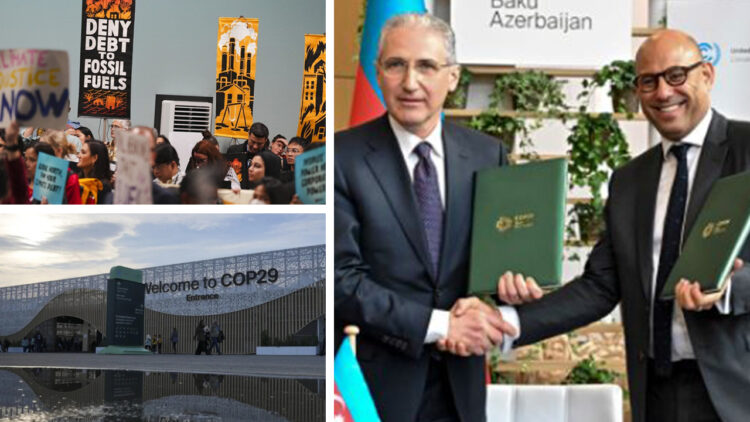
The 29th UN Climate Change Conference (COP29) summit in Baku, Azerbaijan, held from 11-22 November, has sparked controversy as activists, politicians, and human rights organisations denounce the host nation’s alleged rights violations. While the conference aims to tackle the global climate crisis, critics argue that Azerbaijan is using the platform to greenwash its human rights record, specifically regarding violations against Armenians in Artsakh (Nagorno-Karabakh), and silence dissent.
The summit, which brings together world leaders, activists, and climate experts, has been overshadowed by Azerbaijan’s reported human rights abuses, including the detention of over 300 political prisoners, suppression of civil society, and destruction of the indigenous Armenian cultural heritage. The International Human Rights Watch and Amnesty International have both raised concerns about the worsening situation for activists, journalists, and academics in Azerbaijan since the country was announced as the COP29 host in November 2022.
According to Natalia Nozadze of Amnesty International, the Azerbaijani government has intensified its crackdown on dissent in the lead-up to the summit. Prominent figures such as Gubad Ibadoglu, a 53-year-old academic researching the country’s environmental issues, remain under house arrest more than a year after being detained on disputed fraud charges. Anar Mammadli, a leading advocate for reducing fossil fuel emissions, was jailed on smuggling charges in April, while environmentalist Nazim Beydemirli received an eight-year prison sentence for protesting mining activities near his village.
The situation has drawn international condemnation, with the European Parliament criticising Azerbaijan’s “repressive” policies as incompatible with its role as COP29 host. Activists have also called for urgent reforms to ensure future climate summits are not hosted by nations with poor human rights records.
Armenian activists have also voiced strong criticism of Azerbaijan’s role as host, staging protests in cities such as Berlin on 10 November. Armenian activist Arshak Makichyan, who spoke to Medya News, condemned the summit as an attempt to whitewash Azerbaijan’s treatment of Armenians in Artsakh (Nagorno-Karabakh).
“Hosting a climate conference in a dictatorship heavily dependent on revenues from fossil fuel exports is problematic in itself. However, the worst thing is that the host country is using the conference as a platform to greenwash the genocidal acts it has committed against Indigenous Armenians in Artsakh,” the activist said. “This is both disgusting and a compromise of the integrity of climate negotiations. Meanwhile, all other parties remain silent about our indigenous rights, passively complying with the rules imposed by the dictator.”
Armenian protesters are demanding justice for forcibly displaced Armenians, the release of 23 confirmed Armenian hostages, and sanctions against Azerbaijan. Their calls also extend to broader demands for justice, including an end to colonialist policies and prioritising Indigenous peoples’ rights globally. Activists have specifically urged governments to divest from Azerbaijan’s state oil company, SOCAR, which they accuse of financing both fossil fuel dependence and state repression.
Meanwhile, regional tensions have further complicated the summit. Reports revealed that Ankara denied Israeli President Isaac Herzog’s aircraft access to Turkish airspace en route to the COP29 summit, prompting the cancellation of his visit. While the president’s office cited “security considerations,” Azerbaijani and Turkish sources confirmed the airspace denial. This incident highlights the tense regional dynamics, particularly as Turkey severed diplomatic ties with Israel following the October war in Gaza.
The controversy surrounding COP29 has cast a shadow over the summit’s core objectives. Despite Azerbaijan’s attempts to position itself as a leader in climate action, critics argue that its reliance on fossil fuel exports and lack of substantial reforms undermine its credibility.
Azerbaijan’s hosting of COP29 has raised broader questions about the UN’s criteria for selecting summit venues. Activists and organisations have called for stricter guidelines, ensuring that host nations uphold human rights and address internal abuses. This debate highlights the tension between global climate diplomacy and local accountability, as well as the challenges of ensuring inclusivity in tackling climate change.
As COP29 concludes, its legacy may be defined less by climate agreements and more by the growing calls for justice, accountability, and meaningful action. Activists continue to emphasise that the fight against climate change cannot be separated from the fight for human rights.