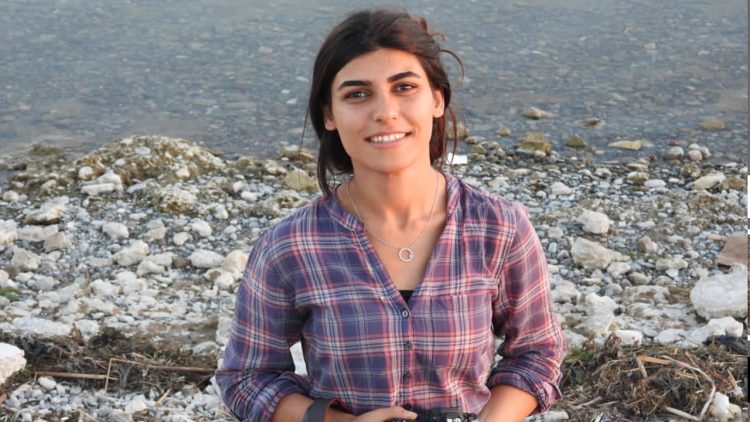
Kurdish journalist Cîhan Bilgîn was targeted and killed in a Turkish drone strike while returning from reporting on the latest clashes at the Tishreen dam close to Kobani (Kobanê) in northern Syria on 19 December 2024. Bilgîn was deeply committed to uncovering the realities on the ground, risking her life to report firsthand and ensure the truth reached audiences worldwide, inspiring audiences and colleagues with her dedication.
Cîhan Bilgîn was born in 1996 in the Midyad district of Mardin (Merdîn) in the Kurdish-majority southeast of Turkey, brought up by a family connected to the Kurdish liberation movement. Cîhan completed her primary, middle and high school education in Midyad, moving to the city of Diyarbakır (Amed) in 2013 to study at the Justice Department of Dicle University.
Cîhan, which means world in Kurdish, began working in journalism at a young age, distributing newspapers such as Azadiya Welat (Freedom of the Country) and Özgür Gündem (Free Agenda). She started working in the Dicle News Agency (DIHA) in 2016. After DIHA was closed down by government decree in the same year, she continued her work within the Dihaber agency.
She aspired to report from North and East Syria (Rojava) to highlight the women’s revolution and the development of the region’s confederal democratic system to a global audience. In 2017, she relocated there to advance her journalism career.
For the last seven years, Cîhan worked for the ANHA news agency, conducting many interviews and reporting on Turkish military attacks against the people of North and East Syria. She also reported on the liberation of the city of Raqqa (Reqa) from ISIS in 2017.
Cîhan centred her reporting on women’s issues, amplifying their stories and serving as their voice. “My participation in the campaign is to highlight the struggle of the Syrian Democratic Forces and the Women’s Protection Units in liberating Yazidi women, who were sold in slave markets, and freeing the people from ISIS oppression,” she said, during the liberation of Raqqa.
In the weeks leading up to her death, Cîhan reaffirmed her unwavering dedication to journalism in a heartfelt letter. She emphasised her mission to expose attacks against the Kurdish people and to honour the legacy of Kurdish journalists who lost their lives in pursuit of truth.
In her letter, she wrote:
What encourages me to fulfil my mission with dedication is the knowledge that I am not alone. I know that many people of hope and purpose are behind us. These people are being persecuted and oppressed, so our first task is to draw attention to this point. We have a sacred cause.
Everyone must uphold this cause with great honour. This is exactly what keeps me alive and enables me to continue my mission.
During my work in North and East Syria, I have met many decent people. The land of Rojava is priceless to me. My comrades Dilîşan, Rizgar and Seyit, whom I had the opportunity to get to know closely, were murdered and buried in this land.
Shouldering the duty of such great people is a task to be honoured. More importantly, we made a promise to our comrades that we would not abandon their path. We made this promise to Seyit and to Gulê.
Dear friends; we need to understand the reality on the ground well. We need to know the reality of the policies implemented against Kurdistan, and we need to make known what is happening in Kurdistan to the world. We must make known the crimes committed against our people and expose the dirty face of the occupiers in our lands.
Her friends and colleagues remember her as a person with a positive attitude and an infectious smile. Reporting on the front lines of the war and facing many challenging and dangerous situations, she inspired her colleagues and audiences people, remaining true to her cause.