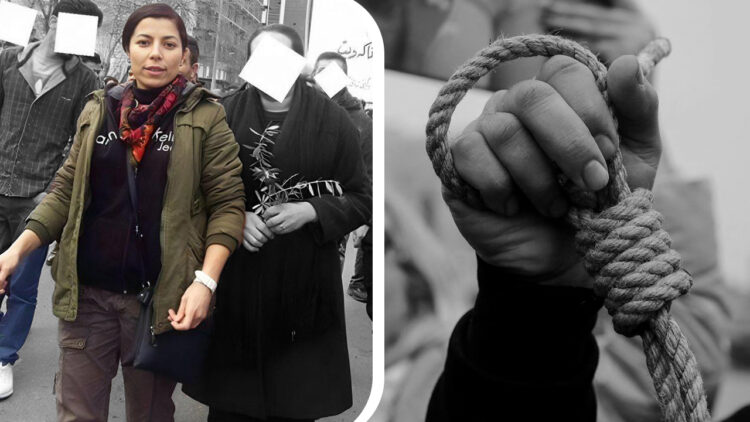
Protests have erupted inside Iran, within and without the walls of Evin Prison, and across the global Kurdish diaspora following the death sentence handed down to political prisoner and prominent rights activist Warisheh Moradi by ‘Hanging Judge’ Salvati at Branch 15 of Tehran’s Revolutionary Court.
A group of women political prisoners organised a courtyard protest in Tehran’s Evin prison, where Moradi has been detained since her arrest in October 2023, human rights sources reported on 11 November.
During the protest, they voiced solidarity with both Moradi and Pakhshan Azizi, another Kurdish woman and prominent political prisoner facing execution. In a recorded audio of the sit-in, the prisoners are heard chanting “Jin, Jiyan, Azadi” (Woman, Life, Freedom) in defiance of the authoritarian regime.
Thousands of women took to the streets of Qamişlo (Qamishli) in Kurdish-led northern Syria to protest against the death sentence passed against Warisheh Moradi. The women who took part in the march condemned the Iranian regime as a “graveyard” for women stating, “The Iranian regime cannot break the will or destroy their cause of free women.”
Meanwhile, Kurdish organisations have publicly condemned Moradi’s death sentence, praising Moradi as a symbol of resistance, demanding an end to all executions in Iran, and calling for the immediate release of Moradi and Azizi.
The Kurdistan Free Life Party (PJAK) has condemned the verdict against Moradi as both “anti-women” and “anti-human”. The PJAK called on international human rights organisations and advocates to take an uncompromising stand against the death penalty laws enforced by the Iranian regime.
The Komala Women’s Committee, part of the Kurdistan Organisation of the Communist Party of Iran, echoed similar sentiments, urging human rights institutions and political movements within and outside Iran to mobilise in protest against Moradi’s death sentence. “The [Islamic Republic’s] goal of issuing such orders is to create fear in the society,” the committee said.
The Free Women’s Society of Kurdistan (KJAR) and the Women’s Society of Kurdistan (KJK) have also issued statements supporting Moradi. They called for an immediate response from Kurdish communities and international actors to stop the executions.
The Women’s Committee of the National Council of Resistance of Iran, affiliated with the People’s Mojahedin Organisation of Iran (Mojahedi-e Khalgh-e Iran), similarly condemned the death sentence, calling for an urgent international response to demand Moradi’s immediate release.
A rally was also held outside the Iranian embassy in Brussels on 11 November, to denounce the death sentences of Moradi and Azizi. This demonstration was organised by the KJAR and PJAK committees, drawing significant attention to the ongoing repression faced by Kurdish activists.
Simultaneously, Afghan women activists have issued statements expressing deep solidarity with Kurdish-Iranian women and condemning Iran’s use of the death penalty against female political prisoners.
Both Moradi and Azizi face inhumane death sentences on charges of sedition. The prosecutor’s report issued after Moradi’s sham trial cited Article 288 which mandates imprisonment, but Judge Salavati altered the charge under Article 287, thereby issuing a death sentence.
Both these activists, in defiance of the severe torture they have endured behind bars, have managed to get letters out from prison highlighting the crucial role of women in resisting authoritarian regimes in Iran and the broader Middle East. Moradi and Azizi have become enduring symbols of women’s resilience and the ongoing fight for transformative change in Iran.