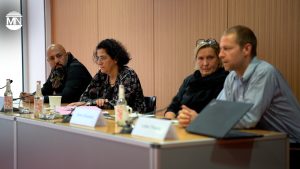
In Germany, legal experts and members of parliament have renewed their calls to repeal the ban on the Kurdistan Workers’ Party (PKK). They argue that the ongoing criminalisation of Kurdish groups undermines human rights and the new prospects for peace emerging from the PKK’s recent decision to dissolve. These calls intensified at a press conference in the Federal Parliament on 20 May, titled ‘PKK Ban Under Scrutiny: Peace Process and Dissolution Decision’. Human rights lawyer Lukas Theune, Left Party MP Ferhat Koçak and Nilüfer Koç from the Kurdistan National Congress (KNK) attended the event and urged the government to reconsider the prohibition imposed in 1993.
Theune, who filed a lawsuit at the Berlin Administrative Court challenging the ban following the rejection of the appeals for lifting the ban in 2022, argued that the recent decision by the PKK to self-dissolve renders the current restrictions obsolete. Theune highlighted that the Interior Ministry’s refusal in 2022 was based on foreign policy concerns, particularly relations with Turkey. “The continuation of the ban criminalises the Kurdish community in Germany and obstructs the peace process,” he stated.
The PKK announced its intention to disband following a call from its imprisoned leader, Abdullah Öcalan, on 27 February 2025, which led to a congress where the movement declared the decision to dissolve itself. The congress, held in early May, formalised this decision, which marks a potential turning point after more than four decades of armed conflict. However, Theune stressed that the Turkish state has yet to establish a political or legal framework to support the transition, raising concerns about potential future provocations.
Despite these developments, the German Interior Ministry has refused to reconsider the ban thus far, citing concerns about foreign relations and national security. This stance has led to the criminalisation of Kurdish activities. Theune has challenged this stance, urging the government to lift the ban and the ‘prosecution authorisation’ introduced in 2011 that permits the criminal prosecution of foreign organisations deemed terrorist. “The PKK no longer poses a threat to public security,” said Theune. “Its peaceful orientation should be met with a policy shift, not continued criminalisation.”
MP Ferhat Koçak echoed similar sentiments, stating that the Left Party has long advocated for the PKK to be removed from Germany’s list of banned organisations. He warned that the policy fuels discrimination against millions of Kurds living in Germany and undermines broader peace efforts. Koçak also stated that, “if the German government truly supports democratic resolution and peace, it must act constructively”.
Nilüfer Koç, representing the KNK, stated that the PKK’s decision to disband should be recognised as a historic opportunity to initiate dialogue and political solutions. She called on Germany to stop treating Kurdish political actors through a security lens, arguing that continued criminalisation obstructs both integration and democratic participation.
The lawsuit challenging the PKK ban is still pending at the Berlin Administrative Court. Advocates hope that the court’s decision will pave the way for a more inclusive and peaceful approach to addressing Kurdish issues in Germany and beyond.