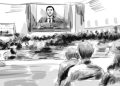
Throughout the first day of the Permanent Peoples’ Tribunal (PTT) on Rojava vs. Turkey, held on 5-6 February, testimonies detailed allegations of forced displacement of civilians, mostly Kurds, from Afrin (Efrîn) following Turkey’s 2018 ‘Operation Olive Branch’. Lawyers presented photographs and video clips as evidence of property confiscation and ‘demographic engineering’, including the alteration of street signs and shop fronts to erase Kurdish identity.
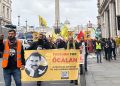
Medya News reporter Erem Kansoy interviewed several of the participants who either testified or observed the proceedings. The Tribunal’s detailed hearing – citing reports, photographs, and testimonies – served as the backdrop to the interviews with key figures who connected the alleged war crimes on the ground to the urgent need for peace and the release of Kurdish leader Abdullah Öcalan.
A call to action by Lorena Lopez, President of The European Free Alliance, echoed the prosecution’s claim that “the forced displacement of civilians from various villages in Afrin back in 2018, coupled with the resettlement of families from Damascus countryside, represent clear violations of fundamental human rights”. Lopez stressed that awareness and international pressure could help end these ongoing abuses.
“Today it has been a very interesting day because we have gathered here many people—civil society, politicians—to give visibility to the aggressions and war crimes committed in Rojava. Displacement, forced displacement and all the exactions that are being committed there is something that is not still well known in Europe. And we need to act and react because this is intolerable. And if we talk about dialogue and peace, Öcalan must be freed because he is a key actor. We need Öcalan for peace.”
Lorena Lopez, President of The European Free Alliance
British lawyer Margaret Owen underscored concerns about Syria “becoming another Libya”, reflecting testimony during the Tribunal that highlighted “bombings and shelling resulting in widespread displacement, as well as the forced repatriation of refugees”. According to Owen, releasing Öcalan, leader of the Kurdistan Workers’ Party (PKK) is crucial to securing a political solution to the Kurdish issue in the region for enduring peace.
“It’s so important that this tribunal is taking place right now when the international community has to wake up to what Turkey with the jihadists is doing right now in northeast Syria and trying to destroy a model of administration for every country in the world. And we have to be most cautious that we do not recognise HTS as heading the administration. And ever more important it is that Öcalan is free, who is our spokesman for peace. And only when he is free can we look after the whole of Syria and it does not become another Libya and another Afghanistan.”
Margaret Owen, International human rights lawyer
Italian lawyer Ezio Menzione’s remarks directly connected Rojava’s pinoneering grassroots women-led democratic project to Öcalan’s theories, and highlighted, “Turkey’s strategies of demographic engineering…point to a systematic pattern of international law violations.” Menzione called for global solidarity, aligning with the Tribunal’s objective to “demonstrate an orchestrated campaign of forced displacement and demographic engineering that has inflicted immense suffering on the civilian population of Afrin.”
“The case of Rojava which has been adopted by the tribunal as the centre of attention is today possibly the most important challenge for international law. To recognise that an experiment of democracy which has been proposed and suggested for many years or so by a leader like Öcalan, who is a permanent prisoner of Turkey, is really considered to be something which is feasible in the real history. Rojava has documented that and the tribunal would like to give that visibility and a voice which is not simply a voice of support but a juridical justification and political motivation for guaranteeing a network of support and solidarity in the world.”
Ezio Menzione, lawyer
Efstathios C. Efstathiou, human rights lawyer from Cyprus, referenced the Tribunal’s intention to use its proceedings, including the expert testimony of Oz Karahan, as leverage to spur international legal and political bodies into action. The Tribunal repeatedly cited “systematic efforts to erase Kurdish identity and alter the demographic makeup of the region” as grounds for potential crimes under international law – claims Efstathiou hopes will carry weight in international forums.
“Of course the working of this tribunal is of great importance, greater importance since we believe that this will constitute an instrument of putting political pressure into Turkey in order from the one hand for justice to be served for the people in Rojava as well for justice to be served for Mr. Abdullah Öcalan.”
Efstathios C. Efstathiou, human rights lawyer