Amed Dicle
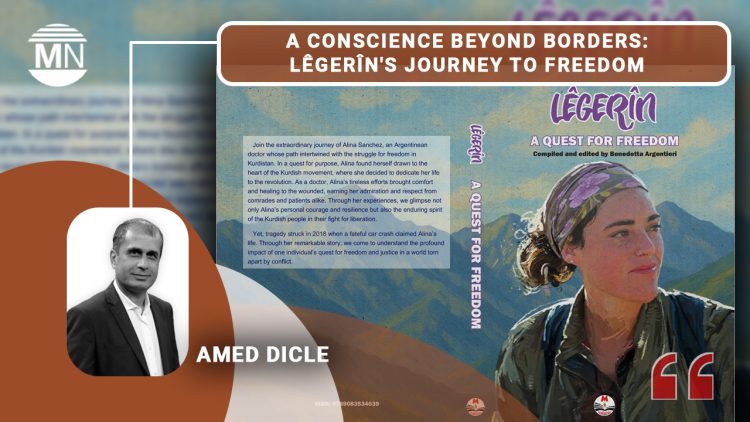
Some lives are not merely lived; they echo across centuries and continents, transforming into a song of resistance. Alina Sanchez, or Lêgerîn Çiya as she is known, is the embodiment of such a life. The book Lêgerîn – A Quest for Freedom traces the extraordinary life of this woman, from Latin America to the Middle East, from Pan-American ideals to the mountains of freedom in Kurdistan. The book is not merely a biography; it is a manifesto of freedom that challenges us to re-examine the meaning of rebellion, revolution, and humanity.
Born in Patagonia, Argentina, Alina grew up with an inner rebellion against injustice at a young age. While studying medicine in Cuba, she saw medicine not only as healing bodies but also as healing social wounds. However, her understanding of ‘healing’ did not fit into the corridors of modern hospitals or the boundaries drawn by the system. Her heart turned towards the silent cries of the world. Rejecting the individualistic moulds of capitalist modernity and turning towards the mountains of collective life, Lêgerîn became not just a guest but a pioneer, a comrade, and a symbol within the Kurdish Freedom Movement.
And one day, she turned her course towards Rojava. There, alongside the Kurdish women revolutionaries she met, she chose to defend life in the midst of war, to take a stand for freedom. The name ‘Lêgerîn’, meaning ‘search’ in Kurdish, was not chosen in vain. This name was not merely a new identity; it was a form of existence. She was no longer just an individual; she was the embodiment of truth, equality, peace, and women’s freedom.
The book, while narrating Lêgerîn’s life, also holds up a mirror to the reader: No matter where we are born, how much can we tolerate injustice? Is revolution merely a political theory, or is it a way of life that must be rebuilt every day?
Compiled by Benedetta Argentieri, this work is not merely a portrait of a revolutionary; it is also an echo of human dignity that transcends geography. Lêgerîn’s story, combined with the ideological depth of the Kurdish women’s movement, leaves the reader with both an intellectual and emotional shock. Throughout the pages, the alternative life practice of free collectivity is laid bare in all its nakedness, in opposition to the individualistic constructs of capitalist modernity.
This theoretical and practical intensity also shows that Lêgerîn is not merely an intellectual figure, but a human being who has melted into those ideals with her body, her labour, and her life.
And when she lost her life in a traffic accident in Rojava on 17 March 2018, she left behind not only memories, but also a word, a hope, a resistance. Lêgerîn’s name now lives on not only in Kurdistan, but also in the poetry of Latin America and in the dreams of freedom around the world.
Because her life was not just a lifetime; it became an idea that others clung to with hope.
…And now, Lêgerîn’s story is not written in a book, but in the collective memory of humanity.
What she left behind is not just a revolutionary biography; it is a legacy of courage marching towards the future. Her life, dedicated to the struggle of another people far from her own, is the simplest and most radical definition of ‘solidarity’. Because Lêgerîn spoke the universal language of freedom, transcending borders, languages, and cultures…
This book is not only about understanding a life but also about hearing the truth that life carries.
And that truth is still calling us.
You can access the book Lêgerîn – A Quest for Freedom at meyman.org and pirtukxane.net.