Emrah Erdoğan
For generations, journalism has been a high-risk profession for the Kurdish people, whose quest for self-determination crosses several borders in the Middle East. Facing censorship, violence and political pressure, brave Kurdish reporters have long served as witnesses to oppression, striving at all costs to shed light on the truth.
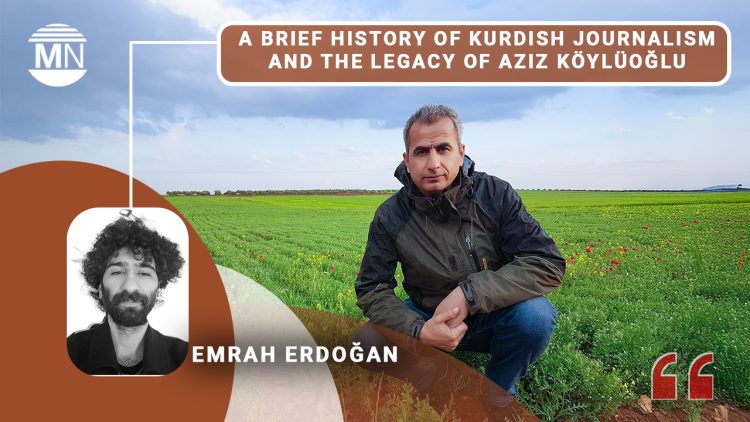
The life and work of Aziz Köylüoğlu
One of these courageous people was journalist Aziz Köylüoğlu, born in 1976 in Diyarbakır (Amed), a city that is symbolic of the Kurdish struggle in southeast Turkey. Since the early 2000s, Köylüoğlu has worked in various positions in the media, from cameraman and reporter to editor-in-chief. His path took him to several outlets in the Kurdistan Region of Iraq (KRI), including Erbil (Hewlêr), Sulaymaniyah (Silêmanî), and Kirkuk (Kerkûk), before moving to North and East Syria, known as Rojava. Wherever he worked, he focused on exposing injustice and fostering a truly free press.
Köylüoğlu regularly contributed reports and analysis to various media outlets covering Kurdish affairs, such as Medya News, Mezopotamya Agency, ANHA and Roj News, commenting on the policies of the Kurdistan Regional Government (KRG), but also on the increasingly aggressive behaviour of the Turkish state: from military incursions into Iraqi Kurdistan to the use of drones for targeted killings.
On 27 January 2025, Köylüoğlu was killed in a Turkish drone strike in the Ranya district of the KRI’s Sulaymaniyah province. The Kurdish Union of Democratic Press (YRD) described his killing as a result of Turkey’s hostile policy towards those with a voice who are perceived as a threat, and praised Köylüoğlu’s tireless pursuit of the truth as an example for future generations of Kurdish journalists.
Turkish drones over Sulaymaniyah: Three Kurdish journalists killed in six months
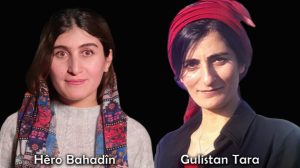
Aziz Köylüoğlu was also a colleague of Gulistan Tara and Hêro Bahadin, two Kurdish women journalists killed in a Turkish drone strike near Sulaymaniyah on 23 August. After they were killed, Köylüoğlu himself was involved in imparting the news of their deaths, speaking about them on a television programme a few days after the incident. He was committed to spreading the truth and knew that the attack that killed Tara and Bahadin was an attempt to silence the free Kurdish press. As a result he became even more active after their deaths, continuing their legacy.
Turkish drones over Kobani: Two Kurdish journalists killed in December
Shortly before Köylüoğlu’s murder, two other Kurdish journalists, Nazım Daştan and Cîhan Bilgin, were killed in another Turkish drone strike, this time in northern Syria near Kobani (Kobanê). They were returning from covering clashes between the Syrian Democratic Forces (SDF) and Turkish-backed militants when the drone targeted their car.
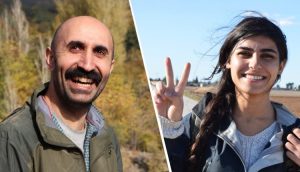
Both Daştan and Bilgin had reported extensively on Turkey’s growing military operations in northern Syria – documenting not only the direct impact on Kurdish communities, but also the humanitarian consequences in a region already scarred by conflict. Their deaths have once again highlighted the serious risks faced by journalists trying to inform the world about events in Kurdish-populated areas.
Kurdistan expert and journalist Fréderike Geerdink highlighted in a recent column that the murder of Kurdish journalists should be understood within the broader context of geopolitical manoeuvring by major powers like the United States and Europe. While European leaders offer sporadic criticism of Turkey’s offensives and human rights violations, Geerdink cautions readers to view political rhetoric with scepticism, noting that it is frequently overshadowed by arms deals, asylum policies, and wider foreign interests.
Geerdink honours the memory of Daştan and Bilgin by emphasising that these journalists were part of a “legacy and tradition” dedicated to the people’s struggle for freedom. This sense of responsibility stands in stark contrast to the political calculations of international actors, who may condemn Turkish aggression in one breath, only to supply arms or uphold strategic alliances in the next.
From Diyarbakır to Kobani, Sulaymaniyah and beyond, the sacrifices of journalists like Köylüoğlu, Daştan, Bilgin, Tara and Bahadin speak to the essential role of a free, unyielding press. Their stories are part of an ongoing struggle for liberation, a battle fought not only on the front lines but also in newspapers, news wires and digital media.
While these reporters have been silenced, their legacy lives on in the dogged reporting of Kurdish and international journalists who refuse to be intimidated. Their work – exposing injustice, championing stories that might otherwise be lost – carries on the tradition of Kurdish journalism: a tradition in which the truth, no matter how dangerous its pursuit, is the highest calling.