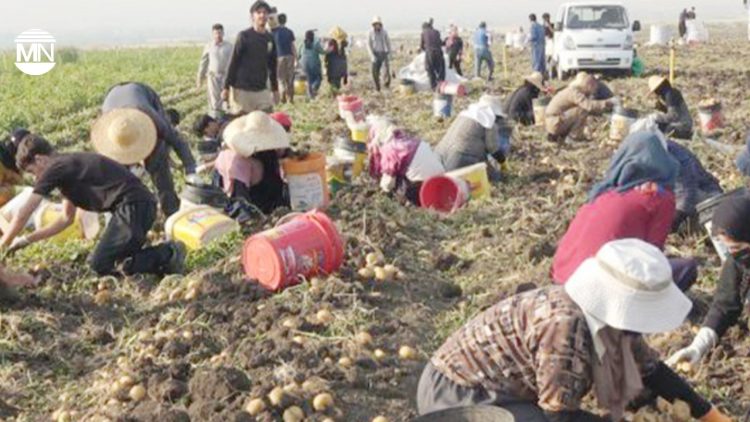
Many university-educated women in Halabja (Helebce) face serious hardship due to the deepening economic crisis and a lack of job opportunities in the Kurdistan Region of Iraq (KRI). Despite their qualifications, these women are unable to find employment in their professions and are forced to resort to agricultural labour to support themselves and their families, reports Yeni Özgür Politika.
Many have taken up physically demanding work in the Shahrizor (Şarezûr) and Penjwen (Pêncwên) plains. While providing for their households, the women strive to maintain an independent and dignified life though this arduous labour.
Sumeye Heme Cafer, a graduate of Halabja University’s Faculty of Physical Education and Sport and top of her class, has been working in agriculture for the past 13 years. She spends eight hours a day harvesting tomatoes, peppers, and potatoes under the sun.
“Labour is hard for women because we are also burdened with housework. But despite all the difficulties, we keep working without stepping back,” she said.
Cafer, who was unable to pursue her lifelong dream of postgraduate study due to financial hardship, criticised the governing authorities. “All young people have dreams, but the government has taken those dreams away. That’s why most are forced into agricultural labour to make a living.”

Reyan Ezize, who holds a degree in agriculture, has struggled to find gainful employment in her sector. To earn a living, she leaves home between 2.30 and 3.00 am each morning to reach the fields in Shahrizor, and sometimes travels as far as Penjwen.
She also highlights the difficulty of combining working the fields with domestic labour, saying: ‘My job has become much harder, but I carry on doing so to sustain our livelihood.’
Women in Halabja criticise the Kurdistan Regional Government (KRG) for a worsening economic crisis and inadequate employment opportunities, hitting graduates the worst. Yet they emphasise their determination to remain self-reliant. In interviews with Roj News, the women condemned the authorities for neglecting the population and urged young people not to passively wait for jobs to come along but to take the initiative.
Despite the challenges, women in the region persevere, relying on their own efforts and resilience.
Related Articles:
A recent report: Women reclaim power in Syria’s Jinwar village project
IWD2025: The residents of Jinwar women’s village are standing strong