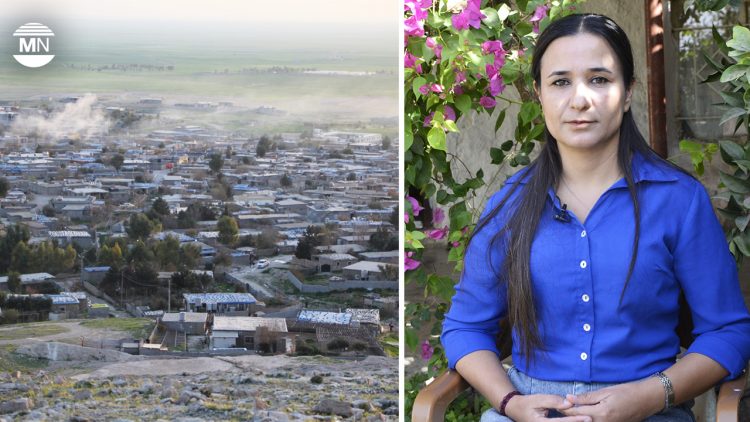
The situation at Makhmur (Mexmûr) refugee camp, located in a disputed region of northern Iraq, has been deteriorating over the past two months, as it remains under siege by both Iraqi federal government and the Kurdistan Regional Government (KRG). Since 10 April, the camp has been under a full embargo, with surrounding roads blocked to prevent supplies from entering and residents from leaving.
Makhmur camp is located approximately 60 km southwest of Erbil (Hewlêr), the capital of the Kurdistan Region of Iraq (KRI). It provides a safe haven for around 12,000 Kurds who fled state violence in Turkey during the 1990s, when the Turkish army burned thousands of Kurdish villages as part of its ‘torched earth policy’.
Filiz Budak, co-chair of the camp’s Democratic People’s Council, spoke to Medya News about the current situation and the impact the embargo has had on camp residents.
“They say that we can’t go to Iraqi cities, work there or go to hospital because our passports have expired,” Budak said, noting that the Iraqi government is responsible for renewing refugees’ passports, and should do so in cooperation with the United Nations which officially recognises the camp as a refugee settlement. The residents’ passports have not been renewed since 2023, with authorities citing technical issues such as delays from the card producers and lack of funding.
Over the past two months, Budak explained, the Iraqi government has increasingly restricted access by blocking roads from the camp towards Baghdad – first by preventing building materials from entering, and later by stopping and detaining residents en route to work or hospitals in central Iraq.
With only one hospital in the camp serving around 12,000 residents, many rely on external medical facilities. Budak also stressed that Makhmur Hospital has faced serious difficulties in obtaining medication under the embargo. She emphasised that the health needs of the camp’s population now exceed the camp’s capacity to meet them.
On 13 May, a delegation including fellow People’s Council co-chair Ehmed Shehbaz, Co-Mayor Edban Yilmaz, and Foreign Relations Committee Co-Spokesperson Bewar Emin travelled to Baghdad for a meeting with the Iraqi Justice Ministry to discuss the embargo and roadblocks. Upon their return the next day, they were detained by Iraqi forces. Budak confirmed that the delegation remains in detention.
She also highlighted that free movement from the camp into the KRI has long been restricted, with Iraqi Kurdish routes blocked for the past six years.
Detailing the hardships caused by the recent embargo, Budak said:
“That is why we have great difficulties in obtaining the necessary things for everyday life, both in terms of health and the essentials we need. It is a refugee camp, so we rely on workers for our economy. When we can't fulfil this in the cities around us, we struggle to earn a living.”
In addition to the two-month siege, Budak said that Islamic State (ISIS) activity continues in the surrounding areas. ISIS has attacked the camp twice since 2014. On both occasions, guerrilla fighters from the Kurdistan Workers’ Party (PKK) defended the camp.
Budak also noted that over the past six years, the KRG has denied university admission to students who graduated from schools in Makhmur.
Calling on the United Nations and the Iraqi government to fulfil their responsibilities towards the camp, Budak urged all democratic forces and organisations advocating for refugee rights to stand in solidarity.