

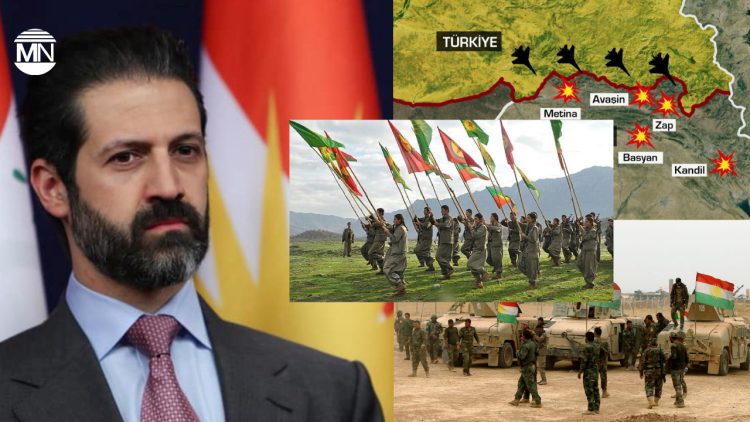
Turkey’s justification for maintaining more than 100 military bases in the Kurdistan Region of Iraq must now be reassessed, said the region’s Deputy Prime Minister Qubad Talabani after the official disarmament of the Kurdistan Workers’ Party (PKK). He added that continued Turkish troop presence raises serious questions about Iraqi sovereignty.
Speaking to Greek news agency Kathimerini on Saturday, Talabani said if the PKK no longer posed a threat, then “perhaps there is no reason for these bases to exist”. Turkey has long cited the fight against the PKK as justification for its extensive military presence in northern Iraq.
Talabani also highlighted the enduring influence of Abdullah Öcalan, the imprisoned PKK leader, across the Kurdish political landscape. “He remains a powerful and respected figure with deep influence over Kurds everywhere,” he said. “Anyone who fails to comply with him risks losing credibility in the international community, as well as support from within the region.”
The PKK announced its disarmament earlier this month following a call from Öcalan, who has been imprisoned on İmralı Island since 1999. The move is being widely discussed in Erbil (Hewlêr), the administrative capital of the Kurdistan Region.
Talabani cautioned that trust in Ankara remains low among many Kurds despite this development. “Without confidence-building measures from Turkey, peace will struggle to take root,” he said, pointing to key demands from the pro-Kurdish Equality and Democracy (DEM) Party in Turkey, including the release of political prisoners such as Selahattin Demirtaş, amnesty for PKK members, and an end to Öcalan’s isolation.
While tensions persist with Turkey, Talabani noted that many disputes have been managed through mutually beneficial trade. In 2024, nearly a quarter of Iraq-Turkey trade was conducted with the Kurdistan Region, where over 1,000 Turkish companies operate. But he stressed that military cooperation must not override political sovereignty.
Asked whether the Kurdistan Region’s semi-autonomous model could be applied to other parts of the Middle East, Talabani was sceptical: “Our histories and tragedies are different.” Nonetheless, he insisted that Iraq’s federal constitution proves that inclusive governance is possible.
Talabani also dismissed calls for a pan-Kurdish independent state as unrealistic. “Emotionally, I relate to that dream,” he said. “But we can achieve more as part of a strong Iraq than as a state locked in perpetual conflict with our neighbours.”
Qubad’s father, Jalal Talabani, a towering figure in Kurdish politics and the founder of the Patriotic Union of Kurdistan (PUK), played a pivotal role in supporting diplomatic efforts to address the Kurdish issue, including collaboration with Öcalan during the 1990s. Notably, he facilitated Öcalan’s 1993 ceasefire announcement, a historic moment aimed at fostering peace between the PKK and Turkey. As a pragmatic leader and later Iraq’s President (2005–2014), he balanced Kurdish aspirations with diplomatic relations, navigating complex ties with Turkey and advocating for Iraqi Kurdish autonomy within a federal framework, a legacy his son continues to uphold.


