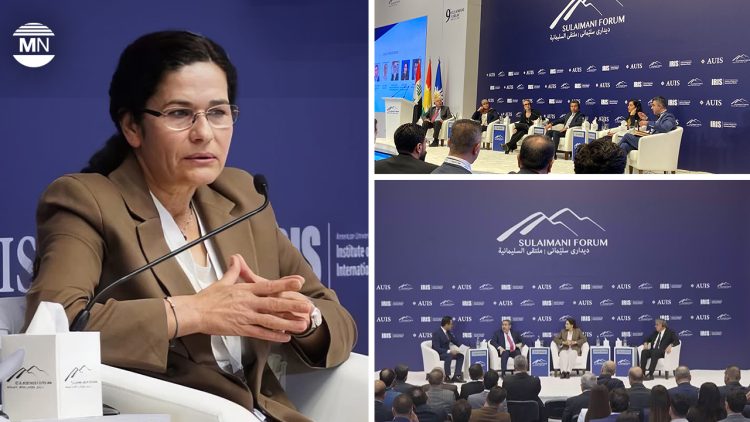
Top Syrian Kurdish politician Ilham Ahmed firmly rejected the idea of reinstating a centralised government in Syria on Thursday, warning that such a move would endanger hopes for a stable post-war future. Speaking at the Sulaymaniyah (Silêmanî) Forum in Iraq’s Kurdistan Region, Ahmed called instead for an inclusive constitutional framework that guarantees the rights of all ethnic and religious groups.
Ahmed, co-chair of the Foreign Relations Department of the Autonomous Administration of North and East Syria (AANES), made the remarks during a panel on regional dynamics at the ninth edition of the Sulaymaniyah Forum held at the American University of Iraq, Sulaymaniyah (AUIS).
“We do not want Syria to return to the pre-2011 era,” Ahmed said. “We reject the insistence on a centralised constitutional system — this system has caused wars, crises, and conflicts in many parts of the world. Syria must be reimagined as a multicultural and heterogeneous country where all communities are constitutionally recognised.”
The forum, which began Wednesday, gathered more than 700 participants including Iraqi Prime Minister Mohammed Shia al-Sudani, Kurdistan Region President Nechirvan Barzani, and senior international analysts to discuss political, economic, and security challenges facing Iraq and the wider Middle East.
Ahmed’s comments come as the Kurdish-led Syrian Democratic Forces (SDF), backed by the United States and controlling around one-quarter of Syrian territory, cautiously engage in dialogue with the transitional Syrian government. An eight-point agreement signed in March between interim President Ahmed al-Sharaa and SDF commander Mazloum Abdi laid the groundwork for integration — but full political reconciliation remains elusive.
“We are at the beginning of negotiations,” Ahmed said. “We have our terms. We seek inclusive governance, and the rights of the Kurds must be guaranteed in the new constitution.”
Rejecting suggestions that the Syrian Kurdish administration might adopt the Kurdistan Region of Iraq as a political blueprint, Ahmed said, “We are not trying to copy the Kurdistan Region model. We respect it and want to learn from it, but the geopolitics, political structures, and societal components in Syria are different.”
Her message echoed across the forum, where decentralisation and inclusivity were recurring themes.
Nechirvan Barzani welcomed the growing unity among Kurdish groups in Syria. “It is encouraging that all Kurdish parties in Syria have united around a peaceful resolution to the Kurdish issue,” he said. “They’ve made important strides by consolidating their demands. We hope they can, in cooperation with the Syrian government, build a democratic Syria that guarantees the rights of all ethnicities and communities.”
Iraqi Prime Minister Mohammed Shia al-Sudani, addressing the forum’s opening, stressed the need for institutional reform in the broader region. “We have adopted an approach aimed at building a strong state and have raised the slogan of a service-based government as a social contract between the citizen and the state,” he said. “Any political framework, whether in Iraq or Syria, must place people’s needs at its core.”
Barham Salih, former Iraqi president and founding chairman of AUIS’s Board of Trustees, warned of deepening regional fragility but urged dialogue. “The region faces serious and frightening challenges,” he said. “But there are real opportunities. We must transition from periods of violence to a new reality based on resource utilisation and economic growth.”
Ahmed, however, cautioned that Syria’s stability cannot be built on symbolic gestures or short-term alliances. “The majority of Syrians — including Druze, Alawites, and Kurds — are rejecting a return to the centralised model,” she said. “Resources and power must be shared fairly. A centralised grip on wealth will only deepen divisions.”
Highlighting ideological undercurrents, Ahmed acknowledged the influence of Kurdistan Workers’ Party (PKK) founder Abdullah Öcalan, whose ideas have shaped the region’s self-administration model. “I want to describe him as having an ideological relationship with us,” she noted. “This relationship guides us in organising our cultural and social life.”
Turkey, which regards the People’s Defense Units (YPG) — the backbone of the SDF — as an offshoot of the PKK, continues to oppose any Kurdish autonomous governance along its border. While Ahmed’s comments stopped short of addressing Ankara directly, her emphasis on democratic pluralism appeared aimed at both reassuring international allies and warning regional adversaries.
UN Special Representative for Iraq, Mohamed al-Hassan, used the occasion to point to Iraq’s own progress as a model for post-conflict stabilisation. “Iraq has reached a stage where it no longer needs the presence of a UN mission,” he said. “This reflects the development of the political and security situation in the country.”
The Sulaymaniyah Forum, held annually since 2013 and organised by the Institute of Regional and International Studies (IRIS), has become a key platform for exchanging ideas on regional peace-building, governance, and economic reform. This year’s forum included partnerships with international think-tanks such as Chatham House, the Italian Institute of International Affairs, and Century International.
With Syria entering a delicate transitional phase following the collapse of Bashar al-Assad’s regime in late 2024, Kurdish leaders are making a calculated effort to shape the constitutional future of the country — one that includes decentralised governance, equitable resource sharing, and constitutional recognition for all minorities.
“This is a historic moment,” Ahmed concluded. “If we are to build peace, it must include everyone. Not just in name, but in the very structure of the new Syria.”