

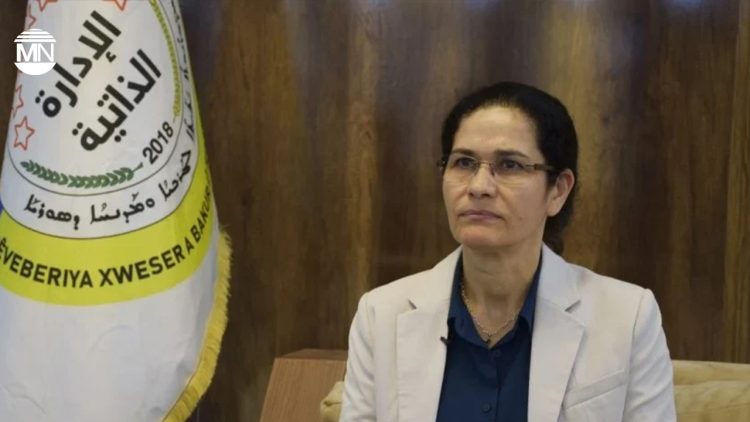
Ilham Ahmed, co-chair of the Foreign Relations Department of the Autonomous Administration of North and East Syria (AANES), has welcomed the recent agreement between Kurdish-majority neighbourhoods in Aleppo and the Syrian interim government, suggesting it could pave the way for further deals to facilitate the return of internally displaced persons (IDPs) — particularly those from Turkish-occupied regions such as Afrin (Efrîn), Ras al-Ayn (Serêkaniyê) and Tel Abyad (Girê Spî).
Speaking to ANHA News, Ahmed said there are significant numbers of IDPs in Syria, and while many returned to their regions following the fall of the Assad regime, those from occupied areas did not return due to security concerns, these regions remaining under the control of the Turkish army and affiliated Islamist mercenaries.
“There need to be security guarantees to ensure the safe return of all IDPs in Syria,” Ahmed said, adding that the AANES and Damascus are engaged in ongoing discussions regarding these regions and that the United Nations has been alerted to the situation. She stressed that Afrin’s residents must be enabled to return to their homes:
“The return of Afrin refugees is a must. This return could be a new step in the history of the Syrian crisis, which could protect the security of citizens, stop the demographic changes of recent years, and forge a new life.”
Providing details on the current situation in Aleppo following the recent agreement, Ahmed said that the internal security forces (Asayish) of the People’s Council in the Sheikh Maqsoud and Ashrafiyeh neighbourhoods will continue to protect both areas, while health and public services will be coordinated with Aleppo city council.
She described the Aleppo agreement as a “new experience for Syria”, but warned that changes to Syria’s basic constitution must follow for the prohibition of new wars, to protect civilians from “conflicts and chaos”, and to guarantee rights and freedoms “that have not been granted to Syrians for many years”.
Sarah Glynn, a columnist for Medya News, also highlighted the potential impact of the recent Aleppo agreement on Syria. “This is still not a final arrangement, but there are hopes that it will inform the approach not just for the future of these two neighbourhoods but for all of the Autonomous Administration and even the region of Afrin (Efrîn), which has been occupied by Turkey for the last seven years,” Glynn said.


