

Sarah Glynn
Negotiating a future in Syria’s political jungle demands a rare combination of patience, determination and understanding. This week brought news of an interim agreement that could prove a positive step towards greater security for Syria’s Kurds and their neighbours – though even that tentative phrase seems like a hostage to fortune and a provocation to the foreign powers competing for influence and control.
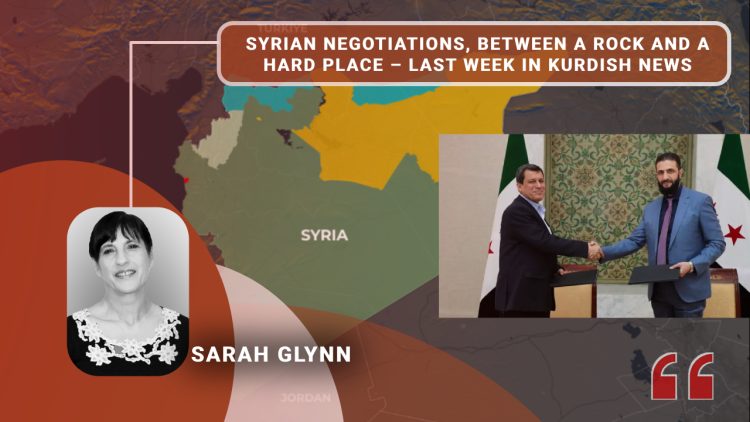
The agreement is between the Civil Council of two Kurdish majority neighbourhoods in Aleppo and the caretaker government in Damascus, and it has come at a time when Syria has become a battleground for competition between Turkey and Israel.
An agreement for Aleppo
The Aleppo neighbourhoods of Sheikh Maqsoud and Ashrafiyeh set up their own autonomous administration during Syria’s civil war, but were always geographically isolated from the rest of the Autonomous Administration of North and East Syria (AANES). As in other parts, the People’s Protection Units (YPG) and – later – the Syrian Democratic Forces (SDF) had to defend the people against attacks from Islamist militias. The Aleppo neighbourhoods also had to contend with attempts by Bashar al-Assad’s government to force them into submission by controlling their access to vital supplies.
When Hayat Tahrir al-Sham (HTS) took control of Aleppo in December, the SDF negotiated for Sheikh Maqsoud and Ashrafiyeh to be left temporarily untouched – though not before they had been subjected to a blockade and threatened by the Turkish mercenary militias of the Syrian National Army.
Now—after further negotiations following the agreement signed between the SDF and Syria’s interim president, Ahmed al-Sharaa—the next stage of the developing relationship has been worked out and agreed. This is still not a final arrangement, but there are hopes that it will inform the approach not just for the future of these two neighbourhoods but for all of the Autonomous Administration and even the region of Afrin (Efrîn), which has been occupied by Turkey for the last seven years.
The agreement is, of course, a compromise, but, for now at least, it ensures the retention of local autonomy. The SDF has left, but security within the districts has been put in the charge of the Autonomous Administration’s internal security forces, the Asayish, in coordination with the Syrian Interior Ministry. And, while the two neighbourhoods will be represented at the Aleppo Provincial Council, and will coordinate with the rest of the city, the agreement stipulates that “The existing service, administrative, and educational institutions, municipalities and local councils in the two neighbourhoods shall be maintained until the joint central committees agree on a sustainable solution.”
Already, the SDF has left, handing over the neighbourhoods’ security to the Asayish. And we have seen the first prisoner swap – 147 SDF members for 97 members of Syrian caretaker government forces.
Bedran Çiya Kurd, Co-Chair of the Autonomous Administration’s Foreign Relations Department, described the agreement as “a significant step toward enhancing stability and coexistence”, which “stipulates the full preservation of the neighbourhoods’ distinct identity, encompassing security, administration, services, culture and political life, in coordination with the relevant service and security institutions in the city of Aleppo.”
The co-chair of the neighbourhoods’ General Council claimed that the agreement would ensure “the privacy of the two neighbourhoods, in addition to fair representation on the city council”.
The relative success of this agreement cannot, however, obscure that fact that Syria’s Temporary Constitution and the formation of Syria’s caretaker government have both been severely criticised for ignoring the primary agreement with the SDF, and, instead, consolidating the power and the Islamist politics of the interim president and his organisation.
Turkey
It is not only Syrians who are shaping the future of Syria.
Turkey, which has already occupied three areas in the north and nurtured HTS as they developed their base in Idlib, is extending its reach militarily, politically, and economically; and Israel is encroaching from the south and carrying out bombing attacks at will.
President Erdoğan’s neo-Ottoman dreams have long envisaged Turkish hegemonic control over northern Syria and Iraq – areas that Turkey claimed in the National Pact (Misak-ı Millî) of 1919-20, but which they had to concede in the Treaty of Lausanne. The Pact declared all territories inhabited by an “Ottoman Moslem majority” to be part of the indivisible Turkish state. That “Ottoman Moslem majority” was comprised of both Turks and Kurds, and many Kurds had been persuaded that they were part of a joint struggle for a sovereign Islamic country. There was no separate Kurdish representation at the negotiations in Lausanne, and it was only after the treaty had given birth to the new Turkish Republic that Turkey’s new rulers made clear that Kurds would now be expected to give up their own culture and language and consider themselves as Turks. Erdoğan’s dreams of Turkish hegemony are coupled with a vindictive determination to crush all forms of Kurdish autonomous control.
Erdoğan has been flexible as to the route for achieving these aims, both supporting Islamist militias fighting against the Assad regime, and attempting to make a deal with Assad for a joint attack against the Kurds. It is thanks to Erdoğan’s interventions that Syria is now largely under the control of an organisation that has its roots in al-Qaeda, and is full of Turkish mercenary militias that combine warlordism and a taste for sadistic violence with a distorted religious fervour. Turkey has been strengthening links with Syria’s new rulers, ensuring Turkish power, influence and profit, through what is portrayed as military and intelligence support and promises of help for rebuilding the country’s shattered infrastructure. They have also used their connections with al-Sharaa and his government to encourage his drive towards centralised control and to obstruct moves that might allow North and East Syria to retain any level of autonomy – which makes the recent agreement for Aleppo all the more remarkable.
Middle East Eye observes, “Ankara and Damascus have been negotiating a defence pact since December, following the ousting of Bashar al-Assad. The agreement would see Turkey provide air cover and military protection for Syria’s new government, which currently lacks a functioning military.” The SDF has drone footage showing Turkish military bases under construction across Syria, and Middle East Eye reported that Turkey has begun to take control of the T4 airbase near Palmyra, where they plan to first install an air defence system and then reconstruct and expand the facilities, which “would help Turkey establish aerial control across the region”. Turkey and their mercenaries are still attacking the Autonomous Administration at the Tishreen Dam to the West of Kobanê, and there is no doubt that an increased Turkish military presence would target the Kurds, and North and East Syria as a whole.
Israel
Israel welcomed the fall of Assad because of his links with Iran and Hezbollah, but now they will not allow the development of a strong Islamist state on their border—regardless of al-Sharaa’s insistence that he has no intention of attacking any of Syria’s neighbours—nor will they allow a Turkish challenge to their regional dominance.
The Israelis have long felt uninhibited over carrying out bombing raids into Syria, and they responded to Assad’s departure by bombing the country’s military assets before anyone else could take charge of them, as well as carrying out a land grab in the South. Now they are continuing their southern incursions, and have responded to Turkey’s military expansion with destructive strikes on the T4 base and other facilities.
Israel’s defence minister told al-Sharaa that he would “pay a very heavy price” if he allowed “hostile forces” to enter the country. And an Israeli military official told the Jerusalem Post that the strikes were intended as a message to Turkey: “Do not establish a military base in Syria and do not interfere with Israeli activity in the country’s skies.”
In a careful response to Reuters, Turkish Foreign Minister, Hakan Fidan, stated that they did not want a confrontation with Israel and that Syria should be free to make understandings with their neighbours. He also repeated Turkey’s usual fairy story in which they are protecting Syria from the dual terrorist threats of ISIS and the Kurdistan Workers’ Party (PKK), which they refuse to differentiate from the SDF. In the real world, Turkey has helped ISIS to recruit and grow, while the PKK and SDF have fought against ISIS and defeated them. Far from threatening Syria, they have defended it.
Picking a path through these powerful forces and finding the gaps created by their rivalries is an immensely complicated task. North and East Syria has been helped in their negotiations by the United States and France. These countries are also acting in their own interests, but they perceive these interests to lie in Syrian stability. For the people of Syria, caught between the ruthless ambitions of Turkey and Israel, stability still seems a very long way off.
*Sarah Glynn is a writer and activist and columnist for Medya News – check her website and follow her on X (Twitter) or bluesky


