

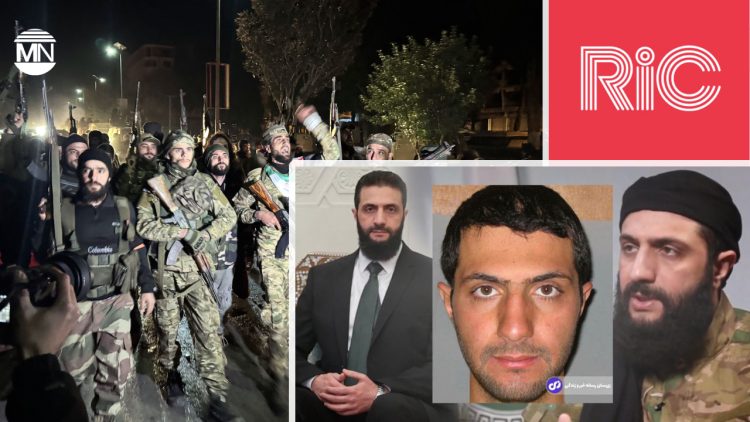
A report by the Rojava Information Center, published on 28 March, details how Hay’at Tahrir al-Sham (HTS), a former jihadist militant group, has assumed control of Syria through its newly formed Syrian Caretaker Government (SCG) following the collapse of Bashar al-Assad’s regime on 8 December 2024. While HTS seeks to present itself as a legitimate governing body, the report highlights that its rule remains deeply authoritarian.
The report provides a detailed chronicle of how HTS, originally a Salafi-jihadist militant organisation rooted in Idlib, evolved into the de facto governing authority of Syria after a dramatic military and political transition. It documents the group’s transformation from an armed insurgency into an institution that now administers the Syrian state through a caretaker government, while maintaining many of its authoritarian practices and jihadist underpinnings.
In late 2024, HTS spearheaded a swift military offensive—codenamed “Deterrence of Aggression”—against Bashar al-Assad’s government and the Syrian Arab Army. Within just 11 days, this campaign led to the rapid collapse of the old regime, culminating in Assad’s departure on 8 December. In the aftermath, HTS seized control and rebranded its leadership, with its longtime jihadist commander Abu Mohammad al-Julani unveiling his real name, Ahmed al-Sharaa. This rebranding was not simply cosmetic; it signified the group’s strategic shift from being known solely as a militant outfit to taking on political responsibilities as the head of an interim authority—the SCG.
The report explains that despite the ostensible promise of a democratic and inclusive transition, HTS has concentrated power in a manner reminiscent of its previous rule in Idlib. Even as official statements stress unity and stability, HTS has continued to rely on centralised control, suppress dissent and maintain a tight grip on both military and civil institutions. Under its previous rule in Idlib, the group was known for arbitrary detentions, torture and summary executions, along with religious discrimination and gender-based violence. The same patterns, the report argues, are now emerging in the new governmental structure, where key positions are filled almost exclusively by long-time HTS affiliates.
The evolution of Hay’at Tahrir al-Sham
A significant portion of the analysis is dedicated to exploring HTS’ ideological evolution. Originally part of the global jihadist movement and affiliated with al-Qaeda, HTS rebranded itself in 2017 as Jabhat Fatah al-Sham, later consolidating under the HTS name. The shift was marked by a move toward “political jihadism”—a strategy that allowed HTS to present itself as a moderate, pragmatic alternative capable of governing, while still upholding core jihadist principles. This rebranding was partly aimed at winning over opposition groups in Syria and gaining legitimacy on the international stage, even as it continued to expel more extreme elements from its leadership. However, the report makes clear that such changes have been superficial; many of the same hardline figures and practices persist even as HTS has taken on state-like responsibilities.
The report details the structural transformation within HTS over the years. In Idlib, HTS had already consolidated its power by forcefully removing rival factions and establishing a parallel state apparatus—the Syrian Salvation Government (SSG). Through a process of institutional capture, HTS not only controlled the military and security services but also set up civil institutions designed to administer the region’s 4.5 million residents. With the fall of Assad, these structures became the blueprint for the SCG in Damascus. Nearly all key positions in the new government are held by individuals with close ties to HTS, and the transition process has largely been a continuation of the power dynamics established in Idlib.
Another important dimension discussed in the report is the role of external actors, most notably Turkey. The Turkish-backed Syrian National Army (SNA), historically involved in the conflict and linked to various jihadist and Free Syrian Army factions, played a dual role. On one hand, it participated in the offensive against Assad’s forces; on the other, its own internal history of human rights abuses and alliance with extremist elements complicated the broader picture of Syrian state-building. In the wake of Assad’s fall, Turkey has exerted pressure on groups like the SNA to integrate under the unified military umbrella led by HTS. This move, the report notes, further consolidates HTS’ hold over the armed factions and reinforces its centrality in Syria’s new political order.
The report provides a thorough account of how power is being restructured within the SCG. In a series of strategic meetings—culminating in what was termed a “Victory Conference”—HTS’ leader Ahmed al-Sharaa was formally announced as the interim president of Syria. This event was used to legitimise the transition by dissolving previous institutions like the 2012 constitution and establishing a new framework that, in practice, cements HTS’ authority. Although the government has introduced the idea of forming a temporary legislative council and holding limited elections, these measures are described as largely symbolic. The elections are highly controlled, with a pre-selected pool of candidates and restricted participation that ensures the continuity of HTS’ elite rule. Women and many minority groups are excluded from these processes, mirroring the exclusive practices seen under both the old Assad regime and during HTS’ rule in Idlib.
A key criticism raised in the report is that the ostensible transitional period is, in reality, a mechanism for HTS to entrench its power further. The report notes that even though there is talk of a “transition” toward a more democratic and inclusive state, the new government is in effect an extension of the same authoritarian regime that has governed Idlib for years. HTS’ approach to governance—marked by centralised decision-making, limited public participation, and the use of coercion to suppress dissent—is likely to have long-lasting implications for Syria’s political future.
In detailing the administrative makeup of the SCG, the report lists the ministers and key officials who hold sway in the new regime. These appointments include figures with deep roots in the jihadist movement, such as the current foreign minister, intelligence chief, and defence minister, all of whom have served with HTS for years. The report also highlights instances of nepotism and the exclusion of potential reformist voices. For example, the replacement of the health minister with the brother of the new leader has sparked accusations of favouritism reminiscent of the corruption endemic to the Assad era.
Furthermore, the report outlines how HTS has manoeuvred to integrate disparate armed groups under its control, dissolving former opposition bodies like the Syrian National Coalition and orchestrating the absorption of various rebel factions into a unified military structure. Meetings between HTS and commanders from groups such as Ahrar al-Sham and al-Jabhah al-Shamiyah were convened with the explicit aim of dissolving these organisations and integrating them into the state military. This consolidation effort not only neutralises potential sources of dissent but also strengthens HTS’s monopoly over Syria’s military apparatus.


