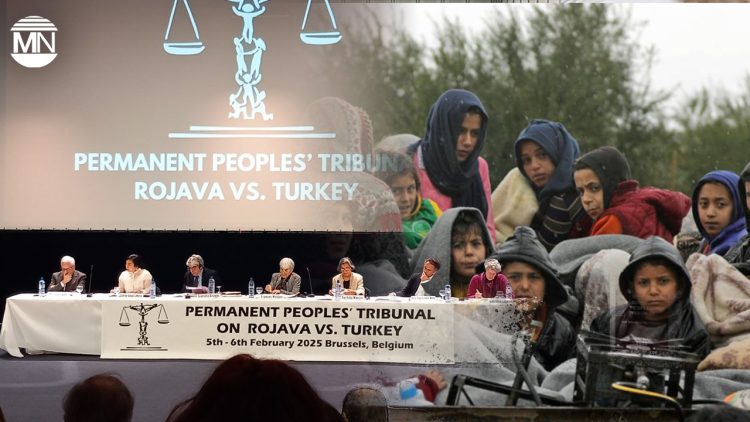
The Permanent Peoples’ Tribunal (PPT) on Rojava vs. Turkey, held at the Free University of Brussels (ULB), brought together legal experts, human rights defenders and witnesses to examine Turkey’s role in the displacement of Kurdish civilians from Afrin (Efrîn) and its wider implications for international law. The prosecution argued that Turkey’s actions constitute a deliberate strategy to alter the ethnic composition of the region, drawing parallels with its past military interventions, including in Cyprus.
Mass displacement and demographic change
Efstathios C. Efstathiou, an investigator for the prosecution, detailed how Turkish-backed forces forcibly displaced Kurdish residents from Afrin during and after the 2018 military offensive known as Operation Olive Branch. The military operation, which was officially launched to combat Kurdish militants linked to the People’s Protection Units (YPG), resulted in the displacement of over 120,000 civilians, many of whom sought refuge in the Al-Shahba region and later in Al-Tabqa due to deteriorating humanitarian conditions.
Efstathiou argued that the forced displacement was part of a broader effort by Ankara to “eradicate the Kurdish presence” in Afrin and repopulate the area with Arab families from the Damascus countryside, particularly from Eastern Ghouta. “This is not just displacement – it is a calculated effort to restructure the demographic makeup of Afrin,” he said.
Reports presented to the Tribunal detailed how displaced civilians faced severe restrictions on movement, coercion and confiscation of property. Evidence showed that Kurdish-owned homes, businesses and agricultural land were seized and redistributed to new settlers, many of whom were allied to Turkish-backed groups.
Cultural erasure and imposed identity
The tribunal also heard accounts of cultural erasure in Afrin. Investigators presented documentation showing that Kurdish street names, businesses and public institutions had been systematically renamed or replaced with Turkish or Arabic equivalents. This included the removal of Kurdish-language signage and the imposition of Turkish administration over local governance.
“This is not just a military occupation, it is a cultural and demographic occupation,” said Ceren Uysal, a lawyer representing the prosecution. “The aim is to erase the Kurdish identity of Afrin and to consolidate control over the region through population engineering.”
Related Articles:
Kurdish displacement in Shahba, Afrin sparks humanitarian crisisThe ironically named ‘Hope Village’ is furthering the ethnic cleansing of AfrinCivilians in Afrin targeted by Turkish attacks, forced displacementTurkey under criticism for “Turkifying” Kurdish landmarks in occupied Afrin
Parallels with Cyprus and historical patterns
Expert witness Oz Karahan, who has extensively studied Turkey’s demographic policies, linked the events in Afrin to historical patterns of forced displacement and population transfers carried out by the Turkish state. Karahan drew comparisons with Turkey’s 1974 invasion of Cyprus, during which thousands of Greek Cypriots were forcibly displaced and the occupied northern region was repopulated with Turkish settlers.
"From Cyprus in 1974 to Afrin in 2018, Turkey has followed the same pattern of erasing local populations and replacing them with communities loyal to its strategic interests."
“We see a systematic approach by the Turkish state – displacement, resettlement and cultural repression – used as a tool of geopolitical control,” Karahan said.
The prosecution stressed that Turkey’s demographic policy in Afrin bears similarities to other conflicts where population transfer has been used as a tool of war. The Rome Statute of the International Criminal Court classifies forced displacement as a war crime when carried out without legitimate security justifications. The prosecution team argued that Turkey’s actions could amount to crimes against humanity under international law.
Humanitarian impact and continuing displacement
The humanitarian impact of the displacement continues to be severe. The investigators presented testimonies from displaced families who described difficult conditions in refugee camps, particularly in Al-Shahba and Al-Tabqa, where resources remain scarce. The Tribunal was shown images of makeshift shelters, overcrowded living spaces and children suffering from malnutrition due to limited access to food and medical care.
"Their homes have been taken away, their land given away and their identity stripped from the city they once called home."
“The people of Afrin are living in limbo, unable to return home due to ongoing hostilities and restrictions imposed by Turkish-backed groups,” said a human rights lawyer who testified at the tribunal.
The tribunal also heard reports of ongoing violence against civilians, with Turkish-backed armed groups accused of arbitrary arrests, torture and summary executions of those resisting the occupation. According to testimonies, Kurdish civilians who remained in Afrin after the occupation faced systematic persecution, with many being forcibly disappeared or detained on dubious charges.
Turkey’s response and international reaction
Although Turkish officials were invited to present a defence to the court, no government representatives attended. Turkey has previously denied allegations of war crimes in Afrin, arguing that its military intervention was aimed at securing its borders from what it considers to be terrorist threats. Turkish authorities have said that the resettlement of Arab families in Afrin was an organic consequence of the Syrian civil war, rather than a deliberate policy of demographic change.
However, rights groups and independent observers have challenged this narrative, pointing to extensive documentation of systematic displacement, targeted attacks on Kurdish civilians and the strategic nature of the population transfers.
The Tribunal’s proceedings are expected to continue, with further expert testimony and testimonies shedding light on Turkey’s role in the displacement of civilians throughout northern Syria. The final decision of the PPT will not carry legal weight, but is expected to contribute to wider efforts to hold the Turkish authorities accountable for alleged war crimes and human rights violations.
Legal implications and next steps
While the tribunal is not an official judicial body, legal experts say its findings could provide a basis for future cases before international courts, such as the European Court of Human Rights (ECHR) or the International Criminal Court (ICC). Lawyers representing displaced civilians have said they are considering legal options to seek accountability for displacement and demographic engineering in Afrin.
“The documentation presented here is a crucial step towards justice,” said Jan Fermon, a lawyer on the prosecution team. “Turkey must be held accountable for these crimes, and the international community must take a firm stand against the forced displacement of civilians.”
As the trial continues, displaced families remain in exile, unable to return to the homes they fled years ago. With Afrin under the control of Turkish-backed forces and displaced communities, the possibility of reversing the demographic changes seems increasingly unlikely.