The notorious Evin Prison, built during the Pahlavi era in northern Tehran, was originally a site where male political prisoners were detained, tortured, and executed. After the 1979 Iran revolution and the surge in female political detainees, the prison was expanded to include a dedicated women’s ward.
During the mass execution of political prisoners in 1988, Evin became synonymous with terror, haunting the memories of Iranians, political dissidents, and particularly the Kurds.
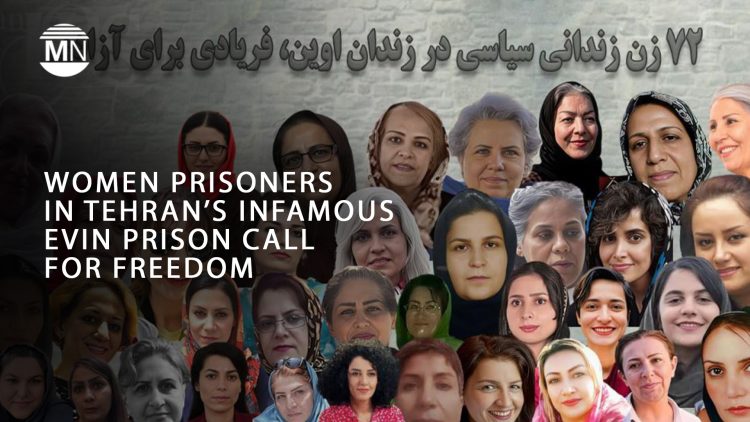
Today, according to the latest HRANA report, 77 female prisoners—mostly political detainees—remain behind Evin’s walls, while eight are on temporary leave.
In the women’s ward, more than ten political prisoners are over 60 years old, with some exceeding 70. Among them, Raheleh Rahemipour remains incarcerated at 72 for her political opposition to the Iranian regime.
Reports indicate that many of these women suffer from severe and incurable illnesses, including multiple sclerosis (MS), cancer, brain tumours, and diabetes, yet they are systematically denied essential medical care and treatment.
Among the detainees, Warisheh Moradi and Pakhshan Azizi face death sentences. Forough Taghipour and Marzieh Farsi have been sentenced to 15 years in prison, while seven others are serving 10-year terms.
Several of the women, including Fatemeh (Hoori) Ziaei Azad, Azar Kurwandi Mosaizadeh, Zahra Safaei, and Moloud Safaei, have been political prisoners since the 1980s. Notably, Azar Kurwandi Mosaizadeh and Zahra Safaei are witnesses to the 1988 massacre of political prisoners and remain imprisoned in Evin to this day.
Most female political prisoners are mothers. Some, like Shiva Esmaili and Zahra Safaei, were arrested alongside their children, sentenced, and are now serving their terms behind bars. The youngest female prisoner in Evin is Kimia Bani-Adam, a 20-year-old who was recently granted temporary leave.
Seven Sunni female prisoners—including one Afghan, two Tajik, one Indian, and one Jordanian citizen—are being held in total isolation under harrowing and inhumane conditions.
Golrokh Iraei, Elaheh Fuladi, Pakhshan Azizi, Maryam Yahyawi, Motaharah Gonae, Vida Rabbani, Warisheh Moradi, and Zahra Safaei have been arbitrarily denied family visits by Evin Prison authorities, with no official justification.
Two of these women gave birth behind bars, yet they and their infants are deprived of even the most basic food, hygiene, and medical necessities. Denied visits from their families, they endure the relentless cruelty of the prison system. Meanwhile, reports of sexual violence against female detainees have surfaced abroad, exposing further layers of brutality.
While Iran’s security apparatus instills fear, silencing many former prisoners, a shift is taking place. Inspired by Kurdish political prisoner Warisheh Moradi, who declared, “Women’s resistance must be narrated”, former detainees have begun breaking their silence, recounting the torture and relentless pressure inside Evin Prison.
Though Qarchak and Qezel Hessar prisons are notorious for even more deplorable conditions, the collective memory of mass executions and the continued suffering of 77 women within Evin Prison sustains its reputation as one of Iran’s most infamous prisons.