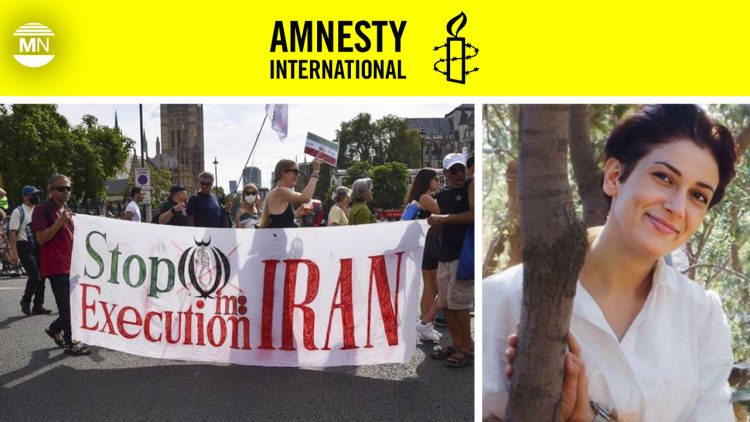
On 5 May, Amnesty International re-published its campaign urging for Iran to halt any plans to execute Kurdish humanitarian worker and human rights defender Pakhshan Azizi. As part of this Urgent Action campaign, Amnesty has prepared a model letter to send to the chief justice of the judicial system of the Islamic Republic of Iran, Gholam-Hossein Mohseni-Ejei, urging activists around the world to take part in the campaign.
As of the 23 May, the letter has been sent by 1,687 signatories. Amnesty had previously re-published the campaign on 14 February, after the lawyers of Pakhshan Azizi were notified that the Iranian Supreme Court had rejected her request for judicial review on 5 February. At that moment, Amnesty urged activists to sign and send the letter by 16 May, but there has been complete inaction from the Iranian Supreme Court regarding the case.
In the letter, first published on the Amnesty site in September 2024, the human rights organisation clearly highlighted that Azizi had received the death penalty unjustly, not only because she had not committed “armed rebellion against the state”, but also because her own allegations of torture practices in Evin Prison have not been investigated. In fact, in October 2024, a court in Tehran sentenced her to six months in prison for protesting the increased use of death penalty in the women’s wing of Evin Prison.
The letter details Azizi’s involvement in non-violent humanitarian activities between 2014 and 2022, which consisted of providing support primarily to women and children displaced as a result of ISIS attacks in Rojava and the Kurdistan Region of Iraq. These activities led the Iranian regime to accuse her of being tied to armed Kurdish organisations in Iran such as the PJAK, which she has consistently denied.
The letter also mentioned that Azizi’s protest against the execution of a Kurdish man and subsequent arrest in 2009 were cited as evidence of her affiliation with armed organisations which are considered terrorist by the Iranian government. This, along with violently extracted forced confessions and interference with Azizi’s communication with her lawyers, are all cited as evidence by Amnesty of an unfair trial against Azizi.
Since July 2024, Azizi has no longer been able to receive her family, except by means of “booth meetings” wherein she is able to use a telephone to communicate with family members while being separated from them by a glass screen during their visits.
In supplementary information attached to the campaign but not included in the model letter, Amnesty cited Iranian lawyer Amir Raesian’s claim that in the verdict delivered in July 2024 to uphold the death sentence, there was not even a mention of any armed operation or conflict. He wrote that “these errors, all occurring in the same case, are not minor inaccuracies; rather, they demonstrate that the case was not even properly reviewed by the [lower court] judges.”
The Iranian regime’s use of the death penalty against minority groups and women in Iran has been documented extensively by Hengaw Organisation for Human Rights, and has been addressed by international organisations such as the United Nations and Human Rights Watch.
Warisheh Moradi and Sharifeh Mohammadi are two other Kurdish women who have been falsely accused of armed rebellion against Iran and given death penalties, which Amnesty deplores as part of its campaign for Azizi. The fate of these three women are deeply connected and, as journalist Fréderike Geerdink has stated, shows that “the right to life and the sanctity of life are under pressure” in Iran.
Importantly, in its campaign text, Amnesty also maintained the following:
“Amnesty International opposes the death penalty in all circumstances without exception. The death penalty is a violation of the right to life as enshrined in the Universal Declaration of Human Rights and is the most cruel, inhuman and degrading punishment.”
Whether or not the Iranian Supreme Court will respond positively to Amnesty’s campaign and its model letter is not known, but the case of Pakhshan Azizi, as well as her own activism from inside Evin Prison, continue to shed light on grave human rights abuses in Iran.