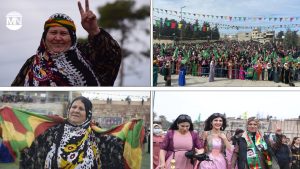
Women across North and East Syria (Rojava) celebrated International Women’s Day with mass gatherings in major cities, reaffirming their role in shaping the future of the region. Since 2022, 8 March has been an official public holiday in Rojava, with all institutions and departments closed for the occasion.
Thousands of women gathered in Kobani (Kobanê), a city that has become a symbol of resistance and victory against ISIS as well as a focal point of Turkey’s aggression, to celebrate International Women’s Day. The event, held at Martyr Egîd Square, came just a month after the 10th anniversary of Kobani’s liberation, marking a decade since the city’s historic defence against ISIS. The celebration highlighted the resilience of women in the region under the slogan “Towards a democratic Syria with the philosophy of ‘Jin, Jiyan, Azadî’”.
Addressing the crowd, Autonomous Administration of North and East Syria (AANES) Foreign Relations Department Co-Chair Ilham Ahmed drew attention to the shared struggle and fate of all women. “The voices rising from this square today are the voices of all Syrian women. The women resisting on the frontlines are fighting for all of us,” she said, underlining the historical significance of the current moment in shaping the region’s future. She paid tribute to those who had lost their lives in the struggle: “If we are gathered here today, celebrating 8 March, we owe it to those who gave their lives for this cause and to the women still resisting on the battlefronts.”
Ahmed also acknowledged the wider context of suffering in Syria, adding:
“We are celebrating here, but in other parts of Syria, massacres are taking place. When women are killed in Latakia and other cities, it feels as though we ourselves are being killed.”
She reaffirmed that women’s struggles and destinies are interconnected, and stressed that the prospective new democratic Syria would only be built up with the struggle of all women:
“Wherever they are, women’s fate is one and the same. The voices rising here are the voices of all Syrian women. Those resisting on the frontlines are fighting for every woman in Syria. A Syria where children and society are free, where women and men are equal, is only possible through the struggle of free women.”
In Aleppo (Helep), women saluted the resistance on the frontlines of Tishreen (Tişrîn) Dam and Qara Quzak (Qere Qozaq) Bridge, which has been ongoing since 12 December against the aggression of Turkey and its proxies. Members of the Kongra Star women’s movement, the largest umbrella organisation in the autonomous region of North and East Syria, noted the importance of the ideas of Kurdish leader Abdullah Öcalan in shaping women’s resistance, and said that the Kurdish struggle had rewritten the history of women’s liberation.
In Hasakah (Hesekê), thousands of Kurdish, Arab, Assyrian and Armenian women gathered from across the region, including participants from refugee camps. A speaker from the Democratic Union Party (PYD) described Öcalan’s prison as “a space of life, peace and equality,” and called for greater unity among women to build a free Syria.
The Qamishli (Qamişlo) event saw women from several towns gathering in the city’s Newroz Square. A leading member of Kongra Star linked the celebrations to Öcalan’s recent peace message, and said that this year’s 8 March marked a renewed commitment to resistance. Another speech condemned the recent massacres of Alevi communities in Syrian coastal regions, linking them to broader patterns of oppression.
In Raqqa (Reqa), women gathered in the city’s municipal stadium, where speakers honoured fallen women fighters and highlighted the importance of defending the gains of the women’s revolution. The event featured music, dance and messages of solidarity with women struggling worldwide.
Meanwhile, the Women’s Protection Units (YPJ) marked the day with a military ceremony attended by women’s defence forces from across the region, including Armenian, Yazidi and Syriac women’s units. The ceremony honoured past and present women fighters, reaffirming their commitment to resisting occupation and oppression.
Across all regions, the message was clear: The women’s struggle in North and East Syria is not just about equality, but about shaping the future of the region itself. The day’s celebrations served as a testament to their resilience, their vision for a democratic society and their continued defiance of forces seeking to erase their gains.