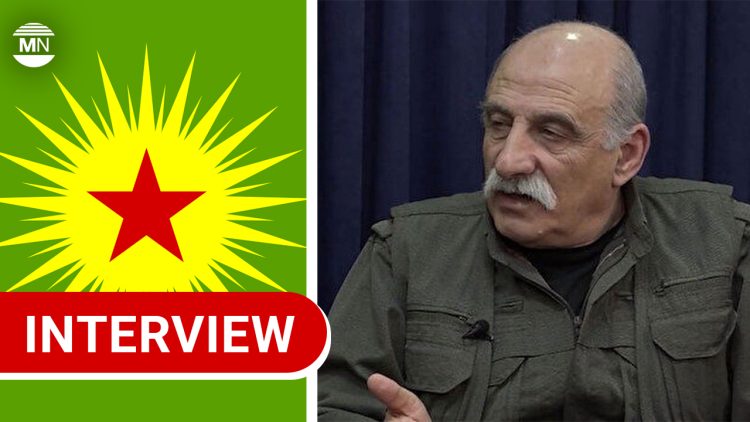
Although three recent visits allowed to to Abdullah Öcalan in İmralı Prison have sparked renewed debate over a political and democratic solution to the Kurdish question in Turkey and signalled a break in the long-standing isolation imposed on the Kurdish leader, there has been very little practical change in policy, noted Kurdistan Communities Union (KCK) Executive Council member Duran Kalkan.
Kalkan was clear in cautioning that despite the increased public discussion, no concrete steps have emerged from official government channels. “There has been a public statement, and Öcalan’s message was conveyed,” Kalkan said, referring to the December meeting by a delegation from the Peoples’ Equality and Democracy (DEM) Party. “But apart from what we have read in the press, no further information has reached us. We do not know the content of the ongoing discussions; we only know that no real, practical steps have followed.”
“Öcalan said that if the torture and isolation system at İmralı is abandoned, if he reaches free living and working conditions, then he can play a role. In the current situation, he cannot. Nothing he says can be published without risking criminal charges.” – Duran Kalkan, KCK
Kalkan was clear that Öcalan’s ability to play a constructive role depends on lifting the stringent conditions of his detention. He argued that Turkey’s ruling circles, especially the Justice and Development Party (AKP) administration, have yet to show any substantive shift in policy or practice.
“Öcalan said that if the torture and isolation system at İmralı is abandoned, if he reaches free living and working conditions, then he can play a role,” Kalkan emphasised. “In the current situation, he cannot. Nothing he says can be published without risking criminal charges.”
“They must create the conditions for him to be able to speak. They must pave the way for him to do politics. Officials continue to talk the talk on the Kurdish issue, but they need to take real action.”
Kalkan directly challenged government officials and political figures who suggest that it is possible for Öcalan to address parliament directly or participate in politics, saying: “They must create the conditions for him to be able to speak. They must pave the way for him to do politics.” Kalkan also credited the campaign “Freedom for Abdullah Öcalan – a Political Solution to the Kurdish Question”, which has mobilised international support to end the isolation imposed on Öcalan and prompt negotiations. He attributed the prison visits to worldwide advocacy and urged continuing pressure:
“The global freedom campaign has already produced important results. A breach has been opened in the total isolation. But we need to keep struggling – more, and with more creative methods.”
While discussions about democratisation and a negotiated settlement have intensified, Kalkan noted that the Turkish government’s actions have largely not matched its rhetoric. He pointed to ongoing arrests, forced trustee appointments, and escalating economic hardships in the country.
“Officials continue to talk the talk on the Kurdish issue, but they need to take real action,” Kalkan stated. “If they’re serious about a solution, they need to walk the walk, not just make statements. Otherwise, their credibility is at stake.”