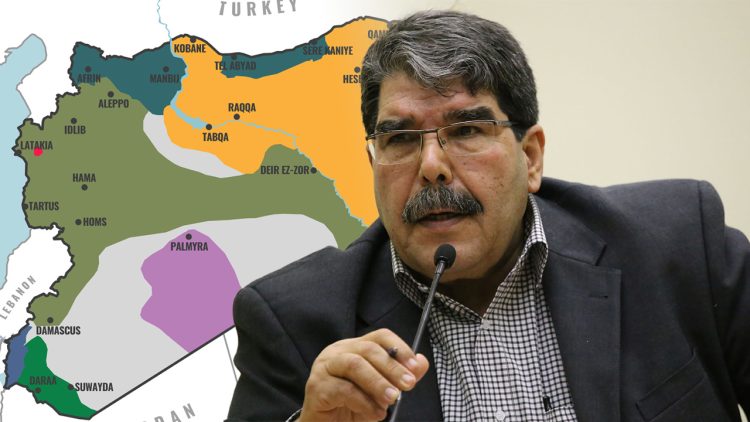
Salih Muslim, a senior official of the Democratic Union Party (PYD), warned that Turkey’s recent diplomatic engagements with Syria could marginalise Kurdish gains and escalate regional tensions. Speaking in an exclusive interview with Delal Akyüz of Mezopotamya Agency on Wednesday, Muslim stressed that the Kurdish-led Autonomous Administration in North and East Syria (AANES) seeks to be part of Syria’s political solution.
Muslim’s remarks come amid shifting dynamics following attacks by Hay’at Tahrir al-Sham (HTS) that led to the collapse of Syria’s 61-year-old Baath regime. Turkey responded quickly, establishing contact with HTS leader Ahmad al-Shara through high-level visits. Turkish intelligence chief İbrahim Kalin visited Damascus on 12 December, followed by Foreign Minister Hakan Fidan on 22 December.
According to Muslim, Ankara’s strategy aims to isolate Kurdish groups and prevent any formal engagement between the Syrian government and the Autonomous Administration. Muslim said Turkey is urging Damascus to reject any dialogue with the Kurds and block relations with the Autonomous Administration. He accused Turkey of pursuing neo-colonial ambitions reminiscent of France’s past mandate over Syria.
Muslim criticised Ankara’s claims of promoting Syrian stability, arguing that Turkey labels Kurdish defence forces like the Syrian Democratic Forces (SDF), People’s Protection Units (YPG), and Women’s Protection Units (YPJ) as terrorists to justify intervention. Turkey uses the pretext of counter-terrorism to control Syria. Their policies are unacceptable to both the Syrian people and the region, he stated.
Highlighting the origins of Kurdish defence forces, Muslim said these groups emerged after 2011 to protect civilians against attacks. Muslim asserted that Kurdish forces were formed to defend their people and gains, and disarmament is only possible if threats are removed and safety is guaranteed.
While HTS has not clashed directly with Kurdish groups, Muslim acknowledged ongoing communication. HTS claims it will not target Kurds, and so far, they have kept that promise. They also advocate unifying Syria’s armed groups, which ‘we do not oppose in principle’, Muslim explained.
He indicated that HTS leader Abu Mohammad al-Julani opposes Turkish-backed groups and seeks to dismantle them. Muslim added that if Turkey halts its intervention and divisive policies, common ground could be found with HTS.
Muslim revealed that discussions with the Kurdish National Council in Syria (KNCS, also known by the acronym ENKS) continue, despite Turkish efforts to obstruct Kurdish unity. He said they are committed to achieving Kurdish unity and addressing shared goals.
Expressing hope for future negotiations with Damascus, Muslim advocated a collaborative approach to drafting laws and addressing disputes. Muslim concluded that they are part of Syria and want to be involved in the political process, adding that dialogue remains the healthiest path forward.