

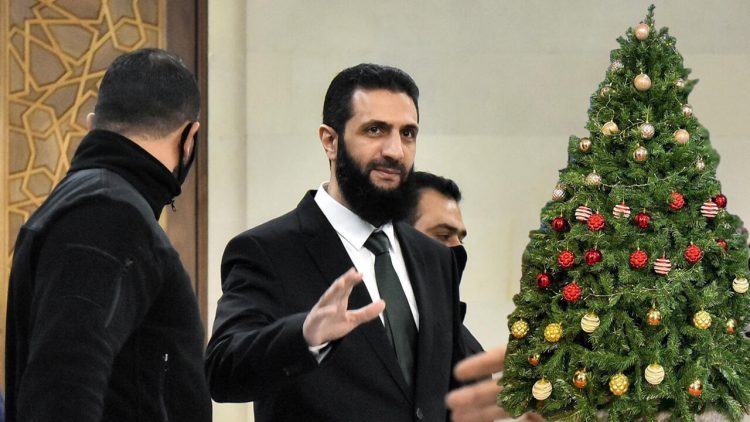
In a move to reassure religious minorities, Syria’s new government has declared Christmas a public holiday, announcing the closure of government offices on December 25th and 26th. This decision follows the recent burning of a Christmas tree in the predominantly Christian town of Al-Suqaylabiyah near Hama, an act attributed to foreign fighters from the extremist group Ansar al-Tawhid, linked to al-Qaeda.
Protests erupt in Christian areas of Damascus after Christmas tree burned
The incident, captured on video and widely circulated online, has intensified concerns among Syria’s Christian communities about their safety under the new leadership of Hayat Tahrir al-Sham (HTS), a former al-Qaeda affiliate that led the coalition overthrowing Bashar al-Assad earlier this month. HTS officials condemned the attack, promising swift justice and the restoration of the tree.
Despite these assurances, many Christians remain apprehensive. Church leaders have advised congregants to scale back Christmas celebrations, reflecting deep-seated fears stemming from years of civil war and the recent regime change. Reports of attacks on Christian sites, such as the assault on a Greek Orthodox church in Hama, and intimidating displays by jihadist groups in Damascus have further exacerbated these concerns.
HTS leader Ahmed al-Sharaa, formerly known as Abu Mohammad al-Jolani, has pledged to protect all religious groups and build an inclusive Syria. However, the Christian population, which has significantly declined from about 2 million before the civil war to between 300,000 and 900,000 today, remains skeptical of these promises.
The declaration of Christmas as a public holiday is seen as a gesture to build trust with religious minorities. However, the recent attacks and ongoing fears highlight the challenges the new government faces in ensuring the safety and inclusion of all communities in Syria.


