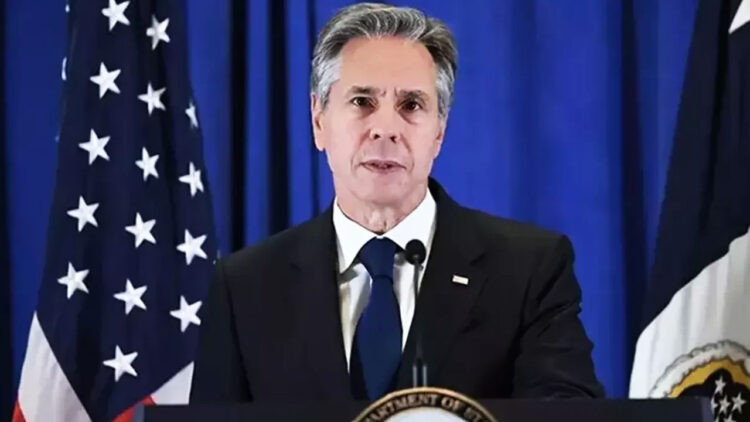
Following its key role in the recent overthrow of Syrian President Bashar al-Assad, the United States has engaged in direct communication with Hayat Tahrir al-Sham (HTS), a group designated as a terrorist organisation, US Secretary of State Antony Blinken announced on Saturday. Speaking in Aqaba, Jordan, Blinken described this as a pivotal moment for Syria, undergoing its most significant transformation in many years after over five decades of dictatorship under Assad.
“Less than a week ago, Bashar al-Assad fled Syria, ending more than five decades of dictatorship. Syria has changed more in less than a week than in any week this last half-century,” Blinken declared at a press conference alongside counterparts from eight Arab nations, Turkey, the European Union and the United Nations.
The Biden administration’s confirmation of direct talks with HTS marks the first public acknowledgment of these interactions. HTS, which once had ties to al-Qaeda, has sought to distance itself from its extremist roots and is working to establish itself as a governing authority in Damascus. While Blinken withheld details of the US-HTS contact, he highlighted the importance of discussing governance and the group’s role during Syria’s transitional period.
“Our message to the Syrian people is this: We want them to succeed – and we’re prepared to help them do so,” Blinken said. Ahmad al-Sharaa aka Julani, the leader of HTS, stated in a televised interview that the group aims to avoid further conflict, pointing to widespread exhaustion in the country after years of war.
The fall of Assad’s regime has opened the door for sweeping political and social changes in Syria, but challenges remain significant. Blinken stressed the urgent need for humanitarian aid, noting severe shortages of fuel, wheat and other essentials. He pledged continued US leadership in aid efforts, stressing the need for cooperation with the United Nations and regional partners. “The humanitarian needs of the Syrian people are massive,” he said, urging other nations to increase their contributions to help stabilise the country.
Despite the progress, threats persist. Blinken highlighted the risk of extremist groups like ISIS exploiting the current instability. Praising the Kurdish-led Syrian Democratic Forces (SDF) for their efforts against ISIS, he stressed the importance of maintaining their role in securing detention facilities holding thousands of foreign fighters and preventing a resurgence of extremist activities. “The success that we’ve had in ending the territorial caliphate of ISIS remains a critical mission,” Blinken said.
International representatives in Aqaba agreed on a framework to guide Syria’s transition. The principles include respect for minority and women’s rights, securing chemical weapons stockpiles, and ensuring Syria does not serve as a base for terrorist activities. Blinken acknowledged the collective nature of these commitments, stating, “No one has any illusions about how challenging this time will be, but there’s also something incredibly powerful at work: a Syrian people determined to break with the past and shape a better future.”
He also reiterated the US commitment to securing the release of Austin Tice, an American journalist who disappeared in Syria over a decade ago. “We have impressed upon everyone we’ve been in contact with the importance of helping find Austin Tice and bringing him home,” he said.
In the streets of Syria, public celebrations, volunteer efforts and a sense of newfound freedom signal hope for a better future. Demonstrations in mosques and public squares, including thousands gathering in the Umayyad Mosque in Damascus, highlight the determination of Syrians to rebuild their nation. Volunteer groups delivering food and medicine and the raising of the Syrian revolution flag by the SDF reflect a shared commitment to unity and recovery.
This historic moment presents both immense opportunities and great challenges to Syria’s people and their international partners. As Blinken stated, “Today’s agreement produced real progress toward that shared goal. The Syrian people are showing the world their resilience and vision for a better future, and we are committed to standing with them.”