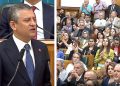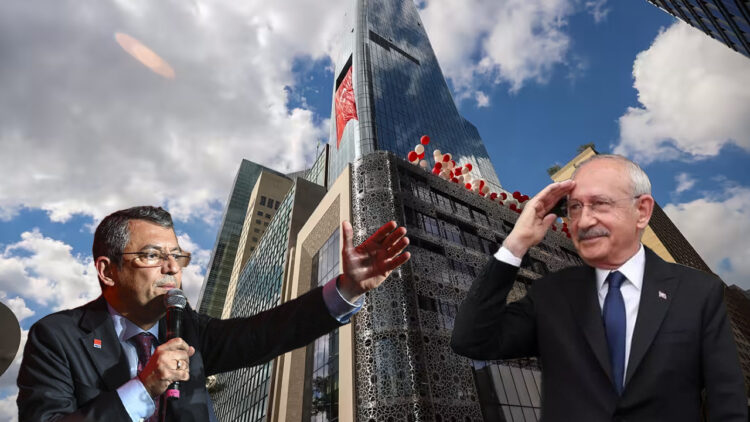
Tensions within Turkey’s main opposition Republican People’s Party (CHP) have escalated following a public dispute between the party’s former and current leaders, Kemal Kılıçdaroğlu and Özgür Özel. The dispute centres on Özel’s remarks about the major bribery scandal known as the Türkevi scandal, with Kılıçdaroğlu accusing Özel of whitewashing corruption under the guise of “normalisation” with the ruling Justice and Development Party (AKP).
On 27 September, Özel visited the Türkevi, a Turkish consulate building in New York, which has become embroiled in allegations that New York Mayor Eric Adams accepted bribes to facilitate its opening. During his visit, Özel defended Turkey, with the remark, “Turkey does not need to resort to bribery” to construct such a building. His comments were seen by many as downplaying the bribery allegations, and sparked criticism that the CHP, under Özel’s leadership, was aligning too closely with the AKP’s foreign policy approach.
Kılıçdaroğlu, who led the CHP until earlier this year, took to social media to voice his disapproval. He stated: “The CHP is not a party that whitewashes bribery or legitimises those involved in corruption. Our responsibility is to hold the government accountable, not to turn a blind eye to its wrongdoings.” While Kılıçdaroğlu did not mention Özel by name, the criticism was widely interpreted as being directed at his successor.
This internal rift has exposed deeper concerns within the CHP about its direction and strategy, particularly when it comes to foreign policy. Özel’s visit to the Türkevi building came at a politically sensitive moment, as the bribery allegations surrounding its opening had just emerged. Critics argue that, by failing to distance the party from AKP policies, Özel’s comments risk undermining the CHP’s position of strength as opposition to the government of President Recep Tayyip Erdoğan.
Reha Ruhavioğlu, Director of the Kurdish Studies Center and Kurd Barometer, highlighted three key mistakes made by Özgür Özel in relation to the Türkevi controversy.
First, he noted that the Türkevi building represents an international extension of AKP party politics, and it was the CHP itself that had previously raised concerns about the flow of money involved in its construction. According to Ruhavioğlu, Özel’s visit to the building — just as the bribery accusations were circulating in Turkey — was a significant misstep.
Second, Ruhavioğlu noted that by not recognising the visit as a miscalculation, Özel was giving the impression that although the AKP is a rival within Turkey, it is a partner abroad, a stance that overlooks the fact that the AKP’s approach to solving problems remains the same whether on the domestical or the international front. He criticised Özel for not distinguishing between Turkey as a nation and the actions of the government, especially given the involvement of bribery in the Türkevi scandal.
Lastly, Ruhavioğlu pointed out that Özel’s insistence on continuing to use the Türkevi building for CHP events could tarnish the party’s reputation internationally, and allow the AKP to claim the building as a domestic success. “The CHP seems to be following the AKP’s partisan foreign policy line, rather than developing its own independent approach,” he said, warning that failing to present a distinct foreign policy could lead to a erosion of trust both at home and abroad.
Political analysts are now speculating on how this division will affect the CHP moving forward. The party, which has long positioned itself as a check on the ruling AKP, faces growing scrutiny over whether it can present a distinct and credible alternative to the government, both in domestic affairs and on the international stage.