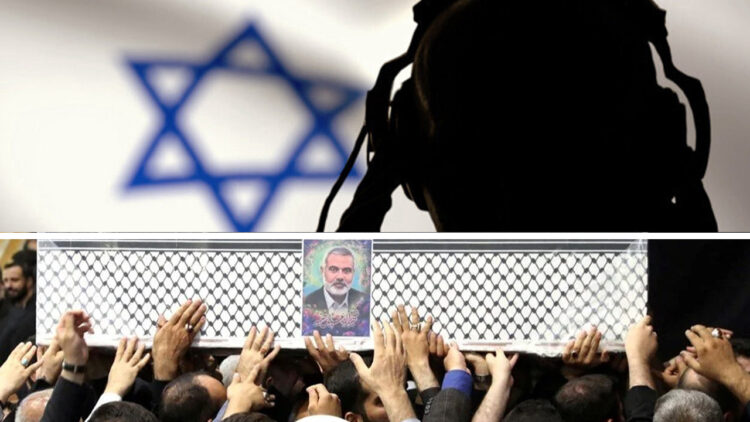
The killing of Ismail Haniyeh, the head of Hamas’ political office, in the highly secure Sa’ad Abad Palace complex in northern Tehran during the early hours of Wednesday 31 July, has reignited concerns about the penetration of Iran’s military-security apparatus by Israeli intelligence agencies.
Experts assert that his assassination in the building reportedly belonging to the Revolutionary Guards epitomises Mossad’s extensive operations, from assassinations to document theft and sabotage of Iran’s nuclear facilities.
The newspaper Jomhouri-e-Islami highlighted the presence of Israeli infiltrators in Iran, stating that the assassination of Haniyeh in his own bedroom indicates that Israel has “infiltrators within our ranks”.
This likely accounts for Ayatollah Khamenei’s visibly uneasy demeanour during Haniyeh’s funeral at Tehran University on 1 August, where his constant glances at the ceiling and surroundings surprised many.
Three years ago, Ali Younesi, former Minister of the Iranian Intelligence Service during the reform period and advisor of former President Rouhani, issued a stark warning in a controversial interview. He warned Iranian officials of Mossad’s deep infiltration, stressing that its reach in Iran’s security and political sectors posed a lethal threat, exacerbated by rivalries among Iran’s intelligence agencies.
Mahmoud Ahmadinejad, former president of Iran, had revealed shortly before Younesi’s speech that the individual tasked with countering Israel in the Ministry of Defense was, in fact, an Israeli spy.
Over the past decade, until 31 July, numerous assassinations and acts of vandalism have occurred in Iran’s security and missile centres in Tehran, a city heavily monitored by security cameras. Notable incidents include the theft of nuclear documents in Torquzabad on 31 January 2018, and the assassination of Mohsen Fakhrizadeh, head of the Research and Innovation Organisation of the Ministry of Defense, on 27 November 2020.
In the Torquzabad operation, Mossad managed to steal 55,000 pages of important nuclear documents and digital files on 183 CDs by breaking into 32 safes, 20 kilometres southwest of Tehran. General Mohsen Rezaei, a former commander of the Iranian Revolutionary Guards Corps, remarked that “Iran has encountered a widespread security problem, exemplified by three security incidents in less than a year: two explosions and an assassination.”
The 2020 assassination of Mohsen Fakhrizadeh, a pivotal figure in Iran’s nuclear weapons program, was executed with the assistance of an Iranian armed forces member, according to then-Minister of Information Mahmoud Alavi.
Following the assassination of Fakhrizadeh, Israel continued its direct attacks on Iran’s nuclear facilities, including a key Defense Ministry complex in Isfahan, in February 2023.
Given the background of Israeli intelligence infiltration in Iran, Abdolreza Davari, a former advisor to President Mahmoud Ahmadinejad, noted on X:
“An Israeli account provided detailed information about the ‘Imam Ali Camp in Sa’ad Abad region’ three years ago.” According to this Iranian security official, Haniyeh’s assassination team had precise knowledge of his route and residence. Media News reported Haniyeh’s location and murder before the Iranian government announced it.