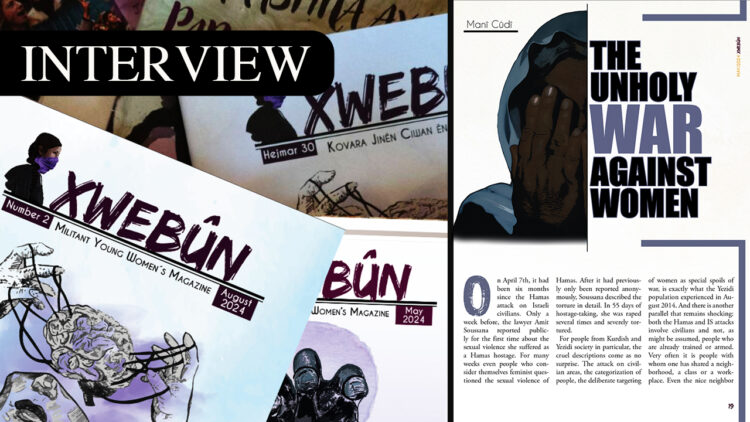
As the International Day for the Elimination of Violence against Women on 25 November approaches, Medya News wants to give special importance to the situation of young women nowadays. To dive deep into the reality that young women are faced with today, Medya News conducted an interview with Ronahî Kılıç, member of the editorial board of the ‘Xwebûn’ magazine, a magazine made by and for young women.
The interview is part of our special coverage week ahead of 25 November, which also included an interview with a young woman activist from Colombia, which can be read here.
The Xwebûn magazine is published every three months in English, German, Kurdish, French and Turkish and covers a range of issues affecting young women. In our interview, Kılıç explains issues such as militarisation and psychological warfare and their impact on young women, and calls on young women to organise themselves to develop a collective response to the different forms of violence they face.
Read the full interview, slightly edited for clarity, here:
Medya News: Could you introduce yourself? What is your background?
Ronahî Kılıç: My name is Ronahî Kılıç. I am part of the Xwebûn Committee. I came to Germany from Amed [Diyarbakır] with my family, when I was a child. So I mostly grew up there. I found out about the Xwebûn magazine at university, where I study social sciences. I read one of the first published magazines and decided to contact the committee afterwards, which is how I got involved.
What is the aim and target audience of Xwebûn magazine?
The Xwebûn magazine is from young women for young women. As we combine both of these specific identities in us – both as youth and as women – with the magazine we aim at opening topics that relate to young women. By understanding difficulties that we face in life, by opening these topics we can give meaning to them and find solutions. The magazine helps us learn to struggle against the capitalist system and build a free personality and a free life. But anybody is welcome to read the magazine. Understanding the attacks of the capitalist system on young women and seeing their reality is essential for everybody trying to build a democratic society.
Can you explain to us what the meaning of the word ‘Xwebûn’ is?
Xwebûn is Kurdish and literally speaking means “being (bûn) oneself (xwe)”. Finding back to our roots, learning our history, thinking, acting and feeling freely – without the influence of patriarchal or capitalist thoughts.
In a recent issue of your magazine, entitled ‘Cutting the ropes of Violence’, you discussed militarism and how it affects young people, especially young women. On the eve of 25 November, the International Day for the Elimination of Violence against Women, how do you link the rise of militarism in society to violence against (young) women?
In the midst of the Third World War, we recognise that both the physical attacks, especially in the Middle East and particularly in Kurdistan, are intensifying as the centres of this war. Today, psychological warfare is being used in an increasingly targeted manner to prevent uprisings, revolutions and changes to the capitalist nation-state system. The hegemonic nation states want to deepen the violent ulcers of sexism and fascism through the militarisation of society and allow them to proliferate within us. This is how they will be able to influence or even manipulate society, as the root of capitalism as well as fascism is patriarchy. A man that has a patriarchal way of thinking will try to establish dominant relationships and control society. A woman that is influenced by the patriarchal way of thinking will underthrow herself to the man and the state. When looking at militarisation, it is about building hierarchies and an obedient society. To implement militarisation, methods of patriarchy are used – physically as well as psychologically. This is why violence like feminicides are increasing drastically especially in the past months. The war is led by hegemonic states but it is our blood that is spilled. This is why 25 November is also a day to stand up against militarisation.
In your recently published magazine “Brave New World” you talk about psychological warfare and its effects on young women. How do you define psychological warfare?
Our brain is the control centre for all our actions. Whether we are thinking, talking, drinking, eating or making life-changing decisions, our brain controls this. We don’t engage with this control centre enough ourselves, but others do more than we think. From a simple advertising industry to war strategists, the human brain is being researched in order to consciously control it.
We often think we do things because we want to. But is that really the case? Can we really be sure that our thoughts are not influenced, controlled or even directed? Can we be sure our feelings are really our own? When actors like capitalist states or firms or other actors try to influence and manipulate us for their own purposes, we reference to this kind of war as cognitive warfare (1). NATO openly states one of their operating fields is cognitive warfare. We often do not pay attention but one of the main strategies to direct society is cognitive warfare. This for example happens through nudges (2).
Which violence do young women experience in Europe?
In Europe we face physical attacks and psychological attacks on our will and hope. The capitalist system aims at dulling us, capturing our feelings. We are supposed to see no hope in true change. This is how the system hopes to condemn any action young women may take against the system. On the other hand, as women we also face verbal, physical attacks on regular basis.
How can young women organise themselves against the violence they face?
Organising starts by meeting other young women, discussing problems and finding solutions. Furthermore, it means embodying collective thoughts, feelings, and will. It requires us to recognise that an attack on one is an attack on all and that our struggles must resonate for the entire community, not just the individual. When we view ourselves as part of the organised women’s struggle, we become acutely aware of our shared responsibility. Every action we take is not just for ourselves but for all women, infusing our efforts with greater significance.
Organisation is the essence of our existence. It brings our strength and vitality to the forefront. Without organisation, we risk being swayed by external influences, which can be perilous. Conversely, when we are organised and in control of our thoughts and actions, we contribute meaningfully to the flow of life.
What is your final message?
Rêber Apo [Abdullah Öcalan] emphasises that our lives must be built upon the foundation of struggle. It is imperative that we know what we are fighting for. The principles we uphold build upon one another: with free thought and will, and through organisation, we gain insight into our battles. To break free from the confines of our existence, we must engage in the struggle continuously. This fight begins within ourselves, as we strive to overcome outdated feelings such as jealousy and self-doubt, making way for broader, more profound emotions. We also grapple with those around us, understanding that we fight for freedom together. Engaging with our comrades requires us to navigate the patriarchal and capitalist tendencies within them, striving to liberate them from the aspects of their personalities that confine them. Our love for one another motivates this fight, as we seek a shared freedom. As women in search of a free identity, we must embrace organised struggle to protect our existence and build a liberated life. The extent to which our thoughts and will are free is directly proportional to our commitment to the fight for freedom. A person who believes in something and understands what they desire will fight relentlessly to achieve it. To go out to demonstrate on 25 November can be a start or a continuation of the fight, but it is not the end.
1 ‘Cognitive warfare‘ by Jonas Togel
2 A nudge, as we will use the term, is any aspect of the choice architecture that alters people’s behaviour in a predictable way without forbidding any options or significantly changing their economic incentives. Nudges are not offıcial mandates. Putting fruit at eye level counts as a nudge. Banning junk food does not.