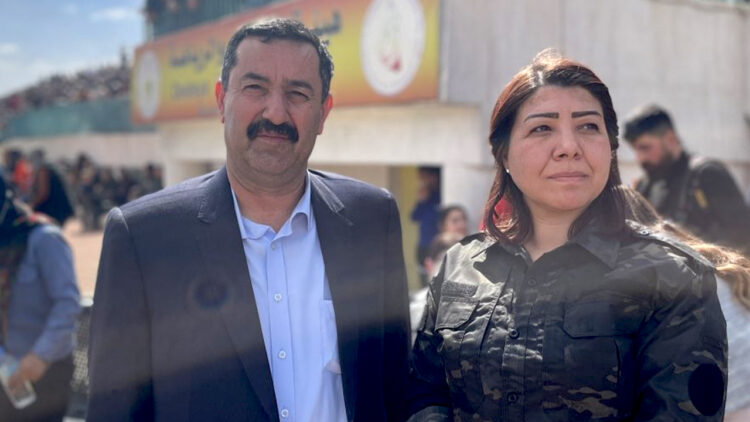
A new report by the Wilson Centre examines the unique model of women’s political leadership within the Autonomous Administration of North and East Syria (AANES). Based on an in-depth survey of 31 women co-chairs in the region, the report, titled A Model for Gender Equitable Leadership in Northeast Syria and co-authored by Meghan Bodette and Arras Yussef of the Kurdish Peace Institute, highlights how gender parity in political leadership has been pivotal in advancing the region’s goals of women’s emancipation and broader social reform. However, the report also addresses challenges posed by entrenched societal norms and conservative opposition.
The report was published under the Middle East Women’s Initiative, part of the Middle East Program, and emphasises the unique nature of the governance model in the AANES. Since its establishment, the administration has implemented a co-chair system mandating every leadership position to be shared equally by one man and one woman. This system is hailed as a transformative step toward gender equity in one of the most conflict-ridden regions of the world.
The survey highlights the dual realities faced by women co-chairs. While 68% reported being respected as leaders by their male colleagues, societal attitudes remain mixed. 35% of respondents felt that their constituents treated them equally to their male counterparts, but 16% reported facing overt inequality rooted in traditional stereotypes that question women’s capability. “Women co-chairs believe that the system is broadly respected in practice, though there is still progress to be made,” the report finds.
The model of female representation at the highest levels of governance right down to the local commune is all the more remarkable since globally, women remain underrepresented in political leadership. According to UN Women, as of October 2024, women hold only 23.3% of cabinet positions and 26.9% of parliamentary seats, with just 19 women serving as heads of state. At the current pace, it could take 130 years to achieve global gender parity in political leadership.
In contrast, AANES offers a rare model where women share equal power by design.. As one respondent noted, some constituents even preferred her leadership: “Other times, they prefer talking to me, because I’m faster in solving their problems and getting things done.”
The report also highlights the critical role of real-world experience in preparing women for leadership. Nearly 90% of co-chairs said they gained knowledge of the co-chair system through practical involvement in AANES institutions, rather than formal training or ideological study. “When I was elected to be the co-chair of [my institution], I realised that theory is not like practical life,” says another respondent to the survey. “I worked very hard to play my role fully as a woman co-chair who wants to implement justice and democracy and wants to show women’s will.”
Twelve years after its inception and eight years since its formal institutionalisation, the report’s authors argue that the co-chair system has achieved notable success in ensuring gender parity in leadership across nearly one-third of Syria. However, the report acknowledges persistent barriers, including centralised decision-making and remnants of patriarchal attitudes.
In conclusion, the report’s authors write, “The model requires men and women to work together, but more fundamentally, it requires two different people with different backgrounds and opinions to come to consensus and share power. Lessons learned from the co-chair system could help strengthen local democratic processes in the northeast and all of Syria.”