

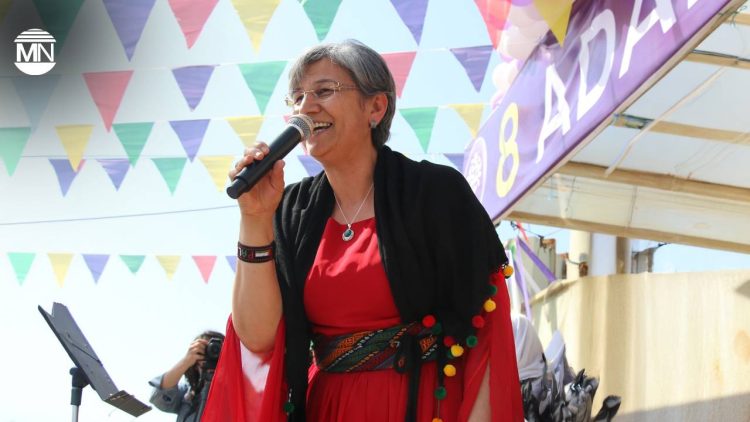
Leyla Güven, former co-chair of the Democratic Society Congress (DTK) and currently imprisoned in Ankara’s Sincan Women’s Prison, has released a powerful statement marking 8 March, International Women’s Day, structured around six key themes.
Freedom is awareness
Opening with the words “Freedom is awareness”, Güven writes:
The true liberation begins when women recognise their unique value and potential. Women, she writes, are engaged in a unique struggle because they are not only deeply aware of their own identities but also acutely conscious of the inequalities that pervade society. Identifying the root causes of women’s rebellion in the oppressive policies of capitalist modernity, she describes these systems as monolithic, nationalist, religious, and sexist.
These structures, she insists, have pushed women to a breaking point. “Women have preferred to be angry rather than sad,” she writes, rejecting the “organised lies” of patriarchal systems and choosing instead to embrace anger as a catalyst for change.
Emphasising the necessity of radical solutions and self-defense in the face of systemic oppression, Güven calls on women to reject passivity and take an active role in shaping their futures. “Rather than listening to the male-dominated mindset, women have chosen to set out on the path guided by the wisdom of women,” she declares. In this way, women are emerging as leaders of change, poised to redefine the struggle for justice and equality.
Women as architects of the future
In another part of her letter on 8 March, Güven addresses women in Palestine, Afghanistan, Ukraine, and other regions facing oppression. She believes that women must lead the call for peace and the creation of a democratic society. For Güven, the leadership of the women’s movement is essential to securing peace and democracy. She calls for immediate mobilisation to counteract patriarchal distortions and urges solidarity with women in Palestine, Afghanistan, Ukraine, and beyond.
Economic expansion, ecological collapse
While economies grow, ecosystems collapse. Güven highlights how financial survival and environmental destruction have become inescapable realities, trapping people in an unsustainable cycle. Migration and crime feed off one another while global uncertainty fuels anxiety. She insists that the only force capable of interrupting this trajectory is women’s leadership. However, solutions cannot emerge from the same mindset that created these crises. Instead, women must reject nationalism, religious fundamentalism, and the corrupting influence of power.
Güven underscored the rise of far-right female leaders in Europe as a development requiring urgent sociological examination. While women’s political participation has historically been associated with progressive movements, the current landscape reveals a paradox. The resurgence of nationalism and xenophobia, often spearheaded by women, calls into question the erosion of ideological coherence in contemporary politics. If ideology is truly “dead”, as some argue, then the role of women in reviving reactionary politics demands critical attention.
Radical strategies and women’s self-defence
Güven contends that:
The issue is not individual men but the patriarchal system that sustains them. She argues that radical strategies, including self-defence, are not merely an option but are imperative in the fight against systemic violence. Women must assume the roles of informers, organisers, and agents of transformation.
In continuation, she believes that as half of the world’s population, women hold the power not only to challenge oppressive structures but also, when necessary, to dismantle the very foundations that perpetuate inequality.
The need for a new feminist discourse
Güven critiques the ruling elite, arguing that they will stop at nothing to preserve their interests. If patriarchal institutions function as weapons against women, then women must become the frontline of resistance. This requires the development of a new language, strategy, and vision for the feminist movement. She warns that the patriarchal system continues to underestimate the potential of women’s collective power.
Turning despair into hope: The strength of women’s solidarity
The struggle continues against forces that seek to rob women of their dreams, futures, and happiness. Güven invokes the saying, “It is better to die on one’s feet than live on one’s knees,” underscoring the urgency of women’s fight for dignity. Women are not mere “branches and leaves” to be discarded; they are the creators of life itself. The growing global solidarity among women is proof that their movement is unstoppable.
In the final part of her message commemorating 8 March, Leyla Güven reflects on the young girls who lost their lives under the oppressive conditions of an unjust society. She speaks passionately about her own hopes, and those of women everywhere, for a life grounded in democracy and freedom.

Inspired by the philosophy of Abdullah Öcalan, the imprisoned Kurdish leader, and his word to “give meaning to life”, Güven concludes her letter with a poignant declaration:
"Though we are confined within prison walls, our spirits will be present wherever 8 March is celebrated."
Güven, a former member of Turkey’s parliament and co-chair of the DTK, was arrested in January 2018 following the launch of Turkey’s military offensive in Afrin, northeastern Syria.
A prominent women political activist, Güven began a hunger strike in prison in November 2019 to protest the severe isolation imposed on Abdullah Öcalan. Despite a Turkish court ordering her release after 79 days of her hunger strike, Güven chose to continue her protest, demonstrating her unwavering commitment to the cause.


