

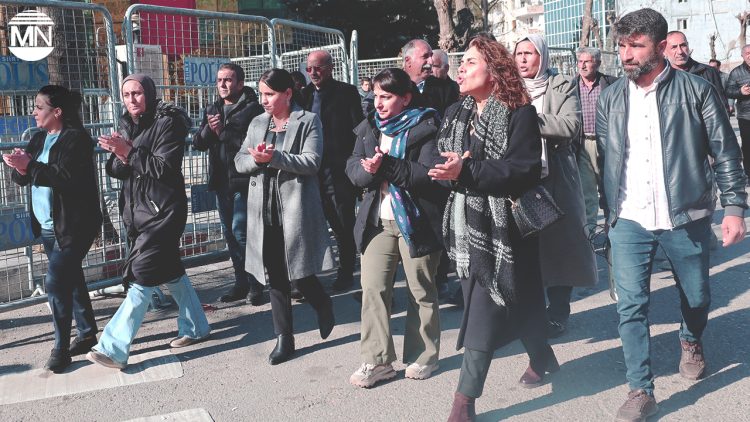
“Why hold elections if you refuse to accept the results? The government is seizing municipalities because it cannot stomach the outcome,” said co-mayor of Turkey’s southeastern city of Siirt (Sêrt) Sofya Alağaş, after the Interior Ministry removed her from office and appointed a government trustee on Wednesday.
The decision to depose the mayor came 24 hours after a court in Diyarbakır (Amed) had sentenced her to six years and three months in prison on a charge of ‘terrorist organisation membership’. The ruling, delivered by Diyarbakır Heavy Penal Court No.5 on Tuesday, was followed swiftly by a police operation surrounding the premises of Siirt City Council early on Wednesday morning. Officers blocked access to the building while the government-installed trustee took office.
Pro-Kurdish Peoples’ Equality and Democracy (DEM) Party co-mayor Alağaş, who was elected in 2023, said the government’s decision was politically motivated. “This was all premeditated. They handed down the verdict just to justify the trustee appointment. They had everything ready in advance,” she told independent news outlet Artı Gerçek.
The move sparked outrage among residents in the city, with crowds gathering outside the council buildings to protest what they called an attack on democracy. Police detained at least three people as demonstrators chanted, “The trustee is a coup! No to the coup!”
The removal of Alağaş is the latest in a series of trustee appointments targeting pro-Kurdish mayors in Turkey. Since 2016, the government has dismissed dozens of mayors from the DEM Party and its predecessors, accusing them of links to the Kurdistan Communities Union (KCK) and the Kurdistan Workers’ Party (PKK), which Turkey classifies as a terrorist organisation.
Alağaş’s case was linked to her previous career as a journalist, during which she reported extensively on human rights violations in Turkey’s Kurdish-majority provinces. “Justice in this country only serves the government,” she said, adding that her trial was rushed to provide legal cover for the removal.
Her lawyer, Resul Tamur, criticised the judicial process, stating, “It is clear that political pressure has accelerated this case. What began as a trial against a journalist was fast-tracked once she became a mayor.”
By 6am local time on Wednesday, police had cordoned off the council buildings in Siirt. According to Alağaş, authorities gave notice of her dismissal only after law enforcement had already secured the area. “They surrounded the council premises before even informing us. The court decision wasn’t about justice—it was about taking control,” she said.
Footage from the scene showed a heavy police presence and barricades blocking entry. Eyewitnesses reported that the trustee entered the municipality under police escort, while other officers prevented Alağaş and other city officials from entering the building.
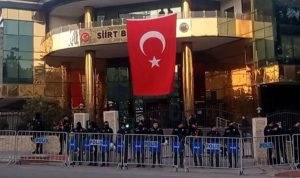
“The usurper walked in shamelessly, as if he had been elected. But he was not chosen by the people of Siirt,”Alağaş said.
Protests erupted in the city following the announcement, with demonstrators holding an impromptu sit-in outside the municipality. “They have stolen this election!” shouted one protester, while others denounced the government’s use of emergency powers to remove elected officials.
The events in Siirt echo previous trustee appointments in Turkey’s Kurdish-majority provinces. The government of President Recep Tayyip Erdoğan has frequently replaced elected mayors with state-appointed bureaucrats, arguing that the councils were being used to funnel resources to the PKK. Critics, however, see it as a systematic effort to dismantle Kurdish political representation.
In her final public address before leaving office, Alağaş referred to Turkey’s history of extrajudicial killings and disappearances, particularly in the 1990s. “We know Newala Qesaba (Butchers’ Creek),” she said, referring to a site notorious for mass graves of Armenians from 1915 and Kurds from the aftermath of the 1980 military coup. “We remember. Our minds are alive, and we will not forget.”
Alağaş vowed to fight her dismissal and conviction in court, stating that she would take her case to Turkey’s Constitutional Court and the European Court of Human Rights (ECtHR) if necessary. “No matter how long it takes, we will exhaust every legal avenue,” she said.
International human rights organisations have repeatedly raised concerns over Turkey’s use of anti-terror laws to silence political opponents. The Council of Europe (CoE) has previously condemned the removal of elected officials without due process, while Reporters Without Borders (RSF) has criticised Turkey’s persecution of journalists-turned-politicians like Alağaş.
The Turkish government has not issued an official statement in response to the protests. Meanwhile, tensions remain high in Siirt, where residents continue to gather outside the municipality, vowing to resist what they call an undemocratic takeover.
Following the 31 March local elections last year, the Turkish government appointed trustees to eight municipalities won by the DEM Party and two held by the main opposition Republican People’s Party (CHP). The first attempt to install a trustee came in Van (Wan), however, public resistance there forced the ruling Justice and Development Party (AKP) to back down. The government has continued to override election results in other municipalities, drawing criticism from opposition figures and rights groups.


