

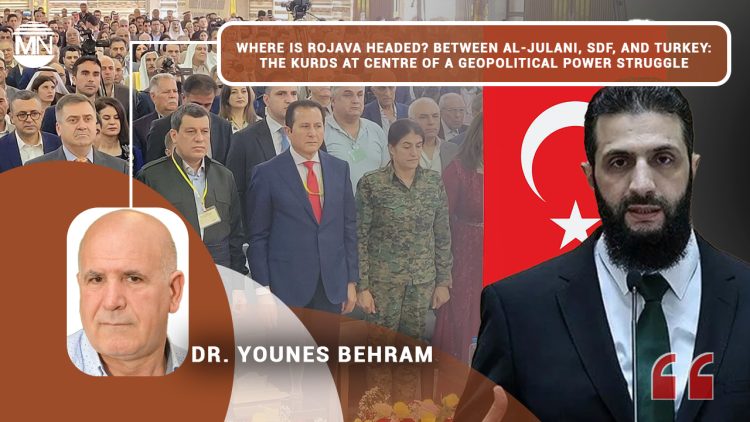
Dr. Younes Behram
Dubious agreements: Legitimising Julani in exchange for crumbs for the Kurds
The reported agreement between the Syrian Democratic Forces (SDF) and the Julani-led Hay’at Tahrir al-Sham could grant the Salafist leader international legitimacy – but the Kurds would receive little more than symbolic concessions in return. Despite this alleged rapprochement, the political reality remains unchanged: administrative and power structures in northern Syria are firmly in the hands of Islamist or pro-Turkish circles.
To this day, not a single Kurdish minister, governor, or even mayor has been appointed. A constitutional reform remains absent – while at the same time, individuals close to Turkey are being appointed to senior positions on a daily basis. Kurdish participation remains purely rhetorical.
Turkey: Ottoman vision as a distraction from internal collapse
Ankara’s aggressive Syria policy cannot be understood independently of its domestic context. Turkey is mired in a deep economic crisis: the lira is falling, inflation is rising, and the ruling Justice and Development Party (AKP) suffered massive losses in the most recent municipal elections. President Erdoğan and his circle are using the Syria card to cover up domestic failures.
The architect of this foreign policy line is Foreign Minister Hakan Fidan – a strategist with a clear Ottoman vision. His goal: to transform Syria in the long term into a neo-Ottoman sphere of influence, where Kurdish existence is tolerated culturally but eliminated politically and militarily.
Tishreen Dam: Economic resources for Julani
Meanwhile, the Tishreen (Tişrîn) Dam on the Euphrates is becoming a strategic centre. After the US withdrew from the Koniko oil field and instead established a base near the dam, the axes of economic power are shifting. Julani, who relies on resources to consolidate his rule, could benefit significantly from this – at the expense of the Kurds and the SDF.
A new theatre of war?
The American presence at the Tishreen Dam could be more than just a restructuring: it could set the stage for a new confrontation – this time between Shiite militias (such as the Iraqi Hashd al-Shaabi) and Sunni forces under Julani’s leadership. A scenario that could not only reactivate Iranian engagement in Syria but also deliberately aim to undermine Turkish interests. The Kurds, once again, remain sidelined.
The Syrian coast: An escape route from isolation?
In light of the blockade in the north, another question comes to the fore: can the Kurds orient themselves towards the Syrian Mediterranean coast – towards the Alawites, who continue to wield influence in Damascus and maintain good relations with Moscow?
Both groups – Kurds and Alawites – share a fear of political Islam and Ankara’s neo-Ottoman agenda. A tactical alliance based on federalist concepts could benefit both sides. For the Kurds, access to the sea would not only be a geographical gain but also a strategic breakthrough that would significantly expand their political freedom of action.
Conclusion: Time is working against the Kurds
The political clock is ticking. While other actors are forging alliances and creating new realities, the Kurds risk once again being pushed to the margins. The scope for action is limited – but there remains a chance: a readjustment of strategy, the building of new alliances, and a return to a realpolitik that focuses not on symbolic gestures but on concrete interests.
Where is Rojava headed?
An open question. But the answer does not lie in the hands of others – it begins with a self-determined Kurdish decision.
Dr. Younes Behram, born in 1967 in North and East Syria (known as Rojava), is a political writer with several publications on Kurdish literature in German and in Kurdish. He is actively engaged in diplomatic work and has a significant presence in international forums. He has studied medicine, political science, sociology and law.


