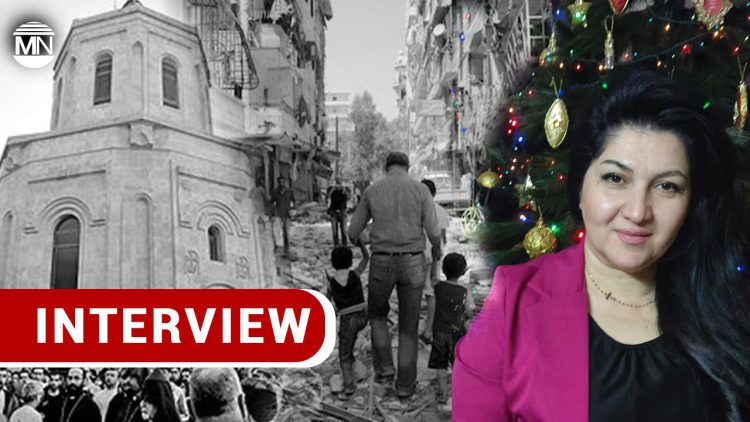
Kohar Khachadurian, a prominent political figure representing the Armenian community in Syria, discusses the uncertain future of ethnic minorities in North and East Syria (Rojava) under potential Islamist rule. Once a safe haven for Armenians, Syriacs, Kurds and Arabs, North and East Syria now faces growing fears over the erosion of cultural and religious freedoms.
“We are in fear of whether we’ll be allowed to speak Armenian, carry our crosses, or celebrate our religious holidays,” Khachadurian says, highlighting growing concerns over new oppression in post-Assad Syria.
Khachadurian serves in the Deputy Prime Minister’s Office of the Armenian Socialist Council based in Qamishli (Qamişlo), in the Autonomous Administration of North and East Syria (AANES). She is deeply involved in governance of the region, advocating for the rights of minority communities, and working to address the challenges facing Armenians amid regional conflicts.
Arev Aintabian, a Syrian-Armenian activist based in Stockholm, Sweden, and members of the Ararat Collective – a Germany-based Armenian antifascist group founded during the Nagorno-Karabakh (Artsakh) invasion of 2020 – interviewed Khachadurian in December. The conversation offers a critical insight into life on the ground in northern Syria since the fall of Assad’s regime, including increasing threats from Turkish-backed forces, and the impact an Islamist Damascus government could have on the region’s Armenian minority.
The Armenian population in Syria is primarily composed of descendants of survivors of the Armenian Genocide of 1915-1923, during which hundreds of thousands of Armenians were massacred or deported, driven from their ancestral lands in Eastern Anatolia (modern-day Turkey).
The situation in Rojava remains precarious, as the ongoing Turkish siege, supported by Syrian National Army (SNA) mercenaries, continues to threaten civilian life and regional stability. Critical infrastructure has been targeted, including humanitarian facilities, and civilians including journalists have been killed in attacks on sites such as the Tishreen (Tişrîn) Dam, defended by the Syrian Democratic Forces (SDF). Only last week, US CENTCOM Commander Michael Kurilla visited officials from the SDF, the local boots-on-the-ground partner in the Global Coalition to Defeat Da’esh (ISIS), to address critical humanitarian and security issues facing the region.
Read the interview transcript here, lightly edited for clarity:
Arev Aintabian: How do you feel right now?
Kohar Khachadurian: Right now we cannot decide how the situation will be, but the people are happy that we are finally done with Bashar al-Assad’s regime.
As an Armenian, how would you contextualise the rapid occupation of Syria by the Turkey-backed jihadist mercenaries? What does it mean for Armenians in Syria (and other groups, especially as minorities)?
Right now as Armenian people, we are in fear of Islamist Arab rule, because our future will be uncertain. For example, as Armenians, will we be allowed to speak Armenian, carry our crosses, or celebrate our religious holidays? Since we, Armenians, already live under Arab governance, in schools everything is in Arabic, and we only have one or two periods in Armenian. This has affected us. Many Armenians don’t speak, or understand Armenian that well. An Islamist governance will affect our native language and our religious rights. We are in fear. Will they make us wear hijabs and will we be able to go to church? These things remain in the thoughts of Armenians.
How do you feel about al-Assad’s fall?
Our feelings are mixed, are we happy or afraid? Everything is mixed up because right now nothing is clear on the ground. We are waiting to see what will happen.
Have the developments also impacted the infrastructure of North and East Syria? What is the current situation regarding electricity, water, food, the dollar and/or Syrian pound, the internet, diesel, market prices, etc.?
After 2011 the situation was bad – there was no electricity, no diesel, and gas was expensive. The dollar was rising, which was a big worry for the people because salaries were low and food and water were already expensive. The people were worried about how they would buy bread, and this was very difficult for us. But now since the fall of Bashar al-Assad, the dollar has started to decrease a bit, the goods have started to get a bit cheaper, salaries will increase. These hopes are keeping us alive, the people are waiting to see what will happen. The dollar can only be earned or spent in North and East Syria, but not in other places – it was prohibited elsewhere.
What were your thoughts and those of the people of al-Jazira (Cizîrê) when North and East Syria came into power and became an Autonomous Administration against ISIS?
It was great for us. In Rojava, everyone became united – Armenians, Arabs, Kurds and Syriacs. Here in Rojava, we live in better conditions, comfortably and safely, and the salaries are good. For example, compared to Aleppo or Damascus, where they lived in horrible conditions, there’s a big difference between the regions. So we are happy to live here, especially as Armenians and Christians, where our people have freedoms.
You said that life was much better for the Armenians after Rojava was formed. Can you explain what was it that got better?
Because it’s much safer here, nobody bothers us Armenians, if we go to church, celebrate our holidays, or wear whatever we want. We commemorate April 24th, celebrate Easter, play a fanfare and sing on the streets – we have freedom to do all of these things!
This reminds me that it used to be similar in Aleppo. Was it like this in Qamishli before the war as well or did it change after Rojava became a de facto?
It was much better in Qamishli compared to the other places because the areas where Arabs, Kurds or Muslims live are all different. The people here are freedom-loving, and progressive; they accept one another. Unlike in Aleppo, where they are much like the Muslim Brotherhood/Islamists.
Do you know how many Armenians are left today in Rojava compared to before the war, for example in Qamishli and Hasakah [Hesekê]?
In Qamishli, there might be around 500-600 Armenian households left, or perhaps 300 Armenian homes overall. In Hasakah, there are [almost] no Armenians, maybe only a few households.
I have seen the Martyr Nubar Ozanyan Brigade military unit, where “Armenians” from Hasakah join the unit to fight in battles.
Yes, they are not Christian. During the Armenian genocide in 1915, when the survivors fled these areas, they were few, and Kurdish or Arab families adopted and raised them. They used to be Armenians and now the Armenian council which we have started is mostly for these people. We collect them and we teach them Armenian language, Armenian history, songs and dances. They love it and they want to return to their Armenian-ness. There are no Christian Armenians left in Hasakah, maybe a few, but it’s only them in Hasakah.
What are your future plans as Armenians, Syriacs or Christians? Do you plan to leave and seek refuge outside of Syria? Or are there thoughts of repatriating to Armenia?
Our only plan is that I hope all of us become united. If we flee because of every minor air strike or inconvenience, leaving our homes and lands, then who will we leave them to? To Turkey? And as we already see, Turkey is attacking us every day – this is Turkey’s intention: to scare away the people so they flee. But all of us together, we try to be unified, it doesn’t matter if [we are] Christians, Arabs or Kurds, all of us live together on this land. We have to be together, [in order] not to let Turkey’s wish come true, not to flee again from Turkey just like after 1915. Of course, we wish to repatriate to Armenia, but this is also our land and our home, we have to always resist, to work together, to become unified, so we remain here for the conditions to improve. Many were forcibly displaced, they were forced to flee. But here the situation is still good, so we don’t want to easily evacuate and emigrate.
Can you present your work within the Armenian Democratic Council of North and East Syria?
We secure the Christian Armenians here, so we try to help anyone who needs a job or has other issues. But our main work is for those Armenians who fled here after the 1915 Armenian Genocide and were adopted by Kurdish and Arab families. We teach them Armenian language, Armenian history and songs, we also have a dance group, singers, theatres and actors. They began to speak Armenian, this was a great success for us because we were moving forward. And we continue to find more assimilated Armenians so we can allow them to approach their Armenian-ness. We will now also start an Armenian army to protect all Armenians and of course, all people that live here.
This is really important work – to fight against assimilation, and preserve language and culture really contributes to the resistance against genocidal politics. I have seen videos of Armenians in Rojava dancing traditional Armenian dances, and singing Armenian songs. I also noticed that an Armenian women’s party has been founded. Why is it especially important that Armenian women organise? What are the challenges and difficulties they are facing?
In Rojava, women have managed to take over their freedom. Before the revolution, it was difficult for women to speak up and get access to education. Now, in Rojava, women have taken their freedom, and their voices are heard.
How would you like it if the international community and the Armenians outside of Syria supported you in this situation? Is there something that gives you hope?
We call for the international community to protect the Armenians and our freedom of religion to live as Christians from the new government that will come and rule over us, so that we can have our rights, to live freely, to speak our language, to wear our crosses, to dress freely and not be forced to cover ourselves with a hijab. It is our right to have freedom and not live with all this fear inside of us as Armenians or Christians. We call for the international community to work for an international answer, to live freely. That you forward our voices and spread about that we don’t want to leave our homes and country. We want to stay here comfortably, we only want to have our rights, with our religion, feasts and clothes. We demand from the entire world that we want to stay here and to live in peace.
Is there a connection for you to the Armenian struggle? Furthermore, do you see a connection to Artsakh?
Indeed, we’re far apart from each other but every Armenian carries the struggle in their heart. When we saw what happened in Artsakh, we got very sad, our hearts were shattered although we were far away. We were fighting every day with our hearts so that these kinds of events wouldn’t take place – in Artsakh or in Armenia. Yes, we are far away, all Armenians are spread out in the diaspora, but there’s always a connection between us. All of us fight together so that this genocidal oppression doesn’t happen to any Armenian, no matter where.
Because in the end, as Armenians we all have the same enemy, namely Turkish fascism.
Yes, every Armenian feels the pain for every other Armenian no matter where, we all care and empathise with each other because we are one, our pain is one.
X account: https://x.com/ArmeniaRojava