

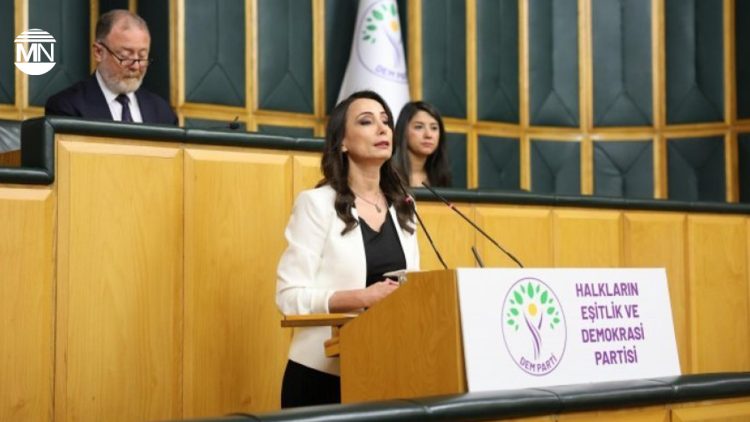
“Millions are waiting for peace like waiting for Godot—and it is the government’s responsibility to act,” said Tülay Hatimoğulları, co-chair of Turkey’s Peoples’ Equality and Democracy (DEM) Party, during a group meeting in parliament in Ankara on Tuesday, urging authorities to take immediate steps towards a democratic peace process and justice reform.
Hatimoğulları called for the urgent formation of a parliamentary commission with a clear mandate and inclusive representation. “The country cannot afford to waste time. The commission must be formed without delay and begin its work actively. This commission must do more than talk—it must deliver concrete proposals, a timetable, and accountability,” she said.
The appeal comes amid renewed debates in Turkey over constitutional reform, judicial amendments, and growing public scepticism regarding stalled peace efforts and prisoner rights. Hatimoğulları framed the moment as critical for Turkey’s future, calling for bold and inclusive action, particularly in relation to Kurdish rights, women’s representation, and regional peacebuilding.
Hatimoğulları criticised the government for dropping the COVID-19 prisoner release regulation from the 10th Judicial Reform Package. “Tens of thousands of prisoners dreamed of spending the holiday at home. Their families hoped to celebrate together. These hopes should not be sacrificed to the concerns of the AKP,” she said. “The concerns of 86 million citizens should transcend those of any single party.”
She urged Parliament to revise the legislation and expand conditional release. “Our demands are not a favour, but a necessity,” she said, listing key proposals: the abolition of conditional release clauses under the Anti-Terror Law, house arrest for elderly prisoners, and an end to exclusions for those serving aggravated life sentences. “These demands are based on fundamental human rights and the spirit of the peace process.”
Hatimoğulları linked the legal deadlock to a broader crisis of trust: “People are asking, ‘Why should we trust this process?’ Even those who celebrated it as a new chapter are now uncertain. That question is more vital than ever.”
On constitutional reform, she warned against a superficial or exclusive process. “If we are talking about a ‘new constitution’, then it must truly be new. It must be shaped by the broadest possible consensus. We need to move away from blanket approaches and clear a path that involves everyone,” she said.
Praising main opposition Republican People’s Party (CHP) leader Özgür Özel’s support for inclusive reform, Hatimoğulları called for constitutional recognition of mother-tongue education and equal citizenship. “Only if its spirit is shaped this way can it be truly democratic. There is no other path to build justice, freedoms, and peace.”
Addressing regional developments, Hatimoğulları described the Middle East as a region in chaotic flux, where the Kurdish issue is central. “Kurdish geopolitics offers a way out of the labyrinth of the Middle East. Those who ignore this gateway are doomed to be lost within it,” she said, urging Turkey to abandon partisanship and assume a mediatory role.
“Turkey’s historical position brings a critical responsibility,” she said, suggesting visits between Ankara and North and East Syria could “greatly contribute to advancing peace—not only for Turks and Kurds, but for the entire region”.
Hatimoğulları also stressed the need for women’s central involvement in any peace commission. “The views of women and feminists must be heard. This point must not be overlooked,” she said, citing a recent women’s peace march in Diyarbakır [Amed] organised by the Free Women’s Movement (TJA) as a powerful signal.
Quoting the Kurdish slogan “Jin, Jiyan, Azadî” (Women, Life, Freedom), she added, “Women marched through the streets of Diyarbakır for society’s demand for peace and democratic resolution.”
Returning to the urgency of political will, Hatimoğulları said, “We must understand the process correctly, voice the truth courageously, and handle the process calmly, regardless of prevailing moods.”
She concluded with a clear message to both the government and society: “Until we end every sentence with a call to build peace and democracy, history will not listen to us. This commission must heed the call of history and show humanity it can build peace.”


