

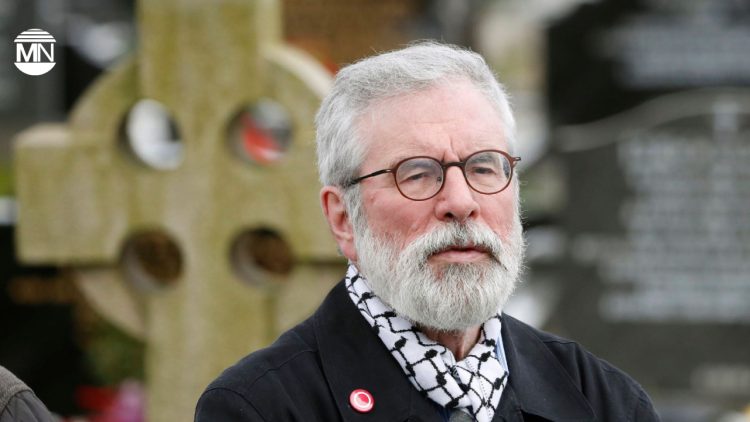
Veteran Irish politician Gerry Adams, once the face of the political party Sinn Féin, has written an opinion piece for belfastmedia.com, in which he draws parallels between the peace process in Northern Ireland (referred to by Irish Republicans as the “North of Ireland”) and that of Northern Kurdistan.
Adams begins by quoting a poem from the famous 19th century Irish writer Thomas Osborne Davis, known for his inclusive, “romantic nationalism”, espousing hope for a united and independent Ireland wherein Irish would be the national language. The poem is as follows:
The North began, the North held on,
The strife for native land;
When Ireland rose to smite her foes
God bless the Northern land.
At the time of the writing of this poem the thought of a united and independent Ireland, in which lasting peace between Catholics and Protestants would be established, was not a new idea. Adams recounts how Belfast, now the capital city of Northern Ireland, was at the close of the 18th century the birthplace of the “Society of United Irishmen”, an organisation created by the Presbytarian Protestant community in favour of Catholic emancipation, agrarian reforms, women’s suffrage and national independence from the British Empire.
This movement was largely inspired by the French revolution, and was brutally suppressed by the British. Adams points out that many buildings in which the United Irishmen met no longer exist, with a number of notable exceptions. For him, those which survive are a metaphor of a lost or crushed progressive history, and, as the struggle continues to unite Ireland by political means, the preservation of these sites a reminder of how progressive ideas and the quest for peace have persisted in and through colonial suppression, insurrectionary violence and sectarianism.
Adams notes that an enemy of the Irish struggle for peace and independence, Winston Churchill, oversaw the use of poison gas against Kurdish people in Iraq after Kurdistan was partitioned into four states according to British and French interests. After the Ottoman Empire fell in World War I, Churchill, then British colonial secretary in the Middle East, referred to the Kurds as “recalcitrant Arabs” and “uncivilised tribes”.
Adams views Abdullah Öcalan’s “Call for Peace and a Democratic Society” as marking a pivotal moment for Northern Kurdistan (that part of Kurdistan situated in the Republic of Turkey), a different “North” from that for which he fought and about which Thomas Davis lamented in his poem. It is here that the Kurdistan Workers’ Party (PKK) was founded, to fight for the self-determination of Kurdish people in Turkey, for socialism and for peace. Öcalan’s call received a positive response from cadres of the PKK and other Kurdish leaders, creating a sense of optimism that peace and reconciliation might be possible.
As one personally involved in the Good Friday Agreement negotations, Adams stressed the importance of all political representatives being involved in any peace process, and commended Abdullah Öcalan’s willingness to initiate such a process in Turkey, despite being imprisoned on Imrali Island.
Gerry Adams and another notable figure in the history of Sinn Féin, Declan Kearney, have joined over 200 politicians, human rights advocates, feminists, artists, scholars, journalists, jurists and activists from around the world who have signed an appeal supporting Öcalan’s call and urging all parties to the conflict between the Kurdish people and Turkey to “take decisive steps towards a lasting peace”.
Beyond Turkey and Kurdistan, Adams notes that the appeal reflects Öcalan’s broader vision of bringing stability to the Middle East more generally, and that it is significant for precisely this reason. He urges the international community to play a constructive role in the peace process, expaining that this was also necessary in the Irish, Basque and South African conflicts. Adams believes that, as in the case of the people of the north of Ireland (whom he describes as an “afterthought to London governments”), certain guarantees, including the release of Öcalan from prison, must be made to support the Kurdish people and their struggle.


