In a statement posted on X on 25 May, US Ambassador to Turkey and Special Representative for Syria Thomas Joseph Barrack issued a stark crticism of the century-old Sykes-Picot Agreement, and declared a fundamental transformation in Washington’s approach to the Middle East. His remarks, sweeping and evocative, encompass an admission of historical culpability and an assertion of a revised vision centred on regional autonomy. Barrack said:
“A century ago, the West imposed maps, mandates, pencilled borders, and foreign rule. Sykes-Picot divided Syria and the broader region for imperial gain—not peace. That mistake cost generations. We will not make it again,”
Framing this historical reckoning as a prelude to a recalibrated policy orientation, Barrack asserted that the “era of Western interference is over”, and outlined a strategic alternative predicated on “regional solutions” and a diplomacy “grounded in respect”. Gone, he said, are the days of prescriptive Western ideological lecturing. Instead, he positioned the United States as a cooperative regional actor, explicitly aligning with Turkey, the Gulf states and Europe.
A century ago, the West imposed maps, mandates, penciled borders, and foreign rule. Sykes-Picot divided Syria and the broader region for imperial gain—not peace. That mistake cost generations. We will not make it again.
The era of Western interference is over. The future…
— Ambassador Tom Barrack (@USAMBTurkiye) May 25, 2025
In keeping with this rhetorical shift, the Trump administration has lifted longstanding US sanctions on Syria—measures that had largely isolated the country during and after the civil war.
“With the fall of the Assad regime the door is open to peace—by eliminating sanctions we are enabling the Syrian people to finally open that door and discover a path to renewed prosperity and security,” Barrack said.
Barrack, appointed in early May and known for his close ties to President Donald Trump, has emerged as a key figure within the administration’s emerging “regional realignment” strategy. His dual mandate in Ankara and Damascus reflects the administration’s intention to replace broad-spectrum interventionism with targeted, diplomacy-first partnerships.
Observers note that Barrack’s emphasis on economic pragmatism and political alignment with Trump makes him a pivotal figure in delivering the administration’s new vision for the region.
The ambassador’s remarks did not go unnoticed within the broader political discourse. Kurdish journalist Amed Dicle published a widely circulated response titled “Sykes-Picot çöktü, Kürtler sahneye çıktı” (Sykes-Picot has collapsed, the Kurds have taken the stage), interpreting Barrack’s comments as potentially acknowledging the historical marginalisation and the present centre-stage position of the Kurdish people.
“‘Sykes-Picot’ is not just a set of letters—it’s a fate,” Dicle observed, referring to the 1916 agreement that institutionalised the statelessness of the Kurdish people across four regional nation-states.
According to Dicle, the real rupture with the Sykes-Picot order came not through its architects but through the resilience of its victims and their efforts at self-governance.
“Kurdish resistance – by governing, organising and building alternatives – has been the true force that eroded Sykes-Picot.”
While Dicle recognised Barrack’s statement as a possible diplomatic nod to Kurdish political agency, he simultaneously issued a cautionary note:
“This could also mark the beginning of efforts to contain Kurdish ascendancy within controlled ‘diplomatic parentheses’.”
He stressed that Kurdish demands for recognition are not just “a question of rights”, but reflect “a political name for an actual situation on the ground”. Without formal recognition, he argued, regional stability and durable peace remain illusory.
The lifting of US sanctions and the accompanying rhetorical overture represent not only a U-turn from past policy failures but also a test of whether inclusive and regionally responsive governance models will be given room to flourish. The key challenge now, analysts suggest, is whether Kurdish autonomy will be respected or reabsorbed into new frameworks of control.
The timing of Barrack’s statement has also raised strategic questions among regional analysts. In Turkey, a new reconciliation process has begun, marking the first such initiative since the collapse of peace talks in 2015. Though still in its early stages, this parallel development suggests a wider recalibration not only of foreign policy but of internal political dynamics within the Turkish state.
The synchronisation of these two moves—Washington’s rejection of Sykes-Picot and Ankara’s cautious re-engagement with the Kurdish movement, including imprisoned leader Abdullah Öcalan and the pro-Kurdish Peoples’ Equality and Democracy (DEM) Party—suggests the emergence of a new geopolitical grammar.
Many observers now expect that Syria’s post-conflict trajectory and Turkey’s domestic evolution may converge around demands for pluralistic governance, democratic inclusion and durable solutions to long-standing ethnonational questions. For international readers, Barrack’s post is thus not merely an abstract condemnation of colonial cartography, but a signal of shifting priorities across Middle Eastern politics.
Since last week, intensive and fast-paced diplomatic activity has been taking place in Ankara involving Ambassador Barrack, Syria’s transitional president Ahmed al-Sharaa (al-Julani), Turkish President Recep Tayyip Erdoğan, and the respective foreign ministers of both countries. According to diplomatic sources, these meetings focused on shaping the future of Syria after the fall of the Assad regime, lifting remaining sanctions, reopening trade channels and launching business initiatives under a new regional economic vision. Analysts see this as emblematic of the Trump administration’s priorities: replacing military projection with commercial engagement, and marketing the post-war Middle East as a frontier for strategic investment and regional capitalism.
Originally signed in 1916, the Sykes-Picot Agreement was a secret treaty between Britain and France, with the assent of Russia, that aimed to divide the territories of the Ottoman Empire in the event of its defeat in the First World War. The agreement laid the groundwork for much of the modern Middle East’s territorial borders, often at the expense of local populations’ aspirations for sovereignty. Among the communities most affected were the Kurds, who were divided among four nation-states—Turkey, Iran, Iraq and Syria—without any recognised national status.

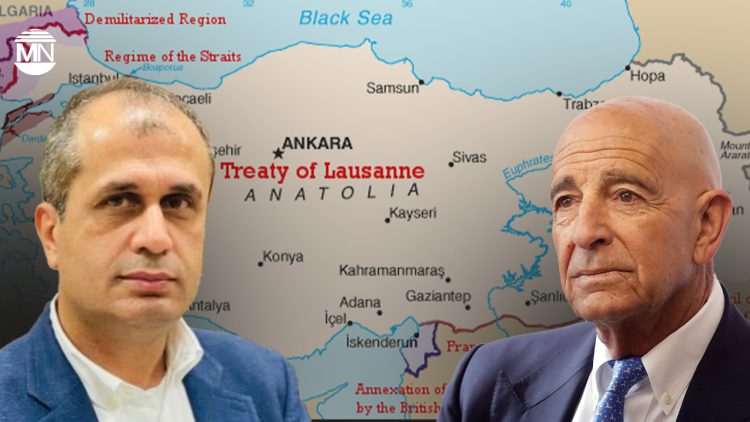
This statelessness was later cemented by the Treaty of Lausanne in 1923, which replaced the Treaty of Sèvres and became the foundational legal framework for the modern Turkish Republic.

The Treaty of Lausanne, a point of continued political debate in Turkey, erased previous international commitments to Kurdish autonomy. It is within this historical context that Barrack’s condemnation of externally imposed borders and exclusionary nation-building processes gains its full resonance—both as a criticism of the past and as a potential marker of policy change.