Emma Audrey
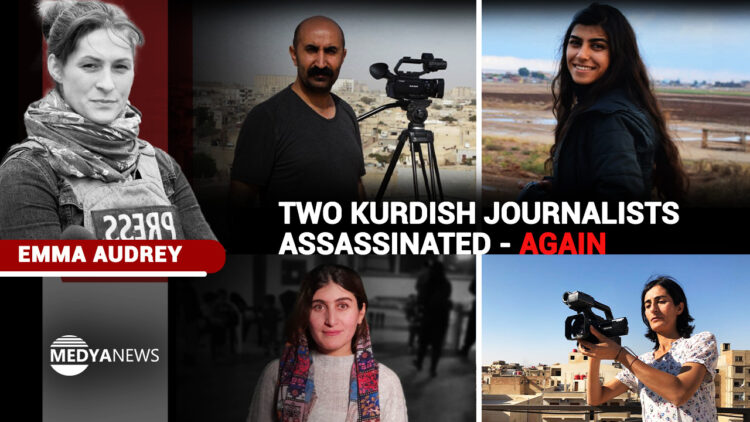
On 23 August 2024, two Kurdish journalists were murdered by a Turkish drone. This despicable and cowardly act took place in Iraqi Kurdistan, near the town of Sulaymaniyah (Silêmanî). At the invitation of the Association of Women Journalists of Mesopotamia, our editorial staff sent a journalist to shoot a mini-documentary, which is currently being finalised, on the situation, a situation unanimously denounced by journalists’ unions in France and other countries, as well as by European and international journalists’ federations. International organisations such as the Committee to Protect Journalists (CPJ) have also expressed their indignation in press releases.
On the ground, the scale of the problem is apparent at every turn. Journalists in the field – including colleagues of the two victims – can no longer operate outside urban areas without risking their lives. The pieces of film showing the spot where the victims’ car was blown up by a missile had to be shared remotely with their crews. It was simply impossible to get there because of the mortal risks involved. Discussions with the governor, journalists’ advocacy organisations and local media representatives revealed a palpable distress: that of colleagues in desperation at having to work in these conditions. A distress sometimes mingled with anger, faced with the indifference of the local and international press which will all too often look the other way.
For the Kurds, the real tragedy is in the media’s silence.
Why haven’t the faces of these two women made the rounds of screens over the world, as would have been the case for other journalists murdered elsewhere? Why this retreat, this silence, when it comes to Kurdish journalists? What is the value of their lives?
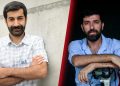
Just as we were finalising this video documentary, another tragedy struck. On 19 December, the news broke. Two more journalists had just been murdered by a Turkish drone, according to local media. Nazım Daştan (32) and Cîhan Bilgin (29), two Kurdish journalists from Turkey, had been executed in the same cold blood. Their vehicle, travelling on a road in the Kobani (Kobanê) region of northern Syria, was targeted from a distance by a Turkish drone.
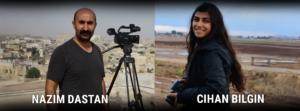
When you murder a journalist, you also murder the voice of millions of people. And that’s precisely the goal; to silence the voices of millions of Kurds.
This climate of impunity has its roots in international relations. [Turkish President Recep Tayyip] Erdoğan continues to be welcomed warmly at diplomatic tables all over the world, with the blood of Kurds (civilians and journalists) on his hands. His expansionist ambitions are known, but tolerated. The hypocrisy would almost make you want to laugh if it didn’t mask so many deaths. Like Netanyahu, whom he denounces publicly, Erdoğan makes no secret of his intentions. He has declared that he wants to crush “the leaders of terrorist organisations, such as ISIS, the PKK and the YPG, as soon as possible.” Following the example of Gaza, Erdoğan is preparing his army to raze a 30-kilometer “buffer zone” along the Turkish-Syrian border. In reality, this “security zone” conceals a plan for territorial expansion and a desire to wipe out the Kurds. What is prepared is genocide and ethnic cleansing, carefully disguised on a pretext of security.
In the field, Kurdish organisations such as the People’s Protection Units (YPG) and their political wing, the Democratic Union Party (PYD), remain on the front line in the face of attacks. These groups, pillars of the Syrian Democratic Forces (SDF), have played a decisive role in the fight against Daesh (ISIS), indirectly protecting Europe from terrorist attacks.
For Erdoğan, these organisations are associated with the Kurdistan Workers’ Party (PKK), which he describes as terrorist because of its fight for Kurdish autonomy. This association is widely contested by the international community, but it provides Erdoğan with a convenient pretext for brutal military operations, marked by massive destruction, forced displacement and the demographic transformation of Kurdish regions.
The presence of Kurdish journalists in the field is essential. Without their work, abuses go undocumented. Without their voices, the crimes remain invisible, and silence triumphs. Erdoğan needs this silence to pursue his deadly plans.
This attack on the press shows one thing – the weakness of the Erdoğan regime. When a regime goes so far as to murder journalists, it reveals the fear that these dissonant voices inspire. Just as the Israeli army targets journalists in Gaza, the Turkish army eliminates those who, on the ground, carry out crucial work, sometimes putting their own lives at risk.
Protests and arrests in Turkey
This act triggered a wave of protests from Kurdistan to Europe (in Turkey repressed by the police as usual), denouncing Turkey’s actions.
Shanaz Ibrahim Ahmad, member of the political bureau of the Patriotic Union of Kurdistan (PUK) and First Lady of Iraq, expressed her deep regret regarding the assassinations. She denounced Turkey’s efforts to occupy Rojava and silence journalists, while highlighting Turkey’s dark history of murdering journalists. Ahmad called on the international community not to remain passive, demanding an end to the brutalities and the establishment of a committee to investigate the murders.
Members of the Kurdistan Democratic Media Union (YRD) issued a statement from the Makhmur refugee camp, expressing their condolences and reaffirming their commitment to documenting the truth despite these Turkish attacks.
In solidarity, women journalists from Iranian Kurdistan (Rojhilat) condemned the murders on social networks despite the security risks in Iran. The JINHA agency also collected their testimonies and shared videos in support of the Kurdish women’s struggle in northeast Syria.
On 20 December, protest rallies were held in several European cities (Paris, Cologne, Winterthur, Lausanne and Nicosia) to denounce the murders of journalists and call for an international investigation.
The editorial staff of Média 25 / Radio BIP expresses its unwavering support for the Kurdish journalists and sends its sincerest thoughts to the families, friends and colleagues of the victims. We stand with them, today more than ever.
This article was originally published in French on the website of Radio BIP/ Media 25