

Ertuğrul Mavioğlu
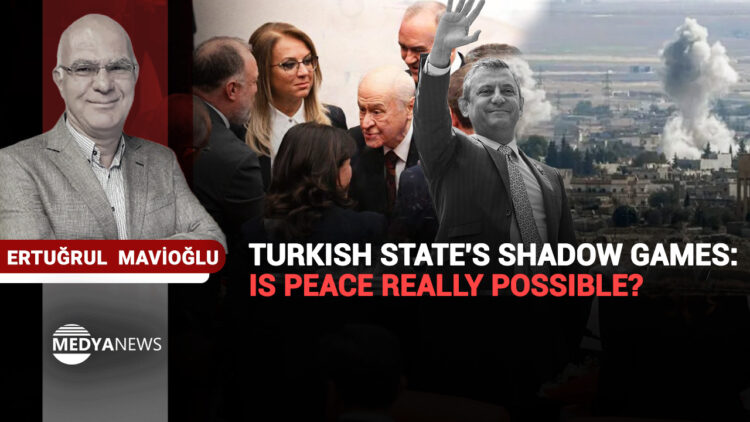
With the re-opening of its Parliament, Turkey seemed to enter a new phase. marked by the unexpected gesture of Nationalist Movement Party (MHP) leader Devlet Bahçeli as he went to the People’s Equality and Democracy (DEM) Party seats and shook hands, followed by the speech he gave at his party’s group meeting.
The handshake was optimistically interpreted as the beginning of a new era. However, political actors who had paid a heavy price in prior processes (without submitting) approached with extreme caution, particularly the Kurdish political movement. As the saying goes: “once bitten, twice shy.”
Indeed, the MHP members who later became involved in the situation must have been alarmed by the possibility that Bahçeli’s handshake could be seen as undermining their Turkish identity. This is likely why one of the party’s deputy leaders, Semih Yalçın, issued a written statement explaining the situation.
One sentence from Yalçın’s statement was particularly striking: “The move by our Esteemed Leader is not a concession, a softening, or a step towards normalisation; rather, it is a reminder to the rightful owners of normality and to those who own the space.”
It was clear that MHP’s Yalçın was preemptively responding to potential criticisms from their voter base and felt the need to emphasise the dominance of Turks over Kurds, using an unsophisticated ‘lumpen’ tone.
However, Bahçeli’s speech at the Parliamentary group meeting, where he made statements about “my authority,” provided a few more clues about what’s going on behind doors in the Turkish state.
Bahçeli wanted Kurdish leader Abdullah Öcalan to attend the DEM Party’s group meeting and deliver a speech. According to Bahçeli, if Öcalan were to ask for a “right to hope” for a curtaiiment of his life sentence, he should declare that he has dissolved his militant Kurdistan Workers’ Party (PKK).
Another significant and noteworthy detail in Bahçeli’s speech was his admission of the reality that Öcalan is being held in isolation, something that had been officially denied by all state institutions.
Then the bidding war began.
Following Bahçeli’s statements, the leader of the main opposition People’s Republican Party (CHP) Özgür Özel, who had recently visited Selahattin Demirtaş in Edirne Prison, responded by saying, “I’m raising the stakes, Mr. Devlet.” He continued:
“I’m offering the Kurds a state, I’m offering a state. I’m offering the Kurds, especially those who don’t fully feel like they belong, the chance to be the owners of the Turkish Republic. If you’re on board, let’s do this together.”
After making this statement, Özgür Özel began to play his part in this process, embarking on a six-day tour of several Kurdish provinces, starting with Diyarbakır (Amed).
Were negotiations still ongoing at İmralı? Were messages being sent to the PKK headquarters in Qandil? Were consultations being held behind closed doors with the DEM Party?
Ömer Öcalan, a Democratic Party MP and nephew of Abdullah Öcalan, has visited his uncle in the latter’s first contact with the outside world since 25 March 2021. yet we have no answers to any of these questions Why?
Because it feels as though we are watching a shadow play orchestrated by the state, and we have no concrete knowledge of what is really going on behind the scenes.
We are not aware of what is being discussed at the upper echelons of the state, nor is there any tangible evidence regarding the possibilities speculated daily by various media outlets.
Rather, there’s plenty of evidence pointing in the opposite direction.
We have an abundance of concrete data in front of us suggesting that peace is unlikely and that war will become perpetual, possibly even escalating in a more intense form.
For instance, we witnessed the famous handshake between the Kurdish opposition and the nationalist political figurehead. But on the other hand, Selçuk Mızraklı, who was hastily arrested and imprisoned while serving as DEM PArty Co-Mayor of Diyarbakır Metropolitan Municipality, has his prison sentence upheld without any need for concrete evidence of a crime.
On the one hand, there is talk of a new process beginning. On the other hand, the arrests and detentions, which have become routine in Kurdistan, continue unabated.
On the one hand, Abdullah Öcalan is said to be preparing to deliver a speech in Parliament.
But on the other hand, he states in the very first sentence of his message, delivered through Ömer Öcalan, that the isolation continues.
On the one hand, there is talk of the possibility of peace. But on the other hand, the government is preparing to introduce new war taxes. The plan to impose a levy on credit cards has been scrapped, but preparations are underway to deduct money under the guise of a defence industry contribution from every house sale, every car sale, and even from mini scooters, toy drones, and wristwatches.
On the one hand, there are hints that the resolution process, which was shelved nine years ago, might be taken out of the freezer and put back on the table. On the other hand, it is also known that 1.6 Trillion lIra ($47 billion) has been allocated for war expenditures in the 2025 budget, more than any previous government has allocated for war. Does this not surprise anyone?
While an average of $20 to $25 billionis allocated from the budget each year for the war against the Kurds, the increase of this figure to $40 billion dollars in 2024 the scale the war has reached. Would it be considered disruptive to ask, “What kind of contradiction is this?” when the 2025 budget further allocates $47 billion dollars for war?
One of the significant signs that the scope of the war will escalate came on 23 October, when an airstrike was launched on Kobane.
The Turkish military bombed the centre of Kobane, several villages, a bakery in Amûdê, flour warehouses, an electricity station serving the Cizire canton, a gas station in Siwêdiyê, Dêrik, and a train station in the Siryan neighbourhood of Qamishli.
While striking these targets, they did not distinguish between the elderly, children, or women. At least 13 people were killed, and dozens were injured.
All of these rapid developments, which have left everyone confused, once again reminded us that peace is far too serious a matter to be left to the initiative of states.
Because we have the experience of 2013–2015, a period known as the “resolution process,” and the lessons learned from it. Turkish society witnessed how, in a single move, the peace table was overturned and how war was swiftly and violently reintroduced into the agenda. The deepening poverty caused by the economic crisis and the destruction of freedoms only added to the misery.
War has given rise to war profiteers, especially around the Presidential Palace. The war created those who exploited and generated profit from it, such as the Bayraktar brothers, Selçuk and Haluk. In a very short time, they soared onto Forbes’ billionaire list. Everyone can imagine how those benefiting from war would recoil even at the mention of the word “peace.”
War shattered all the state’s mechanisms of oversight and granted the ruling powers the ability to act with impunity. While 90% of society was left to poverty and hunger, the government shamelessly defended the interests of the capitalist class it truly represents. The entire financial burden of the war was placed on the shoulders of workers, retirees, youth, and women. Moreover, through the opportunities war provided, an authoritarian system was created, which brutally silenced all dissent. The ability of people who had been stripped of their right to speak to even mention peace became nearly impossible.
Everyone understands that those who see war as a tool for maintaining power only use the word “peace” to distract and deceive the masses.
That is why, if peace is to come, it will be due to the people feeling, in the most visceral and painful way, the need to escape from war, demanding it with a desperate cry.
It will not happen spontaneously. It will become possible when people realise that war and the continuation of isolation policies are the real causes of the misery they endure, and when they break this hellish cycle that kills them bit by bit.
In other words, peace will not take shape through the shadow plays orchestrated behind the scenes by the state, but through the people, as they take the initiative and make it a reality.


