

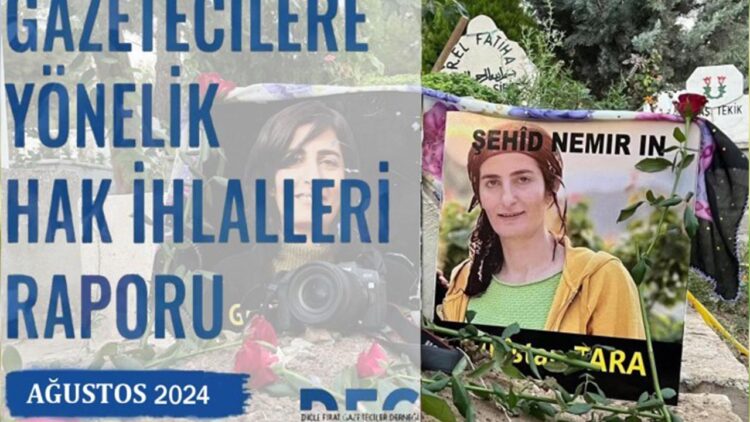
Escalating violence and censorship against journalists in Turkey, including the killings of two Kurdish journalists in Iraqi Kurdistan, are outlined in the latest report by the Dicle Fırat Journalists Association (DFG).
The report, published on 2 September, highlights the deaths of journalists Gulîstan Tara and Hêro Bahadîn in a Turkish attack on a civilian vehicle in Said Sadiq (Seyîdsadik), in Iraq’s Kurdistan region, on 23 August. “The Turkish government, extending its war against the Kurds to the Kurdistan region, has implemented a comprehensive policy of oppression against journalists,” the DFG stated. The killings have sparked protests across Kurdistan and globally, with calls for international organisations to hold Turkey accountable.
The report outlines further violations, including two cases of mistreatment, six threats and two assaults on journalists in August. Additionally, three journalists faced investigations, four were charged and one received a prison sentence of one year and eight months. It also notes that 35 journalists remain in prison, while 16 have lost their jobs.
The DFG report reveals a broad scope of censorship, including bans on 401 news articles and 88 social media posts, as well as the closure of six websites, including Mezopotamya Agency. Moreover, the Radio and Television Supreme Council (RTÜK) issued suspension orders for three programmes and imposed fines on two TV channels. Ten publication bans were also issued in August.
The report criticises Turkey’s use of censorship as a tool against Kurdish voices, pointing to the temporary closure of Instagram and the ban on the game Roblox, citing child exploitation concerns. “Turkey has made censorship a bargaining chip against the Kurds, attacking their right to expression and thought,” the DFG stated.
Protests erupted across Turkey, including in Diyarbakır and İstanbul, in response to the killings of Tara and Bahadîn. “Journalists gathered in Diyarbakır to protest and were attacked by the police,” the report noted. Despite this, journalists vowed to continue their fight, declaring, “We will not remain silent in the face of these attacks, and the voice of the free press will only grow stronger.”
The DFG report also mentions the widespread use of judicial mechanisms to suppress criticism, with numerous news websites and social media accounts blocked by emergency court orders. Many of the targeted articles involved reports on corruption and rights violations by government officials. “It appears that the judicial system is being used to censor and conceal the truth from the public,” the DFG concluded.


