

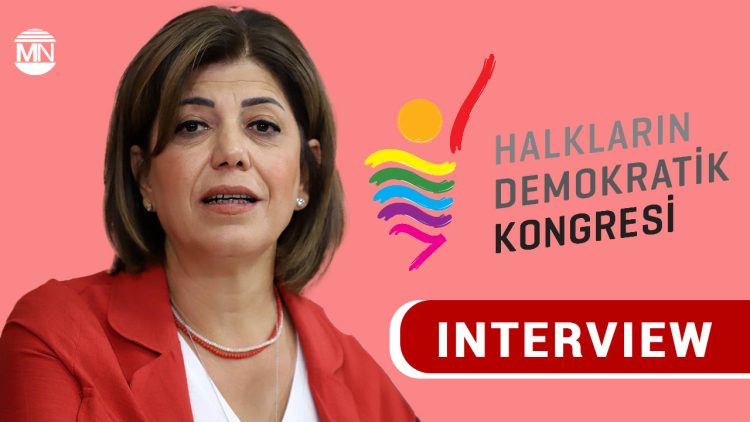
Turkey has witnessed another wave of mass detentions targeting journalists, politicians, and civil society figures. On Friday, over 30 individuals were arrested following a series of coordinated police raids across multiple cities on last Monday. Among those detained were members of the Peoples’ Democratic Congress (HDK), journalists, trade unionists, and politicians.
HDK Co-spokesperson Meral Danış Beştaş, speaking to Nezahat Doğan of Yeni Yaşam journal, condemned the arrests, stating that they are an attempt to silence opposition and stifle ongoing peace discussions. She emphasised that despite the repression, the democratic movement remains committed to its struggle for justice and peace.
Here is the interview between Doğan and Beştaş:
Thirty of the 54 detainees were arrested, and 13 placed under house arrest. Why is HDK being targeted?
The HDK represents a significant segment of Turkey’s social opposition. It is a multi-component structure, and for the past three and a half months, we have been engaged in peace efforts. We launched a one-million-signature campaign for peace, followed by an international conference attended by over 500 invitees, which received widespread attention and sparked crucial discussions.
Is this operation intended to suppress peace discussions?
Its timing is highly significant. As you know, two meetings have taken place on İmralı Island, and a third meeting is on the agenda. A call for peace is expected this month, supported also by [Abdullah] Öcalan’s organisation [PKK]. The fact that these operations are occurring at such a moment naturally raises questions. These crackdowns aim to pressure and intimidate democratic and social opposition, sending the message that ‘if peace is to be discussed, it must be within the boundaries we set.’ The government seeks to dictate the terms of any peace process.

While the state seems to be taking steps towards resolving the Kurdish issue, is there a faction within the government opposed to peace?
I do not believe that these discussions and negotiations are happening independently of the state apparatus or government. After all, the AKP [Justice and Development Party] has been in power for many years, and in recent years, it has governed through its alliance with the Nationalist Movement Party (MHP). While there may be differences and debates within this alliance, I do not think there is a fundamental divergence on the issue.
Are you referring to differences between the state apparatus and the government’s ruling alliance?
Differences might exist, particularly regarding issues like government-appointed trustees and the crackdown on HDK and democratic movements. The situation even extended to TÜSİAD [Turkish Industrialists’ and Businessmen’s Association, Turkey’s largest and most influential business association]. I believe these actions reflect more of a government strategy rather than a state-wide decision. For instance, Devlet Bahçeli, leader of the MHP, speaks with remarkable clarity, saying that ‘there are no losers in peace.’ We have always maintained this stance. We have been advocating for a democratic resolution for years. Even if these meetings had not taken place, even if Bahçeli had not made this call, we would still be calling for peace and dialogue. One year ago, we were already raising our voices against isolation policies [Öcalan’s incommunicado detention] and advocating for a peace process. Therefore, there is no reason for us to step back now. We will not give up just because the government applies pressure, appoints trustees, or carries out mass arrests.
Bahçeli made concrete statements to initiate this process, yet President Erdoğan has not taken clear steps. Meanwhile, operations against elected mayors, HDK, and TÜSİAD continue. Do these actions obstruct the peace process?
There is legitimate criticism regarding this, as these actions damage trust. Many are questioning the government’s sincerity. We, too, are questioning it, and so is the public. Across multiple cities, we have organised peace gatherings, and these discussions continued during our conference. Peace does not emerge spontaneously. The ruling powers do not suddenly declare, ‘we have made peace, changed the laws, and taken these steps.’ Peace requires demands, opposition, social dynamics, and a collective push for a democratic resolution. This means taking action in the media, on the streets, and in public forums.
Meanwhile, the government’s current policies are failing to generate public support. Most citizens are struggling with poverty and economic hardship. For years, the government has pursued a strategy of polarisation and enmity. We have consistently highlighted, even in Parliament, how government policies are built on hostility towards the Kurds. Internationally, Turkey has positioned itself against any Kurdish gains or positive developments. The government may fear that genuine steps towards peace would weaken its political control.
What is the ultimate goal of these operations?
I believe the primary goal is to dismantle and divide the democratic opposition. The government aims to prevent alliances, weaken collective resistance, and obstruct the unification of opposition groups. From municipal alliances to the crackdown on HDK and TÜSİAD, every move reflects this divide-and-rule strategy. They view unity as a threat to their grip on power.
Are Bahçeli and Erdoğan pursuing different objectives?
It is difficult to say definitively. There are no clear-cut divisions between them. Bahçeli’s influence within the [ruling AKP-MHP] People’s Alliance is well known, and his statements have shaped government policies. While minor differences might exist, I do not see a fundamental split. Perhaps they are playing different roles in a coordinated strategy. After all, they continue to govern together and maintain a shared stance in Parliament. While disagreements may arise, they seem to manage them internally rather than displaying them openly.
While a peace call from Öcalan is expected, there is also a crackdown on HDK, NGOs, and opposition groups. Is there an effort to criminalise these movements? How should they respond?
It is essential that we, as democratic forces, play an active role in analysing these contradictions and questioning government policies. However, beyond merely discussing these issues, we must focus on how to advance the peace process. The real question is: how can we unite democracy and peace? Neither can exist in isolation. Conflict, violence, and repression are symptoms of a deeper issue, and the solution lies in democratisation. Internationally, peace is defined in two ways: negative peace, which means the cessation of violence, and positive peace, which ensures that all social demands are met. Thousands of people remain imprisoned for political reasons, the judiciary is compromised, and fundamental rights are under threat. Achieving peace requires fundamental democratic reforms. This cannot happen without struggle. Regardless of contradictions within the ruling alliance, we must continue to push for peace. This is not just up to the government or the MHP-AKP alliance. All of us—civil society, citizens, and democratic forces—are stakeholders in this process.

Final remarks?
The government’s goal is to instil fear and prevent solidarity. But the key to resisting this repression is unity. If we all raise our voices, we can break this cycle of oppression. We call on everyone to stand together in defence of democracy, justice, and peace.


