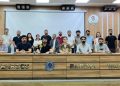
Over 1500 lawyers from more than 30 countries have applied to visit Abdullah Öcalan and other prisoners in İmralı Island Prison, protesting against the restrictions on Öcalan’s access to legal counsel. The group has submitted a formal application to Turkey’s Ministry of Justice, and discussed their concerns at a press conference in Brussels on 16 September. They argued that the conditions in the prison amount to a unique form of isolation, which the European Committee for the Prevention of Torture (CPT) warns may violate international standards against torture and degrading treatment.
The press conference was organised by various legal and human rights organisations, including the Brussels Bar Association and European Democratic Lawyers. Key speakers included Heike Geisweid, co-president of the Association for Democracy and International Law, Thomas Schmidt, Co-Secretary General of European Association of Lawyers for Democracy & World Human Rights (ELDH), and representatives from the Brussels Bar and European human rights groups. The event aimed to highlight the ongoing legal struggle surrounding Öcalan’s treatment and call for greater access to lawyers under Turkish law.
“Abdullah Öcalan, Ömer Hayri Konar, Hamili Yıldırım and Veysi Aktaş, who are detained in [Turkey’s] İmralı F-Type High Security Prison, are unlawfully prevented from seeing their lawyers,” Geisweid said, detailing the petition content.
“The ban on lawyer visits to İmralı Prison clearly violates the United Nations (UN) Standard Minimum Rules for the Treatment of Prisoners (Nelson Mandela Rules) updated in 2015, the recommendations of the Council of Europe’s Committee for the Prevention of Torture and Inhuman or Degrading Treatment or Punishment (CPT) and Turkey’s Execution Law (Law No. 5275).
“The enduring efforts of our colleagues in Turkey against the isolation and violation of the right to defence are essentially a struggle for the implementation of the rights protected in international conventions to which Turkey is a party, especially the European Convention on Human Rights.”
Thomas Schmidt took the stage, and explained that the letter to Turkey’s Justice Ministry addressed “the rights of lawyers in the context of their clients and the rights of prisoners not to be tortured”.
“Our letter has been signed by over 1500 lawyers from 34 countries, and this shows the importance the letter has, and it is very important to demand the Turkish Justice Ministry follow the law and not to violate the law,” he said.
“This is not the crazy idea of some leftist lawyers … we have [significant evidence] that international and European organisations have the same opinion that Turkey is ignoring and violating the law for lawyers and the law for prisoners,” Schmidt reiterated.
“The CPT is quite reluctant to say anything in public, which they should do,” he continued, “but still in everything they have published they show very clearly that Turkey is violating the law and is obliged to allow Abdullah Öcalan and the other prisoners to see their [lawyers] and their families.”
“What is really missing is a clear statement from the CPT … that the law has to be followed by Turkey,” Schmidt stressed. “There is no guarantee that Turkey will follow the demands of CPT but we want to advance the situation… and it also shows to our governments and to the EU that they have to put more pressure on Turkey to follow the law and not to torture people.”
Schmidt also noted a recently published a statement by the United Nations Committee Against Torture, which in contrast to the CPT, stated “quite clearly” that Turkey should adhere to the international convention against torture and allow access to the case files of the four İmralı inmates, and also that disciplinary measures have resulted in an indefinite ban on contact between detainees and their lawyers.
The UN committee pointed to the “regime of aggravated life imprisonment” across Turkey, Schmidt said, and in particular, expressed “profound concern” over the incommunicado detention of Öcalan and the other İmralı inmates, noting that some have had no access to their lawyers in nine years.
“The UN statement is very clear. What is missing is a reaction from our governments and the EU,” he stressed.