

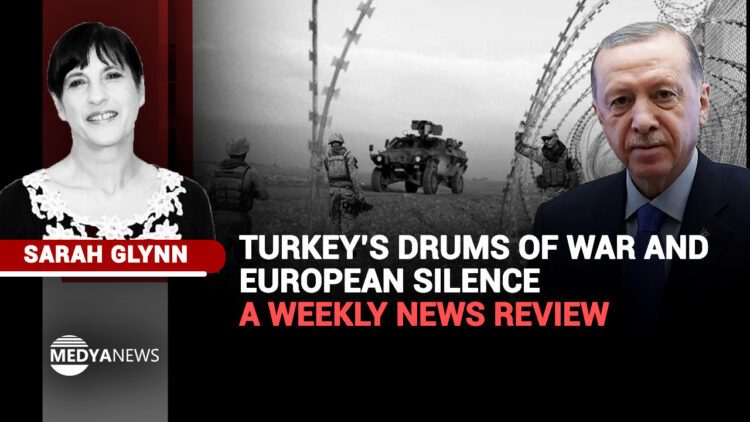
President Erdoğan’s promise to eliminate the PKK – repeated last Tuesday at the police graduation ceremony – is hardly new, but that doesn’t mean that anyone should get complacent. When Erdoğan talks of the PKK, he includes the politicians and security forces in the Autonomous Administration of North and East Syria. This week’s threat has been accompanied by reports of a mass build-up of Turkish forces in the Kurdistan Region of Iraq, and also by tentative indications that Erdoğan and Syria’s President Assad might be moving a step closer to a future rapprochement that could see them combining to crush the Autonomous Administration.
The Kurdistan Region of Iraq
In recent years, Turkish military activity in the Kurdistan Region of Iraq has never let up, but sometimes – as now – it intensifies. Under the guise of eliminating the PKK, Turkey is effectively occupying a large part of the region, and has established a vast network of military bases and linking roads. They have not been able to achieve the control that they would like, and PKK guerrillas are still dug into the mountains, from where they can ambush the invaders and inflict significant loses; but they have made life impossible for the local population, who are increasingly forced to flee their villages and livelihoods. In the first six months of this year, eight villagers were killed in Turkish attacks. Hundreds of villages have already been emptied, and it is claimed that over 600 more are currently under threat. Hundreds of Turkish military vehicles are rolling into the region, and Turkish soldiers have been setting up check points and patrolling village roads.
This is all taking place in Iraqi territory and with the active help of the Kurdistan Democratic party (KDP) and their peşmerga forces. The Barzani family, which controls the KDP, has long hitched their wagon to the Turkish state. The weak Iraqi state that emerged from the debris of the US invasion has never been able to do more than make muted protests, and this spring, memoranda were signed between Iraq and Turkey for greater cooperation on a range of issues. Iraqi border guards now add a further restriction to PKK movement.
North and East Syria
When Syria collapsed into civil war, Turkey backed the Islamist opposition militias that were attempting to overthrow Assad, but which were thwarted by Russian support for the Syrian Government. The militias became mercenaries acting on behalf of Turkish interests. They aided Turkey’s occupations, and continue to attack North and East Syria and the Autonomous Administration’s Syrian Democratic Forces (SDF). In 2022, Turkey declared that Assad’s departure was no longer their aim, and the militias are no longer fighting Syrian troops; however, Assad has made clear that he will not accept continued Turkish occupation in northern Syria. Russia has long been pushing for normalisation between Syria and Turkey, and while Turkey has stated their desire to control the north of Syria – with Erdoğan even holding up a map of his so-called “safe zone” at the United Nations General Assembly before their last invasion in 2019 – they could be persuaded to convert this ambition into an agreement to work together with Syria to eliminate any shred of Kurdish autonomy.
The two obstacles to this are potential opposition from the militias themselves, and the question of Turkish withdrawal from Syria. With regard to the first, Turkish Foreign Minister, Hakan Fidan, implied on Monday that their mercenaries would come on board, stating on Turkish television, “We believe that a more stable Syria, integrated with its government and opposition, will be a more effective actor in the fight against PKK terrorism.” (When Turkey talks about the PKK in Syria, they mean the SDF and the region’s main political party, the Democratic Union Party (PYD), both of which have made clear that they have no intention of attacking their Turkish neighbours.) However, Hayat Tahrir al-Sham (HTS) – the Al Qaeda offshoot that, with Turkey’s backing, has consolidated control over Idlib – might be a different matter from the militias in Turkey’s pay, and the chances of catalysing a strengthened ISIS or new similar groups would also be high.
The day after Fidan’s TV appearance, Syria’s presidential website affirmed “Syria’s openness to all initiatives”; but, it also made clear that any normalisation of relations must be “based on Syria’s sovereignty [and] territorial integrity in its entirety”. Assad wants to see the departure of US and other western troops, the end of autonomous organisation (even though North and East Syria stresses that they are not seeking separation from Syria as a whole), the defeat of HTS, and also the end of Turkish occupation.
The new element in the mix is the involvement of the Iraqi Prime Minister, Mohammed Shia al-Sudani, in the role of mediator, as part of Iraq’s new engagement with Turkey. Negotiations will be taking place in the knowledge that the balance of forces could change following the US election. Donald Trump has shown that he has little interest in keeping US troops in Syria, and the Democrats, too, might consider their withdrawal when not constrained by electoral considerations.
Scharo Maroof reports that a step towards normalisation was taken on Thursday with the opening of a border gate between government-held and Turkish-occupied areas. He reports that some militia fighters attacked it yesterday, but that these were subdued by others. He also foresees resistance from Iran, who face losing their dominant influence over Syria. And he reminds us of the impossibility of predicting what may happen next.
In defiance of Turkish threats and US disapproval, the Autonomous Administration has now committed to holding their postponed elections in August. Turkey, which tries to portray these elections as a threat, may try to make this impossible.
In Strasbourg
Here on the gentle streets of Strasbourg, where the air is heavy with the scent of lime blossom, these political realities can seem to belong to some other world. Even the realisation that in just over a week we could find ourselves under a far-right government feels absurdly incongruous. Our flag-decked Palestine marches give no sense of the nightmare that is Gaza. Impending war in Kurdistan is hard to imagine, and – like the latest developments in Turkey’s erosion of democracy – not something that the great majority of people will even be aware of. But last week was one of the weeks when the Council of Europe hold their parliamentary assembly here – when MPs from the pro-Kurdish DEM Party, who are included in the Assembly’s Turkish delegation, try and raise international awareness of what is happening in their country; when one of the lawyers working on behalf of Abdullah Öcalan comes to the Council and meets with its Committee for the Prevention of Torture (CPT); and when Kurds and their supporters gather at the vigil for Öcalan outside to remind the Council of their duty towards the imprisoned Kurdish leader. So, I took the opportunity to talk to some of our visitors in order to better understand and explain the current state of Turkish politics.
Erdoğan’s war on the Kurds
In a long interview with Berdan Öztürk, one of the DEM Party delegates to the Parliamentary Assembly, we discussed Erdoğan’s commitment to war, and possibilities for peace.
When I asked him if he thought Erdoğan had turned his back on a peaceful resolution of the Kurdish Question and chosen to pursue an option of all-out destruction, in the same way that the Sri Lankan Government had crushed the Tamil Tigers, he responded that Turkey had been following the Sri Lankan model for a long time.
“Erdoğan doesn’t want peace. He discovered that the peace process of 2013-15 strengthened the HDP [the DEM Party’s predecessor]… A dictator wants war always… They don’t have any suggestion in regard of economy… There are many social problems… cultural problems… ecological problems. They don’t have any solution for that… They have just one option, to be enemy of Kurdish people, and try to sell it to Turkish people as well. OK, we have enemy, we are in the war, you have to support us, just be quiet, don’t speak out… [M]ost Turkish cities don’t see it as a war. They see it as a defence…”
“He invested everything into the war against Kurdish people, Kurdish status. He cannot go back anymore to a peace process… He has taken a lot of risk for one goal: to destroy resistance or movement of freedom for Kurdish people… He said, we made a big mistake in Iraq, in regard of Kurdish people and their status. We are not going to repeat it. We are not going to repeat it in Syria.”
For Öztürk, then, the main role of his DEM Party is to explain to Turkish people, “there is a war. We have a solution… You witnessed the way of the solution between 2013 and 2015. You can compare two years of this process with all of the history of Turkey… There is only one solution. The Kurdish question must be solved… The way to find a solution is a dialogue. There is no other way.” And he notes, “we should tell the people of Turkey that if the economy is in bad situations, the reason for that is the war against Kurdish people.”
When I asked Öztürk about the position of the main opposition Republican People’s Party (CHP), which is rooted in Turkish nationalism, he pointed out that the party covers a wide range of perspectives, but that they, too, can see reality and the need for change. He commented that the March local elections – in which the CHP gained at the expense of the ruling Justice and development Party (AKP), and the DEM Party proved its importance in Kurdish majority areas – provided the CHP with an opportunity to take a different road and not suffer a similar fate as the AKP.
I discovered, after our discussion, that the Sri Lankan comparison was made by the CHP MP Sezgin Tanrıkulu as long ago as 2016. A human rights lawyer and now an elected representative for Diyarbakır, Tanrıkulu opposed the arrest of academics who signed a petition for peace, and spoke out against Turkey’s invasion of Syria in 2019. He represents the humanitarian wing of the CHP, but there are others who think very differently, or who prefer to stay silent.
Repression within Turkey
The other DEM Party delegate in Strasbourg was the party spokesperson, Ayşegül Doğun. Although she was elected an MP a year ago, this was the first time that she had been able to come to Strasbourg. She explained to me that there was a case against her in Turkey under terrorism law, though all the evidence citied consisted of legitimate activities for her former role as a journalist. Her election should have given her parliamentary immunity, but this was only recently implemented. Even after that, when she tried to go to Paris for a meeting of the Council of Europe’s Social Affairs Committee earlier this month, she found out at the airport that she was not allowed to leave the country. She is only able to travel now due to intervention by the Council of Europe.
Meanwhile, two DEM party co-mayors who planned to accompany the delegation to Strasbourg so as to inform the Council about Turkey’s attacks on local democracy, have found themselves among nine DEM party mayors who have been given a travel ban.
My interview with Öztürk also looked at other examples of repression in Turkey. He observed that the replacement of the mayor of Hakkâri with a government trustee has found little support outside the ruling AKP, but that protests have elicited no public statement from the Council of Europe, the European institution established to protect human rights, democracy, and the rule of law. He further observed that Hüda Kaya, one of five former HDP MPs whose trial in the “Second Kobanê Case” began on Tuesday, prompted especial government anger for choosing to represent the HDP (the fore-runner of the DEM Party) despite being a religious Turk; that the HDP closure case still hangs over many politicians – including himself – who could find themselves banned from party politics for five years; And that last week’s disastrous fire, which has been shown to have been the result of badly maintained electrical infrastructure, demonstrated the government’s lack of care for anything in Kurdistan.
Abdullah Öcalan
At the centre of Turkey’s oppression of the Kurds is Turkey’s abuse of Kurdish leader, Abdullah Öcalan, who has been isolated in İmralı island prison for 25 years. Cengiz Yürekli, one of Öcalan’s lawyers, came to the Council to demand that they comply with their obligations and make Turkey respect Öcalan’s basic human rights. Turkey – a Council member who must comply with the European Charter of Human Rights – keeps Öcalan in conditions that are regarded as torture, and isolates him illegally from his lawyers and his family. For 39 months he has had no contact at all with the outside world, bar one visit from the Council’s Committee for the Prevention of Torture (CPT) in September 2022, about which the CPT will say nothing.
The CPT has the right to visit all prisoners in member states, and Yürekli met with officials from the organisation yesterday. He told me beforehand that he was going to demand that they send another delegation to İmralı island prison and that they make an open and transparent statement following their visit. He stressed that this could be done without requiring Turkey’s permission – which is needed for publication of their full report – and that this is an emergency in which every minute counts. He emphasised that what happens in the Middle East affects Europe too; that Öcalan fights for the identity of a people whose history is erased, whose language is banned and who have been subjected to massacres; and that Öcalan is also the author of a philosophy that represents the values of humanity, showing a way to live in harmony with nature and in equality with other people.
Öcalan’s importance for humanity, and the failure of the Council of Europe to fulfil their role and protect his rights, were highlighted by international speakers at the press briefing held at the permanent vigil for Ocalan opposite the Council building, on the occasion of the vigil’s 12th anniversary. The speeches were opened by Irish MP, Paul Gavan, who highlighted the hollowness of the Council’s slogan “united around our values”, and the “shame and disgrace” of the Council’s ignoring of the Kurdish Question and of the very just demand that Öcalan must be free. He observed that the freedom of Julian Assange – announced that morning – shows the power of campaigning, and that peace requires dialogue, for which Öcalan is the key.
Sarah Glynn is a writer and activist – check her website and follow her on Twitter


