

Sarah Glynn
Turkey’s President Erdoğan is a master of the ruthless chess game that is international politics, where he manoeuvres simultaneously on different fronts. Having no qualms about changing allegiances, while always being ready to crush internal opposition, probably helps.
The relatively poor showing in the recent elections for his Justice and Development Party (AKP) should have given Erdoğan cause for a rethink of his focus on war policies, which are eating up state resources while leaving Turkish citizens struggling for survival. But, instead, he seems determined to double down on his Turkish ethnic nationalism, attacking Kurdish resistance at home and abroad, and using the Turkish military to expand Turkish power and control across the borders into Iraq and Syria. In pursuing the path of aggression, he is taking advantage of international political convulsions, and also of the general lack of interest in Turkey’s persecution of the Kurds.
In the mountains of the Kurdistan Region of Iraq
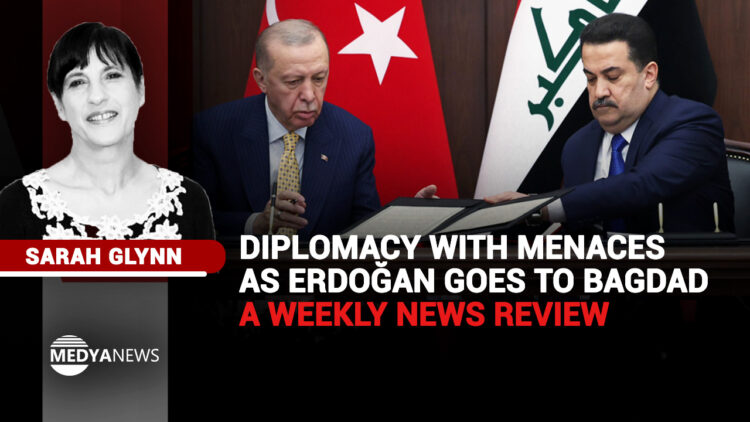
Last Sunday, the PKK announced that the Metîna area of the Kurdistan Region of Iraq had been under intensified Turkish attacks since the night of 16 April. Turkish military vehicles have been crossing the border into the Kurdistan Region, and “relentless air and artillery strikes are being reported”. Erdoğan has made clear his intention to take control of all the areas where the PKK have their bases, and destruction of the PKK was at the centre of his agenda when he met the Iraqi Prime Minister, Mohammed Shia’ Al-Sudani, on Monday. Backing his demands with military aggression is Erdoğan’s style of diplomacy.
This was Erdoğan’s first visit to Iraq since 2011, and he signed two agreements, two protocols and 22 memoranda of understanding with the Iraqi government before also visiting the Kurdistan Region of Iraq. In Erbil, the Regional Government, dominated by the Kurdistan Democratic Party (KDP), not only rolled out the red carpet, but also turned the city’s fortress red with a giant projection of the Turkish flag – to the fury of Kurds across the globe. This is not the first foreign flag to have been projected on those ancient walls, but it was a slap in the face to all those Kurds who have suffered at the hands of the Turkish state. The KDP’s servile relationship with Turkey was further underlined by Turkey’s refusal to use the official name, which includes “Kurdistan”, opting instead for “Iraqi Kurdish Regional Government”.
Water, oil, and trade
The implications of these meetings and agreements have been – and will continue to be – the subject of speculation and debate, but I will try and outline current understandings.
The agreements covered four areas: water (probably the most important for Iraq, the downstream party, which is suffering from severe water shortage); oil export; the planned Development Road linking the Persian Gulf to Turkey and so on to Europe; and (the priority for Turkey) the PKK bases in the mountains of the Kurdistan Region of Iraq. I will look quickly at the first three areas before trying to clarify what was agreed with respect to the PKK.
The water agreements allow for an increase in the flow of river water, which Turkey had severely reduced, and also for Iraq to be given Turkish help to build more efficient irrigation systems. The oil agreements would open the pipeline for the export of oil through Turkey, under the auspices, at the Iraqi end, of the Federal Government in Bagdad. The agreement for the $17 billion Development Road Project was also signed by Qatar and the United Arab Emirates, who will invest in it financially. In all these cases, the agreements allow Turkey to gain further influence and control over Iraq.
The gap between agreements and actual implementation on the ground remains large, and the different agreements do not function independently of each other. Iraq’s desire to put into effect the agreements on water and oil could become exploited as a lever to attempt to push Iraq to take a harsher line towards the PKK; and the Development Road is imagined as doubling as a strategic barrier that would need to be cleared of guerrilla forces.
Relations with the PKK
With respect to the PKK, it is clear that Turkey did not achieve all they wanted, though accounts of what was actually agreed vary widely.
Erdoğan hopes to persuade Iraq to label the PKK as a terrorist organisation. Last month, following a visit from Turkey’s foreign minister, Iraq announce that they were banning the PKK, but what this meant in practice was undefined, and Iraq has continued to resist classifying the PKK as terrorists.
The New Region refers to a “lack of concrete results on the joint combat with the PKK”, concluding that Turkey would continue their attacks on the Kurdistan Region, while Iraq would continue to protest this violation of their sovereignty.
Qatari-owned, New Arab talked with various people who claimed to know what was agreed on Monday – and received some very different answers. Some claimed that Iraq had given Turkey a mandate to attack PKK controlled areas; however, the Turkish Defence Minister stated much more vaguely that a decision had been made to establish a joint operations centre, whose responsibilities would become clear. One of the New Arab’s informants also pointed out that Iraq’s military capabilities are limited.
Reuters reported that Turkey has offered Iraq technical assistance for border control, and at Monday’s joint press conference, the Iraqi Prime Minister said that the two countries would cooperate to improve border security. He didn’t mention the PKK.
Fehim Taştekin observed for Gazete Duvar “The Iraqis do not want to suddenly turn relations with the PKK into a relationship of ‘enmity’. They believe that ‘when Turkey solves its Kurdish problem, the PKK will be solved’. They see Turkey’s operations as a violation of their sovereignty and territorial integrity. Those who call it ‘occupation’ and even fire rockets at [Turkey’s] Bashiqa [air]base [east of Mosul], are among the stakeholders of the Sudani government.” Taştekin noted that Iraq had repeated their assurance that they couldn’t “authorise an attack on another country from Iraqi territory”; and he explained that “the declaration of the PKK as a “banned organisation” was welcomed by Turkey” but that “No serious changes or measures are expected in practice.”
So, what is the situation for the PKK in Iraq? Taştekin quotes Iraqi Government Spokesperson Basim al-Awvadi speaking to Rudaw: “Each PKK member in Iraq will be considered a political refugee, but will not have the right to engage in political or military activity or carry weapons. They will be supervised by the Iraqi government, the UN and international humanitarian organizations.” Al-Awvadi told Rudaw that Iraq’s approach to the PKK would be similar to their approach to the Kurdish dissident and guerrilla groups from Iran.
After heavy Iranian bombardment and many fatalities, and under threat of Iranian invasion and more Iranian attacks on their bases – guerrillas of the Kurdistan Democratic Party of Iran and of Komala had moved to civilian camps, away from the border areas. However, guerrillas from the Kurdistan Free Life Party (PJAK)– the ideological cousins of the PKK – who are located in the remote mountains, remained where they were. The PKK is also ensconced in the mountains, and it is a much bigger organisation than the Iranian groups and much better equipped. The Iraqi government cannot be expecting them to move, but not all PKK members are active guerrillas.
The United Nations High Commissioner for Refugees (UNHCR) recognises “no right per se” for refugees to take part in political activity, and Iraq would not be the first country to attempt to ban political activity for refugee Kurds. (Such a rule could not apply to PKK members with Iraqi citizenship.) Section 47 of the German Residence Act allows the restriction or prohibition of political activity for foreigners for a wide range of reasons, and has been criticised by the European Court of Human Rights for preventing freedom of opinion. In response to a question from Die Linke’s Gökay Akbulut in the Bundestag in August 2022, the Minister of the Interior said that the ban was then being imposed on 13 people, of whom six were Kurdish.
In Erbil
There is no public record of what deals Erdoğan discussed with the different members of the Barzani clan and the elite of their KDP in Erbil, but we can be sure from past experience that any benefits will accrue to their own power and wealth and not to the citizens of the region. The political dangers resulting from the KDP’s collaboration with Turkey’s occupation of the region prompted yet another call for Kurdish unity from the Kurdistan National Congress (KNK), which held their general assembly in the Hague last Saturday. Meanwhile, the personal tragedies consequent on the region’s endemic corruption were highlighted by a brief story from London. The hopelessness of life in Kurdistan drives many people to try and seek a new life elsewhere. There have been several stories of people from the region drowning in the English Channel. This week, two men committed suicide after learning that the British Government was going to send them back.
The PUK
The Kurdistan Region’s other main political party, the Patriotic Union of Kurdistan (PUK), which had delegates at the KNK assembly, failed to persuade Erdoğan to lift the closure of Turkey’s airspace to flights to and from Sulaymaniyah. Effectively, the KDP controls Erbil and the northwest of the region, while the PUK controls Sulaymaniyah and the southeast. In blocking the flights, Erdoğan is punishing the PUK for working with the Syrian Democratic Forces (SDF) in the fight against ISIS, and for having generally more cordial relations with the PKK. There were no protests against Erdoğan allowed in Sulaymaniyah as well as in Erbil, and the issue of the airspace ban was raised by Kurdistan’s Deputy Prime Minister, who is from the PUK; but Erdoğan was unmoved and only threatened to punish the PUK further. The PUK leader, Bafel Talabani, responded by giving a posthumous award to an SDF commander with whom they had worked and who had died in a helicopter crash.
In North and East Syria
Erdoğan has made it very clear that the Autonomous Administration of North and East Syria is also on his invasion list. Even without another major invasion, Turkey’s recent attacks on the region’s infrastructure, constant small-scale bombardments, and ever-present threat of worse to come affect every aspect of life in the region – as they are meant to do. Turkey wants to terrorise, demoralise, and drive people away. They want to prevent the autonomous administration from being able to provide secure conditions, and so – they hope – turn people against them.
Fattah Issa, for North Press, has been talking to farmers to learn how the constant threat of attack holds them back from improving their lives and investing in the future. They dare not borrow money to build a well, invest in solar panels to power a pump, or buy new livestock because something may destroy what they are creating or prevent the harvest, leaving them burdened by debt. Despite the risks, some people try and emigrate.
The instability is providing fertile territory for the revival of ISIS, who benefit, too, from the safe havens offered by the Turkish-occupied regions. Danny Makki for al-Monitor also blames the ISIS resurgence on spill-over from rising tensions between Israel and Iran, world focus on Ukraine and Gaza, conflict between the SDF and Arab tribal groups in Deir ez-Zor, and lack of co-ordination between the SDF and President Assad’s Syrian Arab Army. (Curiously he omits to mention the destabilisation caused by Turkey.) The Autonomous Administration reports that their attempts to negotiate with Assad for a new political settlement for Syria continue to be rebuffed.
In Turkey
Kurdish regions within the Turkish border are also the site of Turkish military activity. This is accompanied by curfews and entry restrictions for local villagers (as in rural Bagok and Gabar and Cûdî Mountains). Mass detentions are carried out under “terrorism” laws (as in Kızıltepe and Cizre.
Newly elected mayors from the pro-Kurdish leftist DEM Party have been accused of omitting to play the national anthem – in Mardin – and of removing the Turkish flag – in Diyarbakir. The accusations have been refuted, but have been interpreted as the potential first steps in the mayors’ removal in favour of government trustees. An attempt was also made to smear a mayor from the Republican People’s Party with a clearly Photoshopped image to which a poster of Abdullah Öcalan had been added.
Tuesday saw the detention of nine more Kurdish journalists in police raids in Ankara, Istanbul and Urfa.
In Europe
Turkey is able to run roughshod over human rights laws at home, and to throw their weight around internationally, because they are never held to account for what they do. Worse, self-interested politics persuades other countries to act as Turkey’s helpers, including in their persecution of the Kurds. The terrorist listing of the PKK is an example of this. Listing is a choice based on politics, not security considerations. When the European Union put the PKK on their terrorist list, the party had declared a unilateral ceasefire and was searching for peaceful political negotiations.
When the nature of the PKK was examined in court in Belgium, the country’s highest court – the Court of Cassation – concluded that the PKK was not a terrorist group but a party in a non-international armed conflict, and was therefore bound by the laws of war, not criminal law.
Despite this ruling, Belgian armed anti-terrorist police raided the Television studios of Medya Haber and Sterk TV (Medya News’ big sisters) in the wee small hours of Tuesday morning, breaking down doors, vandalising equipment, and confiscating computers. It was later learnt that the Belgian Police had acted at the behest of the French authorities; and that same day nine Kurdish activists were detained in France.
Jan Fermon, the lawyer who represented the PKK at the historic Belgian court case, told a press conference in the wake of the police action, “if indeed [financing the activities of the PKK] is the motive of today’s raids, then the Belgian authorities should have refused to do this at the request of the French authorities… It’s very strange that while our Supreme Court decided that anti-terrorism laws do not apply to the PKK and to the Kurdish organisations which are allegedly linked to the PKK, that today, under the pretext of a French investigation, the Belgian prosecutor apparently forgets about this decision of the Supreme Court and organises the raid as we have witnessed here this morning.”
It is only four weeks since the Belgian Prime Minister turned events on their head to accuse Belgian Kurds of terrorism after they had been attacked by Turkish fascists; and it is two weeks since we learnt that the man who was found guilty by a Belgian court of planning to assassinate two leading Kurds had been left to live openly in France. These cases, along with France’s failure to properly investigate the murder of three high-profile Kurdish women in Paris in 2013, and failure to examine links between this triple murder and the Brussels case, pose many questions about the judicial neutrality of these states when Turkish interests are involved.
This week’s ransacking of the television studios prompted public statements against the raid and in support of free media, including free Kurdish media. One of those who spoke out was Dutch MP Kati Piri, who was formerly the European Parliament’s Rapporteur on Turkey, and was interviewed by Erem Kansoy for ANF.
There are claims that, in 2009, Turkey vetoed the appointment of the former Danish Prime Minister as Secretary General of NATO until Denmark agreed to close Kurdish television studios – then Roj TV – located in their country. The next candidate for Secretary General is Dutch, and Al-Monitor suggests that Netherlands-based Firat News Agency may find itself targeted.
After the raid on the television studios, the Conseil démocratique kurde en France (CDK-F) wrote, “French diplomacy, by treating the Kurds for decades not as partners but as bargaining chips to appease Turkey, has shown its inability to defend the values it claims to embody.”
The denial of rights is not unique to the Kurds. It is part of a world-wide abandonment, by increasingly authoritarian governments, of hard-won fundamental freedoms. On the same day that our offices were raided, here in France, the leader of the left in parliament received a police summons for calling for peace for Palestine; and the European Parliament voted for austerity. Liberté, égalité and fraternité seem to have been forgotten, but there are many other groups that have been similarly affected, and are ready to come together to get those rights back.
*Sarah Glynn is a writer and activist – check her website and follow her on Twitter.


