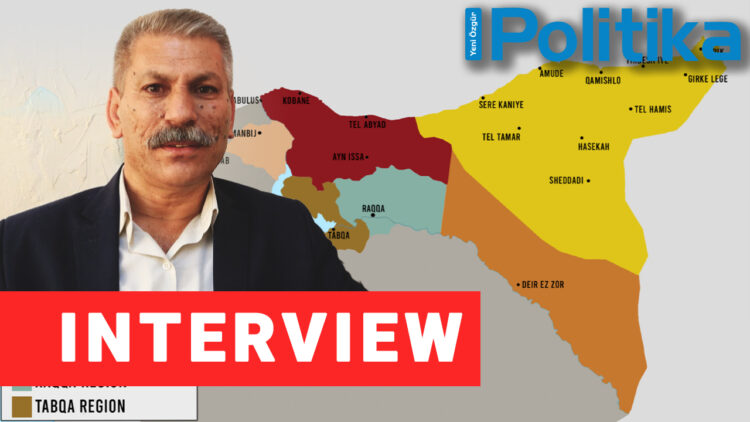
This interview with PYD Co-Chair Xerîb Hiso, conducted by Miheme Porgebol for Özgür Politika, offers insights into Kurdish perspectives on the conflicts reshaping the Middle East. The Democratic Union Party (PYD) is a Syrian Kurdish political organisation central to the governance of the Autonomous Administration of North and East Syria (AANES), also known as Rojava. The PYD advocates for Kurdish autonomy and rights within a democratic, multi-ethnic system, aiming to provide a model of self-governance in a region long impacted by conflict.
In the interview, which took place shortly before the recent escalation of Turkish attacks on Kurdish cities in Syria—beginning 24 October and targeting vital infrastructure—Hiso describes these actions as driven by fear in both the Turkish and Syrian governments. He underscores the alliance between major powers like Turkey and Russia, which he says perpetuates instability in Syria and across the Middle East. Hiso’s comments highlight the Kurdish struggle as a significant, resilient force amid shifting alliances and escalating violence, with the potential to shape a peaceful future for the region’s diverse populations.
This English translation is provided by MedyaNews.
Miheme Porgebol, Özgür Politika: The wars and conflicts in the Middle East are deepening with each passing day. They have spread into Syria and have now reached the borders of the Autonomous Administration. How does the Autonomous Administration and the PYD interpret this period that the Middle East is going through?
PYD Co-Chair Xerîb Hiso: The process the Middle East is currently experiencing is not new. The attacks and wars we witness today are continuations of longstanding conflicts that began in Kurdistan. At the core of the escalating conflicts lies the unresolved Kurdish issue. The occupying states relentlessly maintain their assaults across all four parts of Kurdistan, implementing genocidal policies without pause. The obstruction of a solution to the Kurdish issue on a Middle Eastern scale by four different states is leading to ever-deepening conflicts day by day.
The deadlock itself foretold that clashes and wars would only escalate. As long as this issue remains unresolved, international powers have engaged in a fierce competition over Middle Eastern lands. They have left no alternative other than war and death, poisoning life for the peoples of the Middle East. Middle Eastern peoples have been deprived of their legitimate and natural right to live freely. On one side are nation-states, and on the other, hegemonic international powers, both of which are effectively roasting the peoples of the Middle East on a hot iron plate.
Could you describe the stage we are at today?
Today, we are at a highly dangerous stage, and the situation is creating even more risks as it progresses. This chaos didn’t start with Israel’s attacks on Hamas; its roots are much older. However, after the attack Hamas carried out on Israel on 7 October, with the support of certain powers, the situation shifted to a new phase. The war in the Middle East is unfolding on the stage of a Third World War.
As the conflict intensified, international public opinion was stirred into action. Some parties called for a ceasefire and prisoner exchanges, yet even after a year, there has been no progress on this front. In contrast, Israel has escalated its attacks. It has pursued Hamas, targeted Hezbollah, gone beyond Palestine, and entered Lebanon. Occasionally, it crosses from Lebanon into Syria as well. Regional states’ concerns have been heightened.
Currently, there is no one striving to stop the ongoing conflict or to prevent it from expanding further. Instead of efforts to halt the war, what we see are more alliances and support. For instance, there are groups supported by the Turks; Iran backs certain factions, Western states support Israel, while the Arab nations have been rendered powerless. This situation allows states to intensify threats and provocation against one another, putting the region at great risk.
This major risk will not, and cannot, be limited to Lebanon and Palestine alone. The first step in the strategic plan of this war was to eradicate Hamas and Hezbollah. So, where will the remnants go after Hamas and Hezbollah are eliminated? Will they go to Syria? To Jordan? To Sinai? This is an important question, and the answers will become clearer in the second phase of the conflict. However, regardless of where they go, the attacks against them will not cease; in fact, they will continue with increased intensity.
The attacks have drawn close to you as well…
That’s correct; the attacks are indeed close to us. But in the face of these attacks, what are we to do? In such a period, all we can do is take precautions. We will make our calculations. The most important thing we can do during such attacks is to bolster our defence forces, to strengthen the spirit of resistance, and to prepare our lines and positions. In the current situation, the Kurds and the Autonomous Administration hold a very critical role. The primary emphasis here is on taking a strong stance. Unity among peoples, fostering a shared stance in Rojava, maintaining our party’s own position, and relationships with other parties are among the key precautions we need to take.
They say Israel has a project spanning from the Nile to the Euphrates, a project Israel has been working on for 70-80 years. If we accept the existence of such a project, we must recognise that a massive war awaits us. At the same time, Turkey has its own expansionist project. Under the name of the Misak-ı Milli (National Pact), they have set their sights on a wide area, including many cities from Aleppo to Southern Kurdistan [Kurdistan Region of Iraq, known as Başurê]. This is an occupation and genocide project Turkey has voiced for a century. Such projects disturb society; society does not accept such ambitions. The period we are currently experiencing is one that will determine the fate of both the people and the ruling powers.
The ruling powers have put their own fate in jeopardy. On the other hand, the people now see their fate and future as something they determine for themselves. The Democratic Nation project exists precisely for this reason. The Democratic Nation project may be a new initiative, but it has already created a significant counterbalance to these two occupying projects. People and communities are embracing this project, recognising their will within it because it does not contain invasion, death, ransom, or massacres. This project also holds the potential for a permanent solution to all the issues in the Middle East. The people have educated and organised themselves on the basis of a revolutionary people’s war. We are taking both internal and external precautions. Internally, we are standing united, defending our values and continuing our preparations along the same lines as we resisted in the past. As a legitimate right, we will protect our borders and defend our interests, as there is no atmosphere of security.
Could you elaborate on the phrase “There is no atmosphere of security”?
In our region, we face numerous enemies. For instance, the occupying Turkish state issues daily threats. Turkey itself is gripped by significant fear and panic, which may well be the result of a tactical political manoeuvre. Can the politics of the AKP-MHP [Justice and Development Party – Nationalist Movement Party] alliance be trusted? The same holds for the regime. The regime is also beset by considerable fear. It cannot break away from Iran, Hezbollah, or Russia. This war has, in truth, put the regime in a corner. Dialogue with the regime could have been a key to resolution. The Damascus government needed to take certain steps, such as initiating dialogue and consultation with the Autonomous Administration.
Had it taken such steps, it might not have found itself ensnared in these conflicts. By not taking these actions, the government is not only placing itself in a difficult position but also putting its people at risk, sacrificing them to dirty and dangerous politics. This applies not only to Lebanon and Palestine but also to Israel and Turkey. Unfortunately, the ruling states in the region do not act according to their own will. Syria is no exception to this. They act under the will of external forces, pursuing policies in line with the agendas of international powers through various methods. It is unclear who is controlling whom in this scenario.
What is the current position of international powers in Syria?
For about 13 years now, Syria has been a battleground. During this period, the geography of Syria has fragmented. The country is barely holding on under extremely challenging conditions. On the one hand, Iran, and on the other, Turkey have interfered in ways that have fragmented Syria both socially and geographically. Without our resolve, the areas liberated by the Autonomous Administration would also have been lost. However, the Arab states did not intervene in this issue at all. If the Arab states had played an active role, perhaps Iran and Turkey would not have been able to interfere in Syria to this extent.
The Ba’ath Party’s racist stance towards Arabs caused a rift. The neighbouring occupying state, Turkey, entered Syria with all its economic, political, intelligence, and military power and has gained considerable benefit from this situation. This outcome was possible because the Arab states stayed distant, and perhaps they were indirectly enabling Turkey’s plans. Iran, meanwhile, wanted to secure its corridor from Tehran to Beirut. But as it stands, the conflict has escalated, creating significant dangers for everyone involved. Major and profound contradictions have emerged. Israel wants to remove Iran from Syria, while the regime wants the Turkish occupation to end. In short, dangerous scenarios are unfolding within Syria.
Are the recent attacks on Aleppo part of these scenarios?
Absolutely. All parties aim to gain control of major trade centres, and Aleppo is at the forefront of these. Turkey has even claimed, “Aleppo is ours.” Iran is also vying for control of Aleppo. With everyone wanting a piece, what’s left for the regime? Recently, Israel has shown increased activity in Syria, seeking to expand its influence within the country, sometimes even crossing the border to intervene. We can see this in the media. But what is this a result of? It’s entirely due to the deep contradictions in the region. Turkey, with its proxy militias, aims to reach Aleppo. The plan to surround and seize Aleppo with these groups has underlying motivations.
What are these plans?
Each time conflict and turmoil in southern Syria intensify, Turkey moves its militias further south. The latest instance saw Turkey directing its forces towards Aleppo. Until recently, Turkey was dependent on the regime. But recent regional developments have relieved Turkey of this dependency, and it now seeks to use this as leverage, diverting the regime’s attention to Aleppo. If there is movement in southern and southwestern Syria, the regime may struggle to sustain fighting on so many fronts. This reality should not be overlooked. The concentration of attacks is essentially an attempt to broaden the battlefield, and Turkey is keen to take advantage of this. Meanwhile, Israel already refuses to accept Iran’s presence in Syria, or the presence of Hezbollah, Hamas, and other militant groups, which contributes to conflict within Syria itself. Effectively, all groups within Syria are under attack.
Aleppo is a major city and economically the strongest centre in Syria. Everyone wants influence over this city. If the threat over Aleppo materialises, Syria will fragment and face complete defeat, likely leading to a new era of occupation that could last another hundred years. Neither the local populations around Aleppo nor we can accept this. Losing Aleppo would open up vast areas to occupation. Thus, all components of Syrian society place great importance on Aleppo and reject these plans.
Consequently, as an occupying force in Syria, Turkey will never find peace here. It sustains proxies and agents, using intelligence, military, and economic means to create influence in Syria. It does so even at the cost of plunging its own people into poverty. Amid all its internal problems, they say, “Turkey is in a tough spot, let’s occupy Aleppo.” Yet, seizing Aleppo will not solve Turkey’s problems. Turkey cannot survive by backing militias; instead, this policy weakens the Turkish people.
Turkey has been led into a disaster. To cover this up, it first attacked Southern Kurdistan, where it is currently waging a large-scale occupation war. Now, with the support of militias and the air power of the Turkish Armed Forces (TAF), it wants to capture Aleppo. However, taking Aleppo into the hands of militias, Turkey, or Iran will not be so simple. Everyone is aware of Turkey’s motives. Turkey is a state that has survived by causing discord, by instigating conflicts among peoples, and, as it has until now, continues to stand by spilling the blood of these communities.
What can you say about Russia’s role in Syria?
Russia has a significant influence and role within Syria. After entering Syria, Russia engaged in various diplomatic initiatives in the region, enabling certain other states to establish a presence in Syria. Then, the ongoing war between Russia and Ukraine broke out. One of the main aims of this war is to weaken Russia’s influence in the Middle East. In fact, the Ukraine war acts as a barrier, hindering Russia from taking further steps in the Middle East. Russia’s involvement in this conflict inevitably impacts Syria and the broader region, shaping the scale of the steps Russia can take in the Middle East.
Fundamentally, Russia is not only waging a war against Ukraine but is essentially in conflict with NATO. Turkey and Russia rely on each other both in Ukraine and in Syria. This reliance is entirely based on political and economic interests. Turkey and Russia share common interests in both conflicts, leading to various calculations and plans. If Russia did not maintain this level of relations with Turkey, it might have been able to resolve the Syrian issue. However, Turkey’s role in Syria complicates things for Russia. Similarly, Turkey has a role in the Ukraine war, and if Turkey were not to support Russia in this context, Russia would face difficulties there too. In essence, Russia manages its affairs with the Turks, and vice versa.
Russia initially intended to take certain steps and even served as a guarantor for a time, but it no longer holds that position. During its tenure as a guarantor, it remained passive regarding ceasefires and initiatives aimed at resolving the conflict. As a result, this created space for Turkey’s policies focused on suppressing and targeting various groups within Syria. Turkey can, therefore, target different communities within Syria, be they Kurds, Arabs, Christians or Assyrians. Turkey wants the Syrian conflict to remain unresolved or to be resolved in a way that serves its own interests. However, if the issue is settled according to Turkey’s terms, then Iran and Russia’s interests in the region would be jeopardised.
Notably, there are agreements between Syria and Turkey, the most important of which is the Adana Agreement. Turkey frequently uses this agreement, which grants it the ability to intervene throughout Syria, not just along the border. This agreement enables a different kind of occupation. Using it as a basis, Turkey justifies deploying its militias in Syria, citing various sensitivities and security concerns. These groups are also involved in terrorist activities globally, highlighting the extensive dangers posed by Turkey’s presence in Syria.
Could Russia still be a solution actor at this stage?
Yes, Russia still has a role and could act as a solution actor. If it so chooses, Russia could indeed facilitate a resolution. Our solution is a decentralised, democratic one, a formula prioritising equal rights for all social components within Syria. We advocate for the establishment of a democratic national principle, as it’s time for the rights of the peoples to be recognised. How else can a solution be found in Syria? Meanwhile, Russia’s goal is to return Syria to its pre-2011 state.
Russia’s project in Syria is essentially this; its presence here is entirely grounded on that objective. Turkey and Iran, for their part, each envision a different version of Syria to suit their interests. But what do the Syrian people want? They want a decentralised, democratic Syria within the framework of a democratic nation. This is the correct path. The future of Syria lies here because Syria can never return to the pre-2011 era; that page is closed. Moreover, the Syrian people will never accept Turkish influence. Turkey’s stance is one of destruction, hostility, and oppression, something no one in Syria would accept.
As TEV-DEM, the PYD, and the Autonomous Administration, we have consistently stated that we keep our doors open for dialogue with both the Damascus government, Russia, and other regional powers. If Russia does not play a role in resolving this issue, it will again fall into a passive position and lose its influence. Such passivity in Syria could have negative repercussions for Russia in other regions as well. However, Russia has strong resources to avoid this outcome and can leverage them, as there are viable methods and pathways to a solution. Therefore, Russia still has the potential to be a powerful actor for peace in Syria at this point.
You also follow domestic politics in Turkey. There is a flurry of contacts between political parties, and some interpret this as Turkey preparing for change and transformation. What are your thoughts?
Turkey has not embarked on any meaningful change. With the AKP-MHP alliance in power, the likelihood of genuine change or transformation in Turkey is slim. Any transformation they attempt will be solely to preserve their grip on power. Unfortunately, the situation Turkey finds itself in—the people’s conditions, relations with neighbouring countries, the establishment of social rights, or the recognition of the people’s will in terms of law and freedom—cannot be expected to change under the AKP-MHP. Even if they desired change, they would be unable to deliver it because these are structures that have cultivated hostility towards the people, even towards their own people. The underlying cause of Turkey’s current difficulties is precisely this hostility.
Recently, various developments have unfolded. The MHP shook hands with the Democratic Party (DEM), and this is presented as though it were an extraordinary event, as if something significant would change in Turkey. It’s portrayed as if everyone is pleased and satisfied with this picture, but that is not the case. We do not view it in this way. There have been meetings and alliances between the AKP and CHP, which are indeed normal occurrences as Erdoğan and Bahçeli are playing a tactical game. This, of course, stems from their fear of losing power. They are afraid of the fascism they have imposed, the oppression they have inflicted upon the people, the massacres they have perpetuated, and the unending wars they continue in Southern Kurdistan and Rojava.
So, what are they strategising for? What will these messages bring?
Not every message leads to transformation. If an alliance forms between the AKP, MHP, and CHP [Republican Peoples’ Party], that would pose a real danger and result in a negative shift. Erdoğan is exalted by hundreds of media channels, creating a war narrative under the pretext of Israel, constantly highlighting perceived border threats. But what is Erdoğan truly afraid of? Surely, he isn’t afraid of Israel invading Turkey; Israel is already present here. They have bought vast tracts of land, established numerous companies, and for years, the AKP and MHP have supported Israel on every level. These are not hidden facts. We must not forget that Turkey’s government operates as a terror regime—one that has thrived on terror, nurtured it, and sustained itself through it. This government’s policies instil fear and concern both domestically and abroad. They continually pursue aggressive policies.
In reality, they fear Turkey becoming like Syria or Iran, where uprisings arise among the people. Additionally, as previously admitted repeatedly by the state, if democratic rights are promoted in Turkey, if anti-AKP protests emerge, and if the demand for rights increases, the Kurds will be the primary beneficiaries. To prevent this, the opposition also refrains from raising any democratic demands. The opposition remains silent in the face of fascism. This silence reveals that policies aimed at destruction are actually shared and agreed upon across the political spectrum.
Is this fear also behind the attacks on North and East Syria?
Indeed, what has been established right next to Turkey is a life where people of different backgrounds live together, united, maintaining their values on a moral and political foundation. This has developed within the paradigm introduced by Abdullah Öcalan. The primary fear of the AKP-MHP alliance is exactly this because, if Turkey undergoes any transformation in the future, it will happen based on this paradigm. Erdoğan enforces these policies to prevent a transformation founded on the united struggle and resistance of the peoples, led by women. He tries to instil fear within Turkish society, invoking the idea that “our homeland is at risk,” in an attempt to suppress the spirit of democratisation and resistance, and to block the freedom of the people. This is the central aim of the AKP-MHP government.
Even the CHP and other Turkish parties need to recognise this reality by now. Collaborating with a fascist and oppressive regime will not lead the CHP to a safer position; the CHP must carefully consider this. Take a look at Turkey’s other neighbour, Iran. Today, Iran is engulfed in turmoil—political, diplomatic, economic, social, and even military. If a state like Iran has reached this point, how does Turkey expect to manage such challenges? They understand this quite well too. A shepherd knows when he’s reached the limits of his flock. They know that there’s a price to pay for oppressing the people and that, in the 21st century, policies of oppression and massacre will fail against the will of freedom of the people. Regimes are being overthrown. Everyone who attempts to impose oppression and aligns with it will meet the same end.
You can see the situation in Iran and Syria, and you can see the climate of violence in Turkey. People are killed in broad daylight in the streets. Thus, there is no real transformation in Turkey. If they genuinely intended transformation, they would open the doors of İmralı Prison. Isolation would be lifted, and Abdullah Öcalan would be free in a physical sense. People both in the region and globally are fighting for this. Turkey is currently under intense pressure from this struggle. If there is to be any transformation, it will begin with İmralı. It won’t happen with inter-party visits, handshakes, or greetings, nor through the consensus of two or three parties.
So, taking all this into account, what do you see as the outcome of this process?
As I mentioned earlier, a process like this compels you to take precautions on every front. We observe the developments, interpret them, and take the necessary measures accordingly. We’re implementing measures in every field—social organisation, education, defence, economy, and all other areas. This society must be defended. Our community, which fights this struggle with us, and our various components with whom we are engaged in this work are closely following these developments. Both political parties, the community leaders, and democratic civil society organisations are observing and interpreting this process. Everyone sees the reality of a Third World War. This war presents a new map of the world. Oppressed peoples must see their own will reflected in this new map.
If a map is being drawn and the oppressed peoples do not envision a future for themselves within it, even greater challenges will arise. To ensure that oppressed peoples have a political and legal stake in the emerging map, we must protect our current gains and values. Beyond preserving these gains and values, we must also amplify our struggle. We must prepare on every front. The Third World War will not solely unfold in our region. Yes, as we stated initially, this war began in the geography of Kurdistan and has expanded to its current scope, but it holds the potential to draw in many more states.
If there truly is a map for this war, it will consume many states. Even if such a war does not occur, and there is no map, those people who demonstrate a will to establish a system based on coexistence will be the ones who prevail. The will of people to live together will be the victor.
We say that this era is the era of the Kurds. Now, everyone must consider the Kurds when making any move. Our people living in the four parts of Kurdistan [areas of Turkey, Syria, Iraq and Iran] must see this clearly. Our people should see themselves at the centre of this process. We have created a profound impact across all four parts of Kurdistan. Our people living outside of Kurdistan are also closely following this process.
The new century is the century of the Kurds, because our people have waged the greatest struggle of this age. Against militant forces, against ISIS terror, against occupying states, and against policies of genocide and annihilation, the Kurdish people have been the strongest resisters and have paid the greatest price. The will of the Kurdish people, their fighters, and leaders have proven themselves with this spirit of struggle and resistance. Through their ethics, their stance, and their struggles, they have shown that they fight for the freedom of the people. A people are sustaining an invaluable resistance for the sake of free will. This resistance will create a democratic society.