

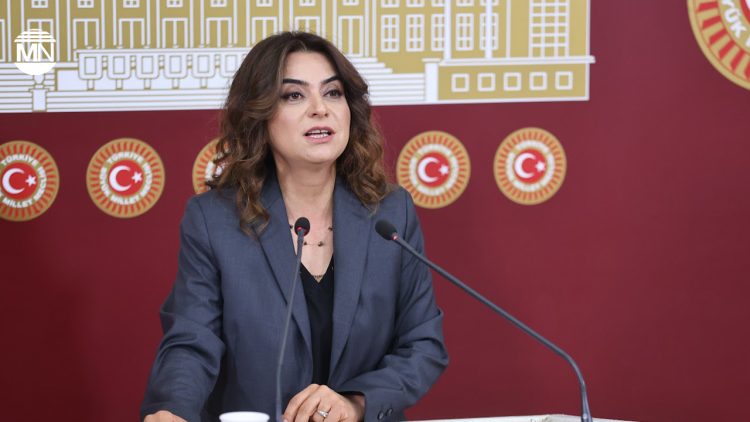
Gülistan Kılıç Koçyiğit, parliamentary group leader for the pro-Kurdish Peoples’ Equality and Democracy (DEM) Party, has called for urgent legal reforms and the establishment of a democratic and transparent parliamentary commission to support ongoing peace efforts and tackle longstanding judicial discrimination.
Speaking in Ankara on Monday, Koçyiğit stressed the need for immediate legal steps to repair what she described as “severe injustices” in Turkey’s penal system, particularly regarding the treatment of political prisoners and those convicted under anti-terror legislation.
“We are in a new era where we speak of peace and democracy,” she said. “But without confronting the darkness behind past massacres and injustices, there is no way to prevent future suffering.”
Koçyiğit’s remarks come amid expectations that Turkey’s 10th judicial reform package will soon be brought before its parliament. Criticising previous reforms, she said none had meaningfully advanced justice or equality. “There has been no approach capable of addressing existing inequalities or meeting the standards of a genuine rule of law,” she said.
The DEM Party, which represents many Kurdish voters and opposes the government’s policy of replacing elected Kurdish mayors with state-appointed trustees, is pushing for structural change. Koçyiğit said the new legal package must tackle deep disparities in sentencing and release practices, especially for those imprisoned on charges related to political activism or association with outlawed groups.
“There is serious discrimination in conditional release and supervised freedom,” she said. “While political prisoners are excluded for writing a letter or chanting a slogan, men convicted of femicide or child abuse benefit from early release provisions.”
Turkey’s anti-terror law often leads to harsher penalties and restricted release opportunities for prisoners convicted of so-called ‘organised crimes’, a category that encompasses many political offences. Koçyiğit highlighted that political prisoners sentenced under the anti-terror law must serve three-quarters of their sentence before becoming eligible for parole, compared to half for those sentenced under other laws.
“This is fundamentally unjust,” she said. “Justice in sentencing and equality in release must become central principles of the legal system.”
Koçyiğit also criticised exceptions in the law that prevent elderly and seriously ill political prisoners from qualifying for supervised release. “Even 65-year-olds convicted under the anti-terror law are denied provisions available to others,” she noted.
Reflecting on recent developments in the peace process, Koçyiğit referred to imprisoned Kurdish leader Abdullah Öcalan’s statement of 27 February, and the Kurdistan Workers’ Party (PKK) congress of 6-7 May, which led to the group’s disbandment. She warned, however, that the ongoing process still lacks a legal framework.
“There is still no legislative basis for this process. Unlike the 2013-15 period, there is no law passed by parliament to protect these steps,” she said.
The DEM Party is advocating for a parliamentary commission to be established by law to support the peace efforts. Although recent public remarks by far-right Nationalist Movement Party (MHP) leader Devlet Bahçeli helped bring the proposal to wider attention, Koçyiğit noted that her party had already raised the idea during talks with other political parties and the Speaker of Parliament.
“The commission must be created specifically for this issue. It must be inclusive, democratic and transparent,” she said. “It should consult civil society organisations, women, writers, academics and journalists, and be guided by international examples.”
Above all, she said, the process must be public. “All discussions must take place in the public eye. The point is not the commission’s size or decision-making methods, but its core purpose: The parliament must lead, the opposition must contribute and society must be part of the solution.”
Koçyiğit expressed hope that the new package could pass before the forthcoming Eid holiday. “We’ve submitted our demands,” she said. “Now we wait to see which of them are reflected in the bill.”


