

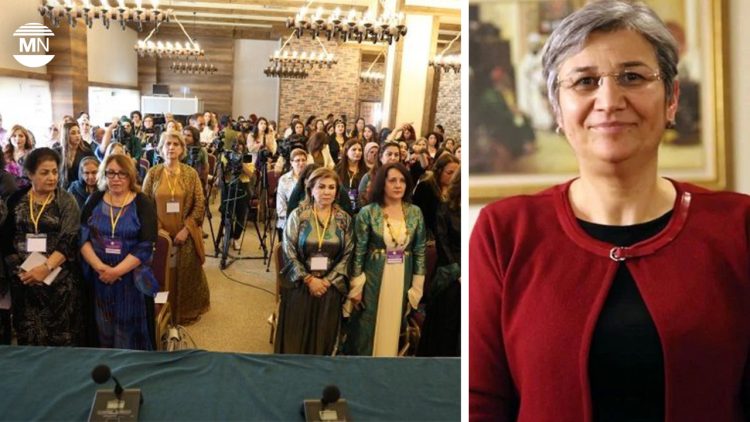
In a bold call for transformative feminist politics, imprisoned Kurdish politician Leyla Güven urged women across the region to spearhead a new era of democratic leadership during the inaugural Kurdish Women Parliamentarians Conference held in Kurdish majority city Diyarbakır (Amed), southeastern Turkey, on Wednesday.
The conference, organised by the Free Women’s Movement (TJA), gathered current and former Kurdish women lawmakers under the theme “Let’s Democratise Politics, Build a Democratic Society”. Güven, co-chair of the Democratic Society Congress (DTK), addressed participants through a letter sent from Sincan Women’s Prison, where she has been detained since 2020.
“The world shaped by patriarchal power is no longer liveable,” Güven said in a statement read by TJA member and former MP Mizgin Irgat. “If a new, just and peaceful society is to emerge, it must be led by women and built on principles of equality and collective governance.”
The event marked a significant moment for Kurdish women in politics, aiming to reflect on decades of struggle and map out future strategies. Güven’s letter traced a historical trajectory of women’s marginalisation from political decision-making while highlighting the persistent resistance of Kurdish women leaders across the region.
“The parliament first changed colour with Leyla Zana,” she wrote, referring to the pioneering Kurdish MP elected in 1991 who became a symbol of both the feminist and Kurdish rights movements. Güven noted that the Kurdish political movement was the first in Turkey to institutionalise gender parity in representation, leading to the appointment of women as parliamentary group leaders and deputy speakers.
While Turkey initially projected a progressive image by electing 18 women to parliament in the early republican era, Güven argued that symbolic representation stagnated until Kurdish women’s entry disrupted the male-dominated status quo. “It was only when the Kurdish political movement declared equal representation a principle that true change began,” she stated.
Güven’s letter was not merely retrospective but forward-looking. She proposed a series of radical political reforms, such as disqualifying individuals with records of violence against women or who deny girls’ right to education from holding public office.
“These are not utopias,” she wrote. “They are necessities for justice, dignity, and social peace.”
A central theme of Güven’s message was the development of Jineology, a Kurdish feminist science that places women at the heart of social knowledge and ethical governance. She argued that the reorganisation of society must be informed by both local cultural values and universal feminist principles.
“We can plan a new life through Jineology,” she said. “Even though we are divided by the borders of four states, our struggle is unified and rooted in the same vision.”
The conference also spotlighted the regional dimensions of Kurdish women’s struggle—from the political participation of female peshmerga in the Kurdistan Region of Iraq, to the execution of women activists like Shirin Alamhouli in Iran, and the ongoing women-led revolution in Syria’s Kurdish-majority Rojava region.
Güven expressed confidence that Rojava’s model—based on direct democracy, ecology, and gender equality—would become an international reference point. “What is happening in Rojava is not only a revolution for Kurdish women,” she said. “It is a prototype for humanity’s future.”
The conference occurred against the backdrop of Turkey’s broader political climate, where the government continues to imprison Kurdish politicians and suppress Kurdish political expression. Güven, a former MP for the pro-Kurdish Peoples’ Democratic Party (HDP), has been detained on terrorism-related charges widely criticised by international human rights groups as politically motivated.
In her letter, she criticised the patriarchal and nationalist structures of Turkey’s ruling order, describing the country’s parliament as historically shaped by “grey-suited men with ties and bellies”. Despite limited reforms, she said, Turkey remains far from achieving true gender parity.
Still, she remained optimistic: “If the atmosphere in parliament has changed even this much, imagine what would happen with genuine equal representation.”
Güven concluded with a call for collective feminist solidarity:
“We Kurdish women must live up to our slogan—Jin, jiyan, azadî (Woman, life, freedom). We must take radical decisions that reshape the future and ease society’s pain.”
Her message electrified participants, many of whom have faced arrest, exile or political bans. The conference ended with renewed pledges to campaign for legislative reforms, amplify the presence of women in decision-making, and expand Jineology education.
In a country where gender equality remains contested terrain, and Kurdish identity is often suppressed, the voices from Diyarbakır’s congress hall rang loud with a singular purpose: to reclaim space, history, and future—on women’s terms.


