

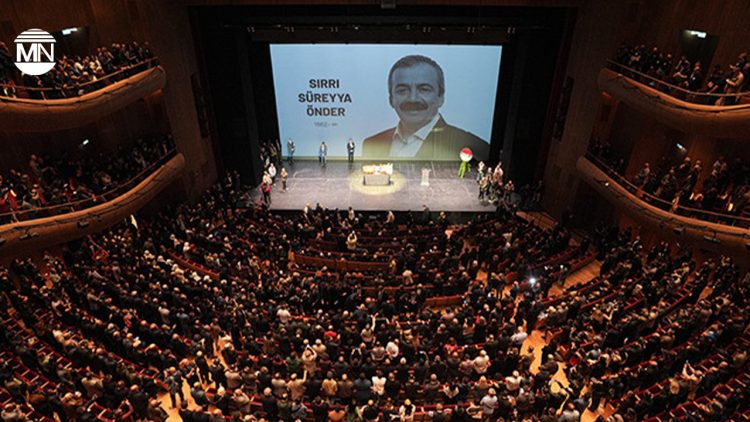
Sırrı Süreyya Önder, deputy speaker of the Turkish parliament and a senior member of the Peoples’ Equality and Democracy (DEM) Party, was laid to rest on 4 May at Zincirlikuyu Cemetery in İstanbul. Önder died on 3 May from multiple organ failure, following complications from heart surgery and an 18-day struggle in intensive care.
The funeral procession, stretching seven kilometres from Taksim’s Atatürk Cultural Centre (AKM) to the Barbaros Hayrettin Paşa Mosque in Levent, drew tens of thousands of mourners. Chants of “The peace envoy is immortal” echoed through the streets, as people paid tribute to Önder’s legacy as a politician, a filmmaker and a leading advocate for peace in Turkey’s decades-long Kurdish conflict.
The ceremony began at the AKM, where Önder’s coffin, adorned with olive branches, received a standing ovation. Political figures, artists, activists and members of civil society gathered, and slogans such as “Long live the brotherhood of peoples” and “Our promise to Sırrı is peace” rang out across the venue. A minute’s silence was observed, accompanied by a reading of Nazım Hikmet’s poem The Song of those who drink the Sun (Güneşi İçenlerin Türküsü). Among those attending were İstanbul Governor Davut Gül, Culture and Tourism Minister Mehmet Nuri Ersoy, and the Peace Mothers, a group of Kurdish women campaigning for a non-violent resolution to the conflict.
Önder’s daughter, Ceren Önder Kandemir, delivered an address: “You wanted to see peace; the suffering of children broke your heart,” she said. She described scenes of unity at the hospital as emblematic of the peaceful society her father envisioned.
DEM Party Co-chair Tülay Hatimoğulları said that Önder’s life reflected the struggles of workers, women and marginalised communities. Co-chair Tuncer Bakırhan declared, “The waters of the Euphrates will flow to the Marmara Sea,” a statement symbolising a unified, peaceful Turkey.
The funeral prayer was led by theologian İhsan Eliaçık, a longtime friend who shared a prison cell with Önder in the 1980s. Eliaçık recalled Önder’s commitment to the cinema and to peace. The procession, accompanied by ululations and slogans, came to an end at the graveside, where flowers were laid.
Önder was a key figure in the İmralı shuttle delegation, which has been facilitating peace talks between the Turkish government and imprisoned Kurdish leader Abdullah Öcalan. He was also a signatory to the 2015 Dolmabahçe Agreement, a briefly hopeful step in an earlier peace process. President Recep Tayyip Erdoğan expressed his condolences, noting Önder’s recent contributions to peace efforts.
Selahattin Demirtaş, imprisoned former co-leader of the Peoples’ Democratic Party (HDP), sent a message: “Death doesn’t suit you, brother,” he wrote.
Born in 1962 in Adıyaman (Semsûr), Önder was orphaned at eight and worked as a photographer’s apprentice. Imprisoned after the 1980 military coup, he later graduated from Ankara University’s Faculty of Political Sciences. His film Beynelmilel, a satire of military rule, won multiple awards and remains a cultural touchstone.
Önder served as a parliamentarian for İstanbul and Ankara, and survived various legal challenges, including a 2018 prison sentence which was overturned by Turkey’s Constitutional Court. A three-day condolence ceremony began on 5 May at İstanbul’s Cemal Reşit Rey Concert Hall, with further gatherings at DEM Party offices nationwide. His legacy as a peace advocate continues to inspire efforts at reconciliation.


