

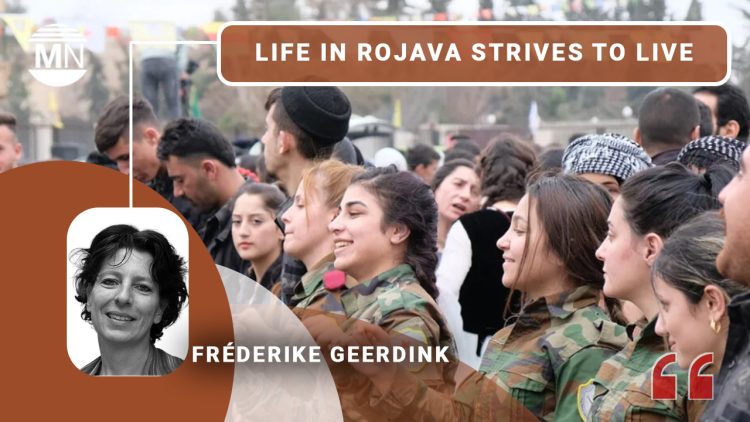
Fréderike Geerdink
Interesting dynamics are unfolding in the debate on the status of the Autonomous Administration of North and East Syria (AANES), now that Assad has fallen and Ahmed al-Sharaa (Abu Mohammad al-Jolani) has established himself as the (interim) president of Syria. I have heard people say that the Syrian Democratic Forces (SDF), which is defending the autonomous region, should lay down its weapons and that the civil administration should abolish itself. These are not Turkey-fed media-outlets or social media accounts, but analysts from outside. The longer I think about it, the more I see it as a disregard for life.
Reportedly, negotiations are ongoing between Al-Sharaa and SDF General Commander Mazloum Abdi. This is also tied to Turkey, which is strongly supportive of Al-Sharaa’s interim-government and which wants nothing more than the SDF to crumble and the autonomy in the northeast of Syria to vanish. There are talks ongoing with jailed Kurdish leader Abdullah Öcalan, whose ideology not only inspires the SDF and the Autonomous Administration but the Kurdistan Workers’ Party (PKK) as well.
Statement
In short, on or slightly later than 15 February, Öcalan will make a statement reportedly calling for the end of the armed struggle (which is not the same as laying down arms). One of my reliable sources told me that after this call is made, the ball will be in Turkey’s court and it will have to swiftly take some step towards the democratic solution of the Kurdish issue. Simultaneously, reportedly Al-Sharaa has given armed groups until 1 March to hand their weapons to the new Syrian army.
Now, I am writing this column in a huge hall in the Free University of Brussels, where the Permanent Peoples’ Tribunal (PPT) on Rojava vs. Turkey is taking place. The prosecution, consisting of the organisers of the Tribunal, are pleading their case before an international panel of expert judges. Witnesses and legal and human rights experts give their testimonies. This was already planned before the fall of the Assad regime, but it has become even more urgent now. After all, before Assad’s fall, Turkey was an occupying force committing war crimes and crimes against humanity, and currently it is the most important backer of the new interim-government.
Testimony
As I have been following Syria and Kurdistan in Syria for many years and have visited northeast Syria many times, I know about the crimes of Turkey and its Syrian National Army (SNA) mercenaries, but over these two days at the PTT, we hear them all compiled together in one huge testimony. Displacements of populations, demographic engineering, massacres, bombings, torture, kidnapping, gender-related crimes against women and girls, the use of banned weapons, attacks on energy and water infrastructure and medical services, destruction of the environment and of cultural and religious heritage, bombing of civilians and civilian infrastructure like schools, printing houses – and more.
These crimes have not stopped since Assad’s fall. The threat has even increased because the anti-Kurdish forces are now at the centre of power in Damascus. A water station was bombed as recent as this week. Let me be clear: Assad was no friend of Kurds either, to say the least, but the power balance was different. The jihadist extremists that have caused so much misery in northeast Syria, encouraged by Turkey, are now in charge.
Male-centered
And these are the criminal forces that the SDF has to hand its weapons to? These are the male-centered, women-hating authorities that the Autonomous Administration, which consists of at least 40% women who have fought for their freedom, has so bow to? Not enough people pointed it out but there were literally no women present at the so-called Victory Conference of Al-Sharaa and his armed friends. The Autonomous Administration has invested in a thriving life for all groups in society and for women for some thirteen years now, and they just have to give it up because the jihadists grabbed power?
This is what I mean when I say that asking this is a disregard for life. I was talking about it with friends the other day – about life, I mean. The key characteristic of life is that it wants to live. That sounds simplistic, but think about it. Human beings don’t easily give up on life, even when it is severely threatened: we run, we hide, we grasp for air, we plea for mercy, we usually pick up the pieces and go on, however big our suffering. Lust for life is very strong. Not just among human being, also among other mammals, and trees, flowers: it all strives to live.
Generations
And I see societies as living entities too. Leaders, warlords and destructive systems like capitalism can weaken and try to destroy them, but societies want to survive. If a society is strongly built, its members will stick together to protect it. They will stay put or return to their land – look at the Gazans at the moment – they will build again, they will pick up the pieces and restore, if only for the next generations.
Telling the Autonomous Administration to dissolve itself and the SDF to hand over its arms, is like a cigarette smoker who says, well, it’s okay, I have to die of something, right? It’s nonsense: if you have to die of something, you might as well walk blindfolded in heavy traffic, and who does that? So why expect the courageous people and their protection forces to cut themselves off from life? It’s not logical and disregards the essence of life. Life strives to live some more, and then some more.
Fréderike Geerdink is an independent journalist. Follow her on Bluesky (or X) or subscribe to her acclaimed weekly newsletter Expert Kurdistan.


