

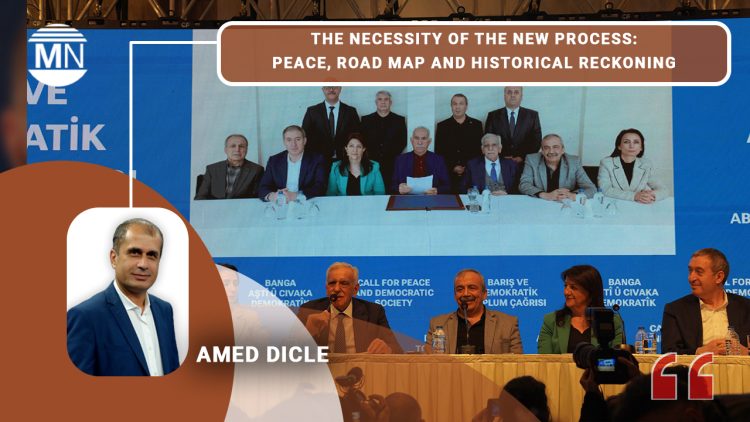
Amed Dicle
Peace is only possible when the truth is confronted. Today, Turkey is facing the harshest form of truth imposed on it in the Kurdish issue.
The Turkish state has hit the wall of a political regime that continues to exist by postponing its founding crisis. The Kurdish issue can no longer be confined to a ‘security’ problem or an ‘identity’ demand; it is a structural fault line that directly collides with the Republic of Turkey’s nation-state codes, its centralised understanding of sovereignty and its singular citizenship regime. This historical tension, which has been postponed for a hundred years, has now deepened to the extent that it cannot be managed without transforming the system itself. Since the political regime constructs not only the Kurds but the whole society through denial, oppression and lack of representation, the search for a solution has become a necessary threshold for not only the Kurdish people but also for Turkey to reconnect with democracy.
The 12th Extraordinary Congress of the PKK, held on 5-7 May 2025, should be read as a response to this historical threshold. The decision is not only the transformation of an organisation; it is a political invitation that necessitates Turkey’s transition to democracy.
With the congress, the organisational formation based on armed struggle was terminated; however, this is not the end of the struggle, but the direct intervention of the democratic society paradigm developed under Öcalan’s leadership into the political line. The ideological line that Öcalan has been building for years has implemented the will to continue the social struggle through democratic means, this time with a strategic decision. The 27 February 2025 call from İmralı for ‘Peace and Democratic Society’ is no longer just a call, but a road map, a political framework. The 12th Congress is the realisation of this framework.
As much as the historical value of this decision, its claim for the future is also remarkable. Because this is not only an organisational orientation, but also a redefinition of the forms of social struggle.
For this very reason, what will determine the direction of the process is not the announcement of the decisions taken, but how and under what conditions these decisions will be implemented.
The Final Declaration of the Congress underlines three basic conditions for the implementation of the decisions: Recognition of Abdullah Öcalan’s role in directing the process, constitutional guarantee for democratic politics and the establishment of a comprehensive legal basis. Without the fulfilment of these conditions, the peace process remains an abstract expectation.
For the Turkish state today, these demands are not a favour or a bargaining chip, but a political necessity. The sustainability of the state under the current crisis conditions will be determined by how it approaches this process. Because the driving force of the transformation is no longer only the will of the Kurdish movement, but the contradictions of the system, which have become too heavy for its internal dynamics to bear.
Although President Erdoğan’s language on the process is less tense than in previous periods, it does not carry a binding content. This may not be relatively negative, but it is a directionless and borderless attitude. Expressions such as ‘it can be taken into consideration’ carry the risk of obscuring the process rather than taking a political position. This approach only manages expectations while making the will for a solution vague.
On the other hand, Devlet Bahçeli’s discourse since 1 October 2024 has revealed a surprising political position in many respects. For the first time, Bahçeli thanked Öcalan directly and maintained his stance towards the new era. For the MHP, this attitude points to a change that should be taken into consideration in terms of both domestic politics and state wisdom. Therefore, it is clear that today, if not a rupture or a change of direction in all layers of the state, at least a threshold that is not easy to go back from has been reached.
The most critical element that must come into play at this point is social pressure.
The new process cannot be carried out only in a manner indexed to the attitude of the government. At this stage, the DEM Party and other actors of democratic politics must not only be the interlocutor but also the playmaker. It is necessary to steer the process, not wait for it. The organised political representation of the Kurdish people cannot be content with relying solely on expectations from the government; it is obliged to weave a democratic ground for reconciliation that includes broad sections of society.
This is not possible through limited interventions at the parliamentary level, but through social mobilisation from the local to the central level. The participation of civil society, labour and women’s movements and youth in this process will determine the depth and permanence of the solution. Because peace is not only a demand addressed to the state; it is possible with the new contract that society will establish within itself.
The steps to be taken today will not only remain within Turkey’s borders. The resolution of the Kurdish issue has the potential to create a domino effect towards democratisation in the Middle East. Every crisis that Turkey is unable to solve at home narrows its room for manoeuvre in foreign policy. However, a Turkey that has established its own internal peace can become not only a strong but also an exemplary democratic republic. This could be the beginning of a promising new era not only for the Kurdish people but also for all the peoples of the region.
In conclusion, the new era that began with the decision of the PKK’s 12th Congress is not a dissolution, but the announcement of a founding threshold. The paradigm proposed by Öcalan is no longer a suggestion; it has become a political necessity. It is not only the responsibility of the Kurdish people, but also of all those who believe in peace, democracy and common life in Turkey to make this process a success. Now it is the turn of politics, law and society to speak out. Silence points to the repetition of the past; taking a step points to the door to a democratic future.
This article was first published on numedya24 on 14 May.
Amed Dicle was born and raised in Diyarbakır, Turkey. He has worked for Kurdish-language media outlets in Europe, including Roj TV, Sterk TV and ANF. His work has taken him to Rojava, Syria, Iraq and many countries across Europe. Follow him on X (twitter).


