

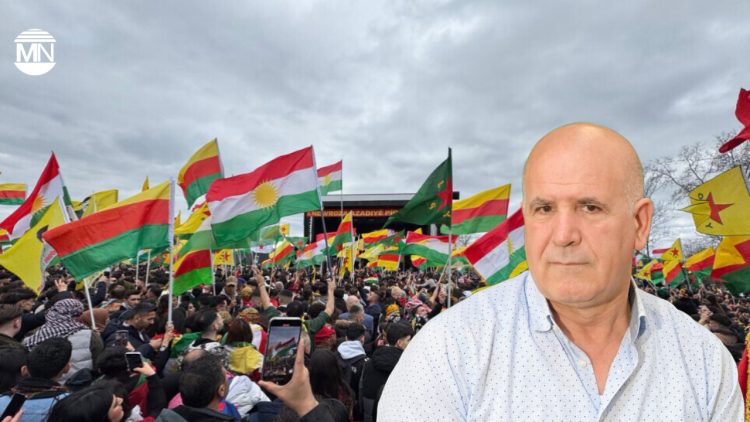
Younes Behram
A historic Kurdish mobilisation unfolded in Cologne and Frankfurt am Main, where an estimated 70,000 individuals from all four parts of Kurdistan gathered. More than a cultural observance of Newroz—the Kurdish New Year—this mass event became a transnational expression of political agency, reminiscent of the 2017 independence referendum held in the Kurdistan Region [of Iraq]. Through collective chants, political symbolism, and emotionally resonant speeches, participants projected a reinvigorated message of Kurdish unity and aspiration.
The festival commenced in Cologne and reached its culmination in Frankfurt, evolving from a public celebration into a powerful scene of shared identity and communal belonging. The event visually and sonically illustrated unity: Kurdish flags in their varied colours waved high, and traditional songs and garments filled the public spaces. Kurds from Bashur (South), Rojhilat (East), Bakur (North) and Rojava (West) Kurdistan converged not just geographically but ideologically, affirming their collective desire for recognition. Slogans like Bijî Kurdistan (Long Live Kurdistan) and Jin, Jiyan, Azadî (Women, Life, Freedom) rang out in unison, linking this contemporary moment to broader Kurdish struggles for rights and representation.
Ilham Ahmed, a leading Kurdish political figure from Rojava often referred to as the “Iron Woman”, delivered a compelling address to the crowd. She characterised the present moment as historically significant, following a sustained fourteen-year period of resistance. “We are on the brink of a decisive juncture,” she stated, “one in which the Kurdish people will assert their right to self-determination”. Her remarks carried both confidence and urgency, concluding with a striking claim: “This century is the century of Kurdistan.” She also hinted at further developments on the horizon: “You will hear joyful and surprising news after the holiday.”
Cengiz Çiçek delivers Öcalan’s message from prison
One of the most powerful moments of the day came from the main stage, where Cengiz Çiçek, Member of Parliament and legal representative of imprisoned Kurdish leader Abdullah Öcalan, addressed the crowd. Çiçek, who was part of the historic seven-member delegation that visited Öcalan on 27 February, delivered a deeply resonant speech, sharing Öcalan’s greetings and message with the public.
“Mr. Öcalan sends his regards and greetings to all of you,” Çiçek began. “He reminded us that this is a 52-year-long marathon for Kurdish freedom, a struggle in which he has never once compromised the path or words of Şeyh Said and Seyit Rıza.” These historical figures, executed for leading Kurdish uprisings in 1925 and 1938 respectively, continue to symbolise resistance for many Kurds today. Çiçek made clear that Öcalan sees his own lifelong struggle as a continuation of their legacy.
According to the message conveyed by Çiçek, Öcalan traced the roots of this resistance to 1973, when he and fellow students celebrated Newroz in Ankara. This symbolic act laid the foundation for what would later become the Kurdish national liberation movement and led to the founding of the Kurdistan Workers’ Party (PKK). That moment, though modest in scale, marked the beginning of a national democratic resistance that has endured for more than five decades.
“It is time for freedom. The call for peace and democracy completes the revolution,” Öcalan stated from Imralı prison. He urged the Kurdish people to place their trust in themselves rather than in the state, asserting that the Kurdish political project is inextricably tied to the broader democratic future of the region.
Çiçek closed by underscoring the global significance of Kurdish resistance: “The Kurdish people have been on the streets for 50 years. If there is still hope for democracy in Turkey and the Middle East, it is thanks to this long and determined struggle.”
German authorities praise organisational excellence
Despite the event’s enormous scale, it unfolded with notable coordination and respect for public order. German police recorded no security breaches or disturbances, and several officers publicly commended the disciplined behaviour of the attendees. One officer remarked with admiration, “I tip my hat to you!” He also expressed interest in the cultural meaning behind the slogan Jin, Jiyan, Azadî, reflecting the increasing international resonance of Kurdish political discourse.
Political implications: Between expression and action
The event’s overarching message was unequivocal: the Kurdish diaspora continues to affirm its right to self-determination. The spirit of the 2017 Hewlêr [Erbil] referendum persists not as a past aspiration, but as a present and future demand. However, translating this energy into tangible political outcomes remains a complex challenge.
Kurdish political actors are navigating a highly fragmented regional landscape. The enduring authoritarianism of regimes such as that in Damascus, coupled with regional competition over resources—particularly in the Eastern Mediterranean—complicates strategic planning. Amid this context, some intellectuals and organisers advocate for a “third path”. This approach proposes the establishment of a Kurdish political structure that is autonomous, yet grounded in alliances with democratic movements across the region.
Such a vision seeks to transcend reliance on dominant state actors by fostering collaborative relations with communities including the Kurds of Jabal al-Akrad (Mountain of the Kurds), Alawites and Druze populations. It also implies a move toward democratic confederalism—a decentralised, pluralistic model of governance emphasising grassroots participation and cross-communal solidarity.
Perseverance and possibility
The gatherings in Cologne and Frankfurt signified more than cultural celebration—they represented a symbolic referendum conducted through collective presence and performative solidarity. The Kurdish diaspora, spanning multiple continents, reaffirmed that their cause is ongoing and rooted in both historical memory and future-oriented hope.
Their demonstration in Germany was a political statement, one that posed an implicit challenge to Kurdish leadership: can this surge of communal energy be shaped into a coherent and practicable political strategy? Can the unity displayed in public spaces be mirrored in leadership structures and diplomatic vision?
These questions will likely shape the trajectory of Kurdish political developments in the years to come. For now, the diaspora has articulated its message clearly and powerfully. The task of transformation now lies in the hands of those positioned to carry it forward.
*Dr Younes Behram, born in 1967 in Rojava-NE Syria, is a political writer with several publications on Kurdish literature in German and in Kurdish. He is actively engaged in diplomatic work and has a significant presence in international forums. He has studied medicine (radiology), as well as political science, sociology and law.


