

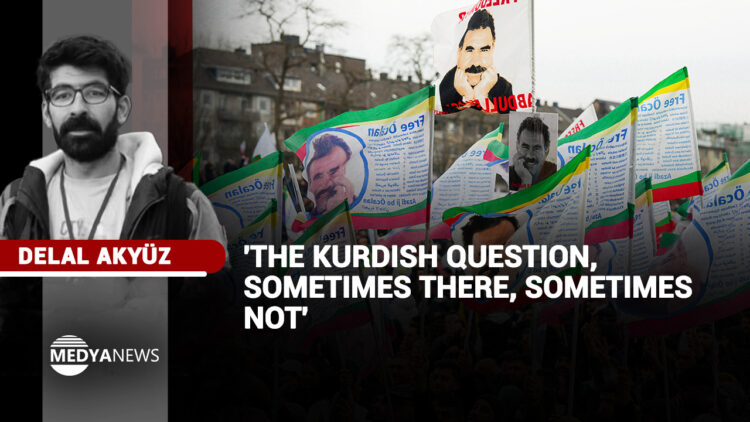
In a comprehensive opinion piece published by the Mesopotamia Agency, Kurdish journalist Delal Akyuz critically examines Turkey’s approach to the Kurdish question, with a particular focus on the 22-year rule of the Justice and Development Party (AKP).
Akyuz argues that despite a century since the founding of the Turkish Republic, the Kurdish question remains unresolved; indeed, its denial has only exacerbated the underlying financial and social crises. Central to his analysis is the contention that President Erdoğan’s AKP has repeatedly turned to imprisoned Kurdish leader Abdullah Öcalan for guidance when faced with policy impasses.
Read the full translation of Akyuz’s analysis, slightly edited for clarity, here:
‘If you say there is no problem, it disappears’
After coming to power, the AKP ended the State of Emergency (OHAL) in Northern Kurdistan (Kurdish-majority regions in southeast Turkey) on 30 November 2002. AKP’s Tayyip Erdoğan visited the construction site of the Turkish Trade Centre in Moscow, the capital of Russia, on 22 December 2002, signalling his perspective on the Kurdish problem. Erdoğan responded to Kurdish workers at the construction site that said ‘The Kurdish problem must be solved’ by saying ‘If you say there is no problem, the problem disappears. We say there is no such problem’.
During his visit to Amed (Diyarbakır) in the third year of his party’s rule, Erdoğan declared that ‘The Kurdish problem is also my problem’. However, despite these words, no steps were taken for a solution. Immediately afterwards, 14 HPG (People’s Defence Forces) fighters were killed by chemical weapons on 24 March 2006 in the countryside of Şenê (Şenyayla) Plateau in Mûş.
Erdoğan, who was the prime minister at the time, made a statement on 28 March of the same year regarding the police violence against social protests: ‘Whether it is women, children or the elderly, the necessary will be done’.
Likewise, following Erdoğan’s remarks, a police attack took place against the funeral ceremony of six HPG fighters in Amed. Protests spread to many cities and 13 people, including children, were killed. Hundreds of people were injured.
Oslo process
Unable to get results from the politics of war, the AKP initiated talks with Kurdistan Workers’ Party (PKK) leader Abdullah Öcalan in 2008 through Turkey’s National Intelligence Organisation (MİT). In 2008, the process started between MİT Undersecretary Emre Taner and Abdullah Öcalan in İmralı and continued with a series of meetings known as the ‘Oslo Talks’ between Kurdistan Communities Union (KCK) executives and state officials in Oslo, the capital of Norway, which was the coordinating country.
Erdoğan came to Amed once again before the 2009 local elections. This time Erdoğan said, ‘Call it the Kurdish problem, call it the Southeastern problem, call it the Eastern problem, or let’s call it the Kurdish opening. Whatever we call it, we have started to work on it’.
During his visit to Tehran on 11 March 2009, President Abdullah Gül also said ‘Good things will happen’ on the Kurdish issue. ‘Whether you call it terrorism, the Southeast or the Kurdish issue, this is Turkey’s most important issue and it must be resolved’, Gül said on his return visit to Prague on 9 May. These statements began to emphasise the idea that the Kurdish issue could be resolved through democratic negotiations.
Abdullah Öcalan, evaluating Gül’s statements in his talks with his lawyers in 2009, said: ‘Mr Gül’s statements are important. Especially when we look at the history of Turkish-Kurdish relations, they can have consequences that can play a historical role. I will fulfil my responsibility in this regard. They don’t need to be afraid. If these two peoples, the Kurdish and the Turkish people, do not fight each other, no one can do anything to us. If we solve this problem as two peoples, Turkey’s path will be paved and Turkey will become the leading country of the Middle East.’
Peace group members arrested
With the call of Abdullah Öcalan, the Peace Group consisting of 34 people including four children from Qendîl (Qandil) and Mexmûr (Makhmour) entered the Habur Border Gate in Silopi district of Şirnex (Şirnak) Province on 19 October 2009. Tens of thousands of people welcomed the members of the Peace Group. The government backed down in the face of the rhetoric of racist and nationalist groups. Therefore the arrival of the second group from Europe was cancelled. Shortly afterwards, 30 people from the first group were indicted and 17 of them were arrested.
KCK operations
The Constitutional Court (AYM) ordered the closure of the Democratic Society Party (DTP) on 11 December 2009. Kurdish politicians Ahmet Türk and Aysel Tuğluk were stripped of their parliamentary seats. On 25 December, operations against Kurdish politicians under the name of ‘KCK operations’ were launched. Thousands of people, including politicians, journalists, lawyers, intellectuals and writers, were detained and arrested.
Hunger strikes
The government, which has once again embraced security policies, deepened the isolation of PKK Leader Abdullah Öcalan in İmralı F Type High Security Closed Prison. Abdullah Öcalan was not allowed to meet with his lawyers after 27 July 2011. PKK and PAJK prisoners started a hunger strike on 12 September 2012 against the deepening of the isolation in İmralı and the lack of news. As a result of this strike, which lasted 68 days with the participation of thousands of people, the İmralı gate was opened.
Abdullah Öcalan, who met with his brother Mehmet Öcalan, stated that the hunger strike had reached its goal and called for an end to it. During this process, Erdoğan announced in a television programme that they were in talks with Abdullah Öcalan. Subsequently, Ahmet Türk, then co-chair of the Democratic Society Congress (DTK), and Ayla Akat, MP for Êlih of the Peace and Democracy Party (BDP), went to İmralı Island on 3 January 2013 and met with Abdullah Öcalan.
Dolmabahçe agreement
Abdullah Öcalan stated that ‘I have been working for peace for 20 years’. The talks continued until 5 April 2015. This was also the beginning of the so-called ‘Resolution Process’. With the creation of the atmosphere for a democratic solution, a declaration titled ‘farewell to weapons’ was read out at the 21 March 2013 Amed Newroz celebrations. Abdullah Öcalan made a call: ‘Let the guns be silent and let ideas and politics speak’.
Within the scope of the dialogue process that lasted for about 2 years, the Dolmabahçe Consensus was announced on 28 February 2015. Following the announcement of the memorandum, which included articles on a democratic and constitutional solution to the Kurdish question, concrete steps were expected to be taken towards a solution. However, Erdoğan denied the agreement.
Attacks
With Erdoğan’s statement, the talks that started on 3 January 2013 were terminated on 5 April 2015. With the breakdown of the talks, the AKP returned to its old codes. In this process, bombs started to explode in many cities. In the run-up to the 7 June 2015 elections, bomb attacks were carried out against the Mersin and Adana offices of the Peoples’ Democratic Party (HDP). Again on 5 June 2015, the party’s rally in Amed was attacked with a bomb.
After the 7 June elections, the AKP failed to achieve the desired result and decided to hold new elections. On 1 November, the elections were renewed. Prior to this, a massacre took place in Pirsûs (Suruç) district of Riha on 20 July 2015, killing 33 young people. On 24 July 2015, the AKP bombed the Kurdistan Region of Iraq (KRI) with warplanes, citing the death of two policemen in Serêkaniyê (Ceylanpınar) district on 22 July. While those arrested within the scope of the incident to end the process were acquitted, the incident was not clarified.
Plan to collapse the process
It was revealed that the AKP decided on a 10-point ‘Collapse Plan’ against the Kurds at the National Security Council (MGK) meeting on 30 October 2014. Within the scope of this plan, many HDP MPs were arrested after their immunity was lifted. Trustees were appointed to municipalities run by the Democratic Regions Party (DBP) and co-mayors were arrested. Curfews were declared in many cities of Northern Kurdistan. Hundreds of people were massacred and tens of thousands were forced to migrate.
Abdullah Öcalan’s message
After the end of the process, the state of emergency was once again imposed in the cities of Kurdistan. With the 2017 referendum on the ‘Presidential Government System’, the environment of repression became more pronounced. İmralı isolation was deepened even more. Abdullah Öcalan was prevented from seeing his family and lawyers and no news was received from him. On 8 November 2018, a hunger strike was launched under the leadership of DTK Co-Chair Leyla Güven. The action spread to all prisons. Upon public pressure, lawyer visits were organised five times on İmralı Island in 2019 after an 8-year break. Maintaining his stance on peace and solution, Abdullah Öcalan underlined the need for a deep social reconciliation and democratic negotiation for the solution of the problems and sent the following message to the public in his lawyer interview on 2 May 2019: ‘Our stance in İmralı is determined to continue the way of expression that we stated in the 2013 Newroz Declaration by deepening and clarifying it. For us, an honourable peace and democratic political solution is essential.’
In his last meeting with his lawyers on 7 August 2019, Abdullah Öcalan stated that he was ready for a solution and said: ‘I am trying to make room for the Kurds, let’s solve the Kurdish problem. I say I can eliminate the possibility of conflict in a week. I can solve it, I trust myself, I am ready for a solution. However, the state and the state mind should do what is necessary.’
Intermittent phone call
After this date, absolute isolation was imposed in İmralı. Abdullah Öcalan held an intermittent phone call with his brother Mehmet Öcalan on 25 March 2021 due to the growing public concerns. Abdullah Öcalan reacted to the way this meeting was conducted and the fact that he was not allowed to meet with his lawyers, and warned ‘How will this problem be in the future? This problem can only be solved by law. If there is to be a meeting, it must be with lawyers. Because this situation is both political and legal.’
A worldwide campaign was launched on 10 October 2023 for the lifting of the absolute isolation in İmralı, the physical freedom of Abdullah Öcalan and the democratic solution of the Kurdish question. In this context, various actions and events were organised with the participation of millions of people in many centres of the world, especially in the cities of Northern Kurdistan. World-renowned names and Nobel laureates also participated in this campaign.
As the campaign continued, on 2 October, MHP Chairman Devlet Bahçeli made a remarkable statement. Bahçeli went to the desks of the Peoples’ Equality and Democracy Party (DEM Party) and shook hands with Co-Chair Tuncer Bakırhan and MPs.
In his speech at the group meeting on 22 October, Bahçeli acknowledged the isolation of Abdullah Öcalan and stipulated the ‘liquidation of the organisation’ as a condition for the ‘right to hope’, for which the Committee of Ministers of the Council of Europe said ‘take the necessary measures’.
Meeting after 43 months
Abdullah Öcalan met with his nephew Ömer Öcalan on 23 October on İmralı Island after 43 months of isolation. Ömer Öcalan posted on his social media account about the meeting and said that Abdullah Öcalan said, ‘Isolation continues. I have the theoretical and practical power to move this process from the grounds of conflict and violence to the legal and political grounds if the conditions arise.’
Bahçeli’s remarks were also supported by Erdoğan. In his group meeting on 30 October, AKP President Erdoğan defended Bahçeli’s statements and said, ‘Our main interlocutor is our Kurdish brothers themselves.’
Attacks and trustee
However, at a time when these discussions were taking place, the Kurdistan Region of Iraq and the cities of North and East Syria were targeted again. Immediately afterwards, Ahmet Özer, the mayor of Esenyurt, who was elected in the 31 March local elections with the ‘Urban Consensus’, was arrested. A trustee was appointed in his place yesterday.


